How to start preparing for IELTS on your own on a small budget
There are so many IELTS websites, videos and books that it is hard to know where to begin. The good news: self-study does not require all of them. You need an honest picture of your level, a simple plan and regular full practice tests.
Step 1. Work out what score you need
Check the requirements of the specific university or programme: they usually give an overall band and a minimum for each section, for example “6.5 with no less than 6.0 in each”. That is your target. Also check the test type: study usually requires Academic, while work and migration often accept General Training.
The exam itself costs a fair amount, so the goal is to pass the first time. Preparing well is cheaper than paying for a retake.
Step 2. Take one full practice test
Do not start with a textbook. First take a full test in exam conditions: Listening, Reading and Writing back to back, with a timer and no dictionary. It will show you:
- your approximate band in each section and how far it is from your target;
- which section is weakest, which is where most of your time should go;
- whether you have enough time and where exactly you lose it.
If your result is around 4.0 or below, it is too early to build your preparation around practice tests. First strengthen your general English, including grammar, core vocabulary and listening comprehension, and come back to tests in a couple of months.
Step 3. Pick one resource per skill
The biggest mistake is jumping between a dozen websites. Choose one resource per skill and stick with it for at least a month. There are enough free options:
- Format and sample tasks: the official IELTS website, which explains how each section works.
- Listening: English podcasts and talks, for example BBC Learning English. Listen every day, first with subtitles, then without.
- Reading: popular science articles in English, because IELTS Academic passages are written in that style. One article a day, noting down new words.
- Writing and Speaking: write and speak yourself, with a timer. Feedback is what matters most here; more on that below.
- Full tests: one platform with tests in the exam format and automatic scoring.
Step 4. Build a simple week
An hour a day beats five hours on Sunday. Here is a sample week for someone who studies or works:
| Day | What to do | Time |
|---|---|---|
| Mon | Listening: one part of a test + a podcast | 45–60 min |
| Tue | Reading: one timed test passage + an article | 45–60 min |
| Wed | Writing Task 2: an essay in 40 minutes | 60 min |
| Thu | Speaking: timed answers out loud, recorded on your phone | 30–45 min |
| Fri | Writing Task 1 + review of the week’s mistakes | 60 min |
| Sat | Full practice test in exam conditions | ~2.5 hours |
| Sun | Rest or review new words | — |
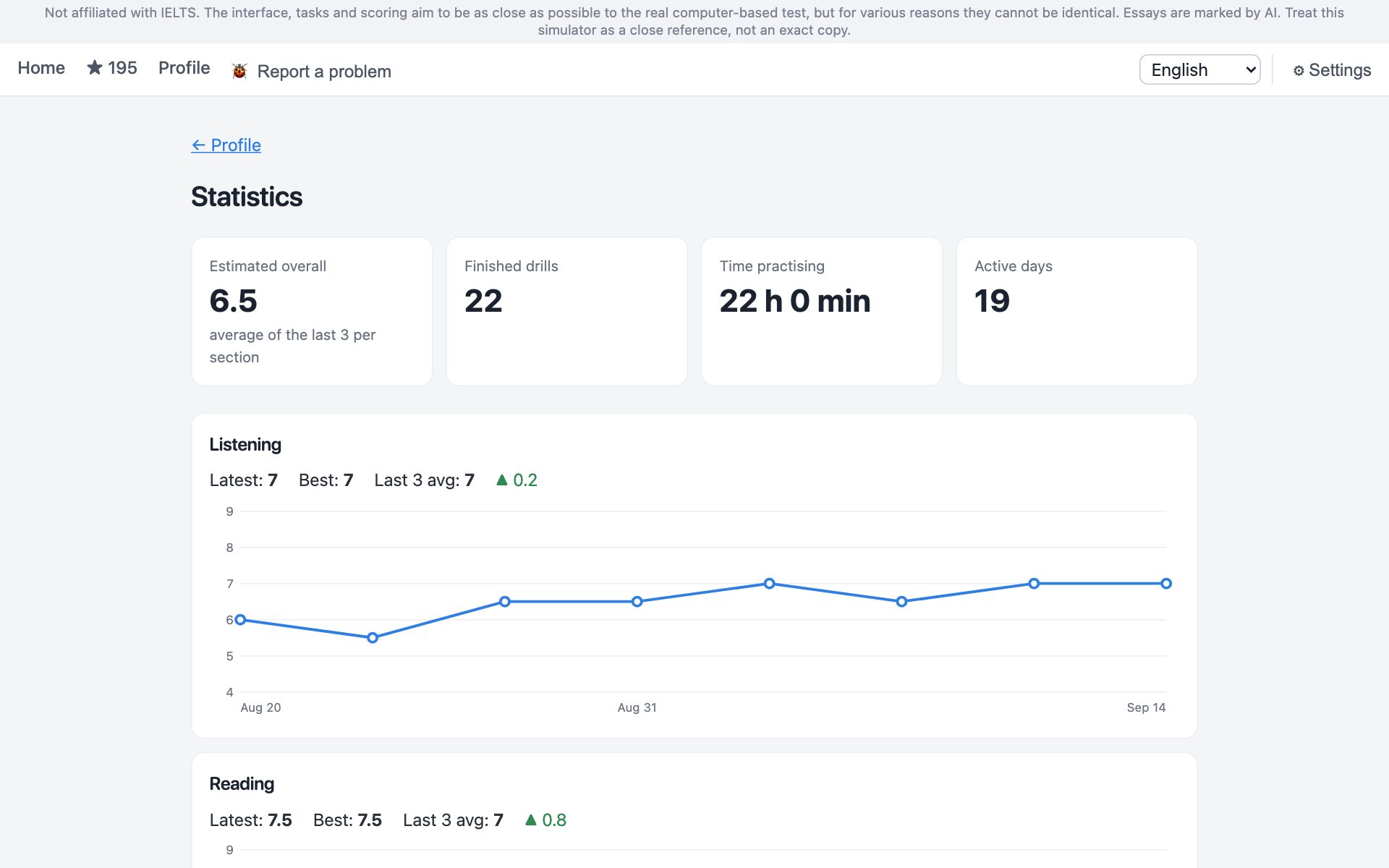
A full test every week or two is your main benchmark. Write down your band for each section after every test: after a month you will see what is improving and what is not.
What not to cut corners on
You can prepare for Listening and Reading entirely on your own: the answers are clear-cut and the key tells you where you went wrong. Writing and Speaking are harder, because it is almost impossible to mark your own essay. Your options:
- a friend with a high score, or a teacher, who can look at at least a few essays;
- a conversation club or a speaking partner;
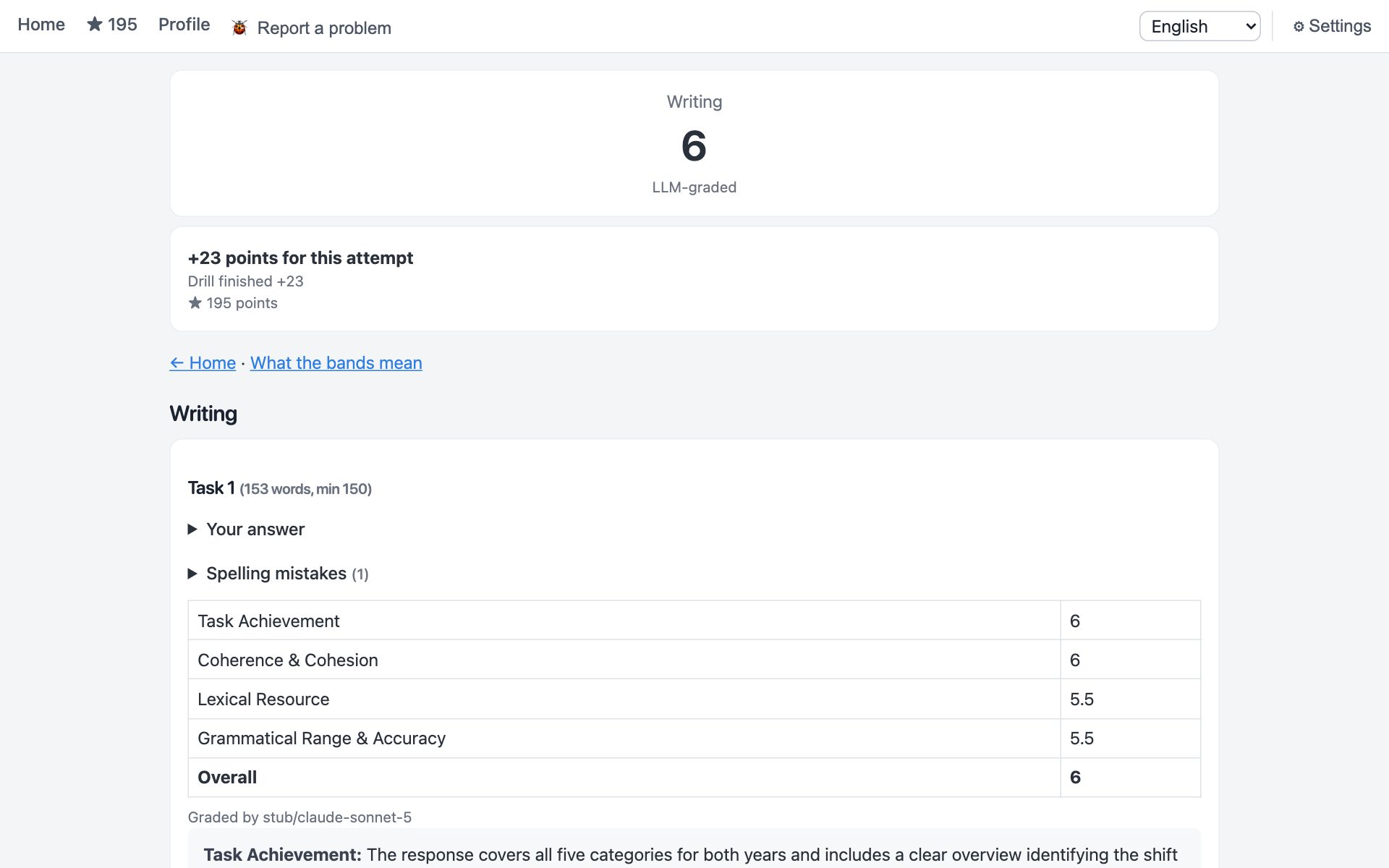
- automated feedback against the IELTS criteria, which is the cheapest option but a guide rather than an examiner’s mark.
How not to drown in materials
- Do not hunt for “the best website”. A decent resource you actually use beats a perfect one you never get round to.
- Do not collect PDF books. One test you complete is worth more than twenty you download.
- Do not change your plan more than once a month. Decide what to change based on full test results, not on how you feel.
Where to take full tests
That is exactly why we built Tilmashq. It is free for now, needs no sign-up and works in the browser on a computer or phone. You will not have to choose where to start: tests unlock in order, each one after the previous. The screen, timings and task types follow computer-delivered IELTS Academic, your band for each section is calculated automatically, and your essays and Speaking answers get feedback against the criteria.
The feedback comes from AI, which is on average stricter than an examiner and does not assess pronunciation yet, so treat it as a guide, not a replacement for a teacher. But it is enough to start preparing today, at no cost.
Read next
- IELTS Listening: format, parts, timing and every question type
- IELTS Reading: format, the three passages, timing and every task type
- IELTS Writing: format, criteria, timing and how to prepare
- IELTS Speaking: format, the three parts, criteria and how to prepare
Updated: 2026-09-14