IELTS Reading: format, the three passages, timing and every task type
Reading is the section where "I know English" and "I score well" diverge the most. There is a lot of text, little time, and the questions are built so that you cannot find the answer by spotting a familiar word. Here is how to divide the 60 minutes, how the three passages differ, what mechanism every question is built on, and how to answer each of the fourteen task types.
The format in brief
| What | How |
|---|---|
| Duration | 60 minutes, with no extra time to transfer answers |
| Passages | 3 passages, about 2,200–2,750 words in total, getting harder from the first to the third |
| Questions | 40, usually 13 + 13 + 14, one mark each |
| Where the passages come from | Academic: adapted articles from journals, books and newspapers written for a general audience; no specialist knowledge needed |
| Scoring | the number of correct answers converts to a band from 0 to 9; no penalty for wrong answers |
| Academic and General Training | different passages: General Training uses short everyday and workplace texts and a more lenient band table |
Everything below is about Academic. Reading comes straight after Listening with no break, so you start the section with your attention already spent. That is part of the exam too, and full practice tests are the way to get used to it.
What Reading looks like on the computer
The screen is split in two: the passage on the left, the questions on the right. The halves scroll independently and the divider can be dragged. The timer is at the top; along the bottom runs a row of all forty question numbers: answered ones are underlined, and you can jump to any number, including one in another passage. A question can be flagged with Review to come back to at the end.
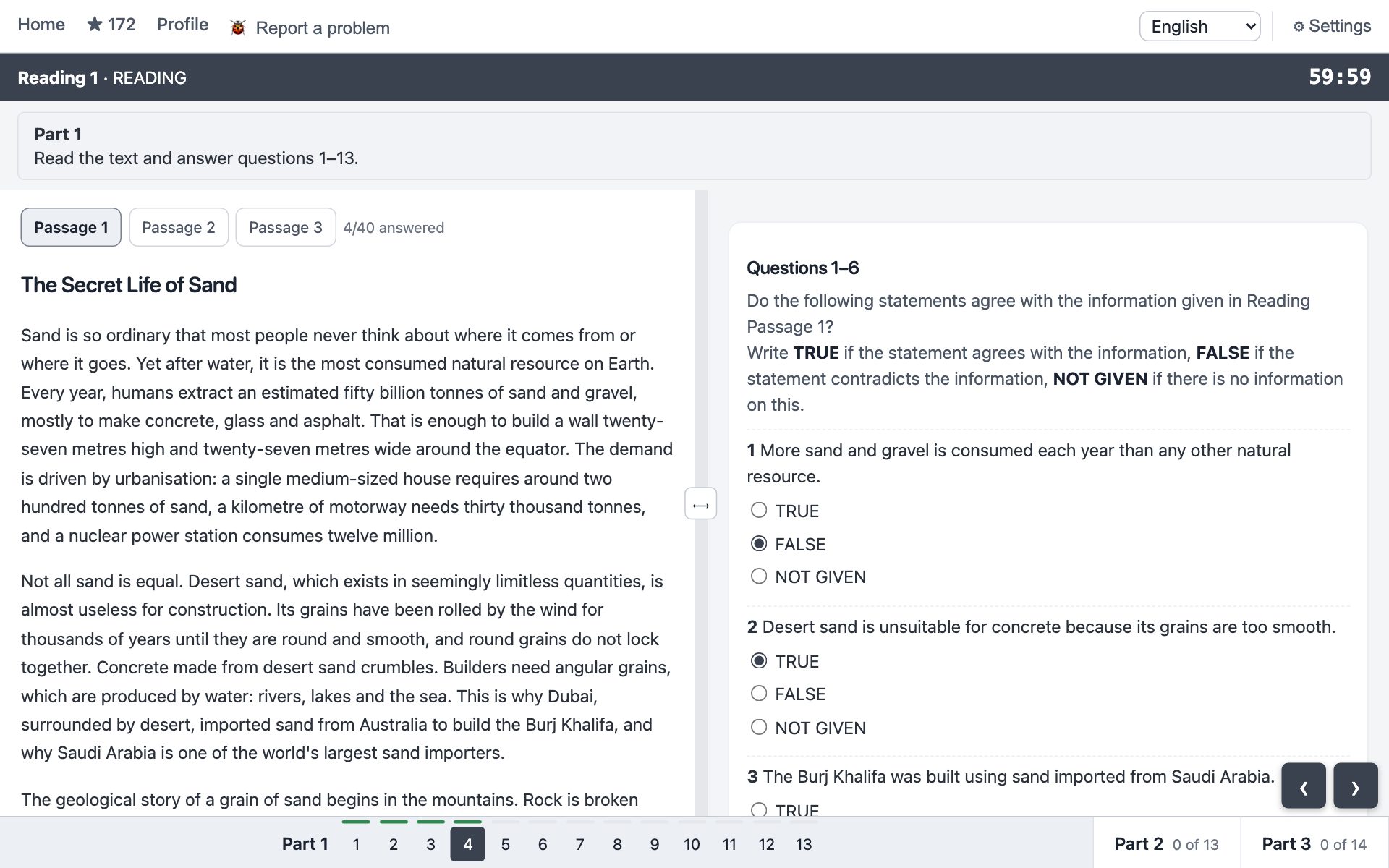
What this changes compared with paper. First, there is no separate ten minutes for transferring answers: you type or drag the answer straight away, and whatever is in the field when the time runs out is your answer. Second, you cannot underline a whole paragraph in pencil, but you can highlight text and leave notes with the right mouse button. Third, there is no spell-checker: a misspelt word gets no mark.
Timing: 60 minutes for three passages
The most common mistake is splitting the time equally. The first passage is the easiest and is worth the same marks as the third, so it should be done quickly and without losses, not used as a warm-up.
| Passage | Time | Why |
|---|---|---|
| Passage 1 | 15–17 minutes | facts and descriptions, answers are easy to locate |
| Passage 2 | 20 minutes | paragraphs A–H appear, with tasks about the structure of the text |
| Passage 3 | 23–25 minutes | the densest passage, with questions about the writer's views and reasoning |
Two rules that save your band. First: each passage has a hard deadline, and when it arrives you move on, even with empty fields left. You can come back to them at the end, but never reaching the last 14 questions is a sure way to lose a band. Second: no question gets more than a minute and a half; if the answer will not come, put the most likely one, flag it with Review, and move on.
The three passages: what is in each and how to handle it
Passage 1: description and facts
The history of an invention, a natural phenomenon, an account of a city or an industry. The text is linear and does not argue with the reader. Typical tasks: True/False/Not Given, table, note or summary completion, short answers. Almost all of them follow the order of the text, so the answer to question 5 comes after the answer to question 4. This is where you cannot afford to lose marks: every question in Passage 1 is worth as much as the hardest one in Passage 3.
Passage 2: a text with paragraphs A–H
Usually an account of a piece of research or a problem, where each paragraph carries one idea. This is where Matching Headings and Matching Information usually appear: tasks about structure rather than detail. A useful habit: as you read, sum up each paragraph in one phrase in your head. Those notes are your draft answers for the headings.
Passage 3: argument and the writer's opinion
The longest and hardest passage: the writer is proving something, arguing with other views, making qualifications. The tasks are about the writer's position (Yes/No/Not Given), multiple choice, sentence endings, summary with a word list. Here it matters to separate what the writer claims from what they merely report as someone else's view, and to watch for words like however, although, some argue, it is often claimed: the correct answer usually hides behind them.
The core mechanism: paraphrase
An IELTS question almost never repeats the words of the passage. The passage says "the population fell sharply"; the question says "a dramatic decline in the number of inhabitants". While you are searching the passage for a word from the question, you are searching for something that is not there. It works the other way round: from the question you pick out the key that cannot be paraphrased, a name, a date, a number, a term, a place, use it to locate the spot in the passage, and only then compare the meaning.
Three kinds of paraphrase worth knowing by sight:
- Synonyms: purchase / buy, sufficient / enough, decline / fall, drop, decrease.
- Change of word class: the discovery of X / X was discovered; growing rapidly / rapid growth.
- Restructured sentences: A caused B / B was the result of A; unlike A, B… / A and B differ in…
The second principle, which saves the most time: which tasks follow the order of the text and which do not.
| In text order | In any order |
|---|---|
| True/False/Not Given, Yes/No/Not Given, all Completion tasks, Short-answer, single-answer Multiple Choice, Matching Sentence Endings | Matching Headings, Matching Information, Matching Features, Multiple Choice with several answers |
For the tasks in the left column the answer to the next question is always further down than the previous one, so do not go back to the start of the passage. For the right column it helps to do the "ordered" tasks of the same passage first: by then you already know where things are.
How to read: not "the whole passage first"
Reading 900 words carefully and only then answering is a luxury there is no time for. A working routine for one passage:
- 2–3 minutes of overview. The title, the first sentence of each paragraph, the last sentence of the passage. The aim is the topic and one phrase per paragraph, no more.
- Read the questions as a group, not one at a time: in a set of six statements the keywords tell you which part of the passage you will need.
- Locate the spot in the passage by the key and read the two or three sentences around it carefully. This, not the overview, is where slow reading belongs.
- Answer and move on. For ordered tasks the next answer is further down the text.
Unknown words are normal, not a warning sign. Academic passages deliberately contain terms no candidate knows; the answer usually does not depend on them. If the word is the one in the gap, copying it from the passage without understanding it is enough.
Task types
Below are all the formats found in Academic Reading, how they are answered on the computer, and tactics for each. The screenshots are from our Tilmashq practice tool; the passages and tasks in them were written by us and are not taken from official materials.
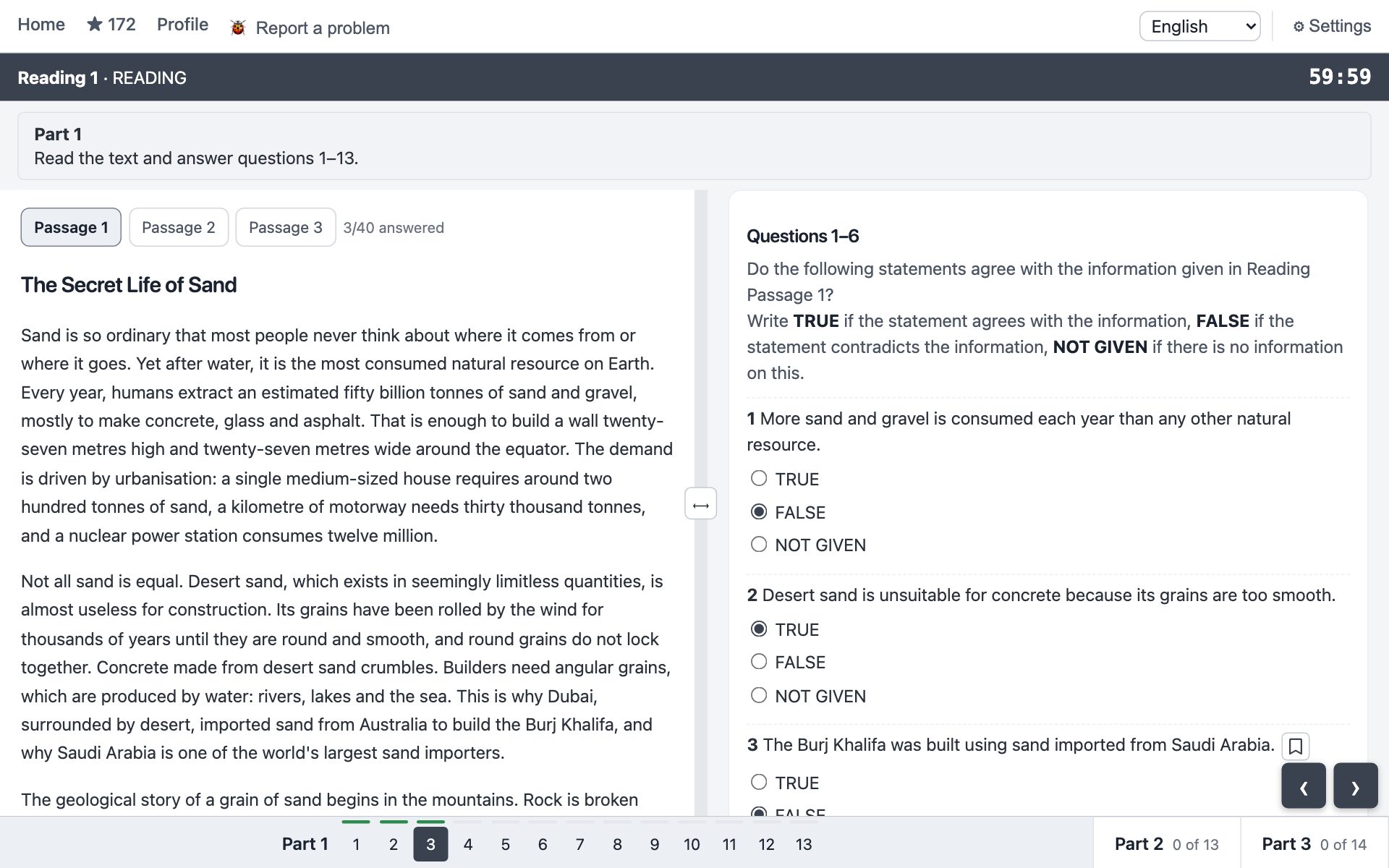
True / False / Not Given: facts
A list of statements and the passage. TRUE means the passage says the same thing, FALSE means the passage says the opposite, NOT GIVEN means the passage says nothing about it. You pick one of three options; the statements follow the order of the text.
- The main difficulty is the line between FALSE and NOT GIVEN. The test: find the part of the passage about the same thing and ask yourself, "Does the passage state the opposite?" If yes, FALSE. If the passage talks about something else or is silent, NOT GIVEN. FALSE needs a contradiction, not a lack of confirmation.
- Traps in the qualifiers. The statement says "all", "only", "the first", "most", "always", while the passage says "many", "one of", "often". Compare the degree and scope, not just the topic.
- Do not answer from your own knowledge. A statement can be true in real life and NOT GIVEN in the passage.
- If you cannot find the part about the statement within a minute, it is almost always NOT GIVEN.
Yes / No / Not Given: the writer's views
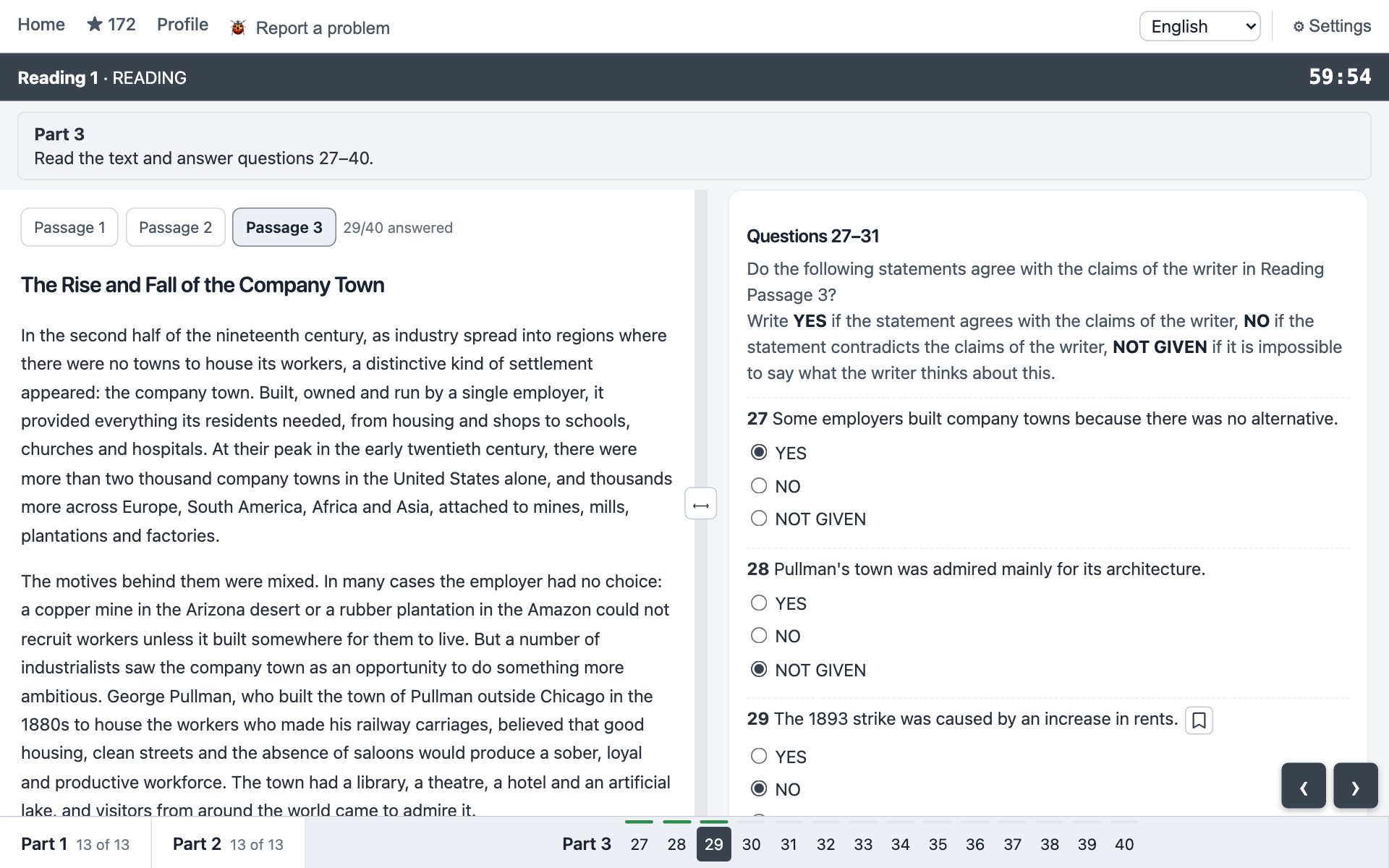
The same format, but about the writer's views and claims rather than facts. Usually in Passage 3. YES means the writer thinks so, NO means the writer thinks otherwise, NOT GIVEN means the writer does not give an opinion on it.
- Separate the writer's position from other people's views they report: "Some researchers believe X" does not mean the writer agrees with X.
- Look for evaluative words: clearly, undoubtedly, it is a mistake to, there is little evidence that. These are what carry the position.
Matching Headings: headings for paragraphs
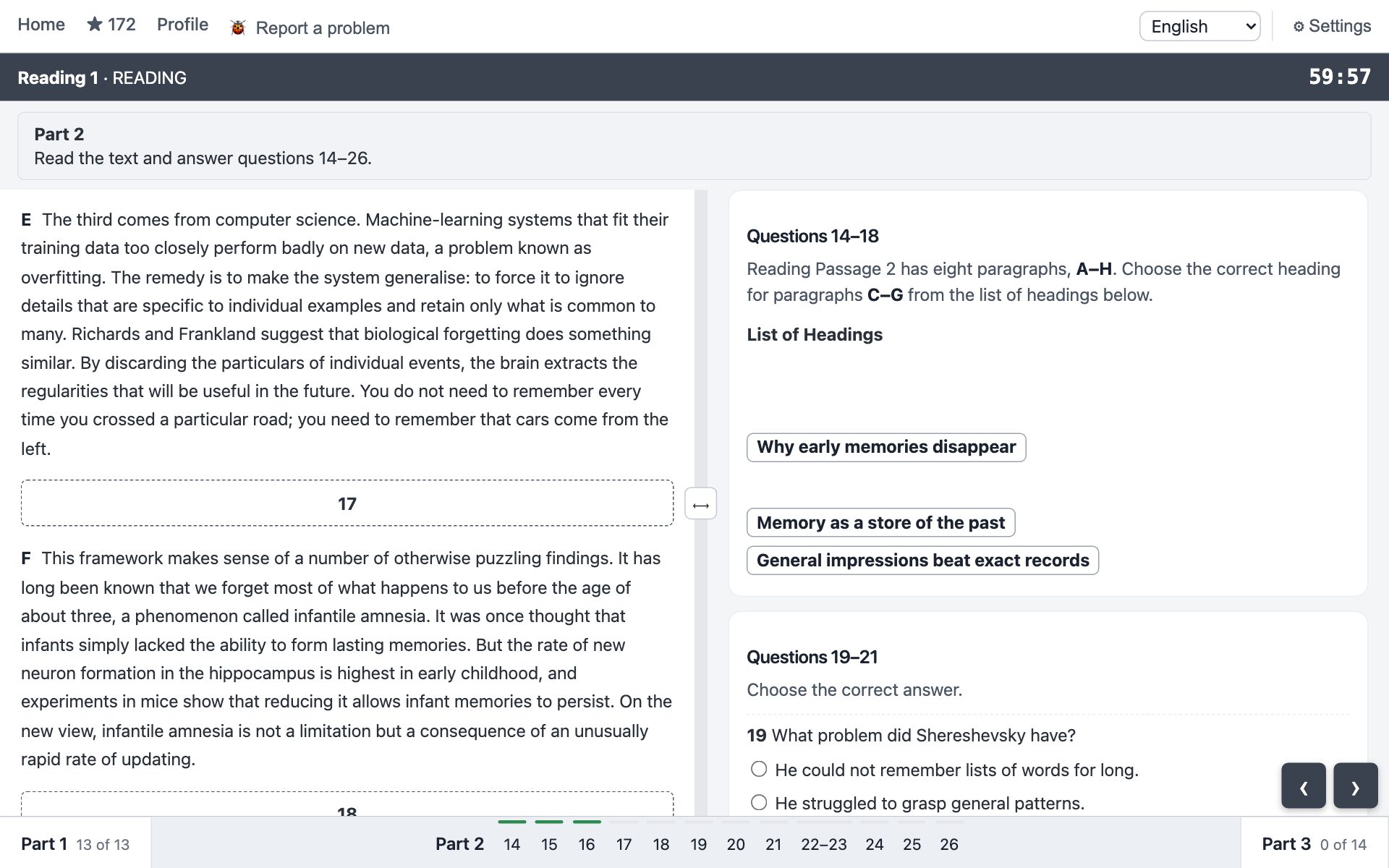
A list of headings and a passage with paragraphs A–H. Each paragraph needs the heading that captures its main idea. On the computer you drag the heading into an empty slot directly above the paragraph in the passage; a used heading disappears from the list. There are more headings than paragraphs, and one or two paragraphs are sometimes already labelled as an example.
- The heading is about the main idea, not a detail. The spare headings are deliberately built from vivid details of the paragraphs. If a heading matches one sentence but not the paragraph as a whole, it is a distractor.
- The main idea is usually in the first or last sentence, but in Passages 2–3 it can sit in the middle, after however.
- Start with the easiest paragraphs and cross off what you have used. Leave the most debatable ones for last: by then there are fewer options.
- Headings are paraphrase too: they will not contain the words of the paragraph.
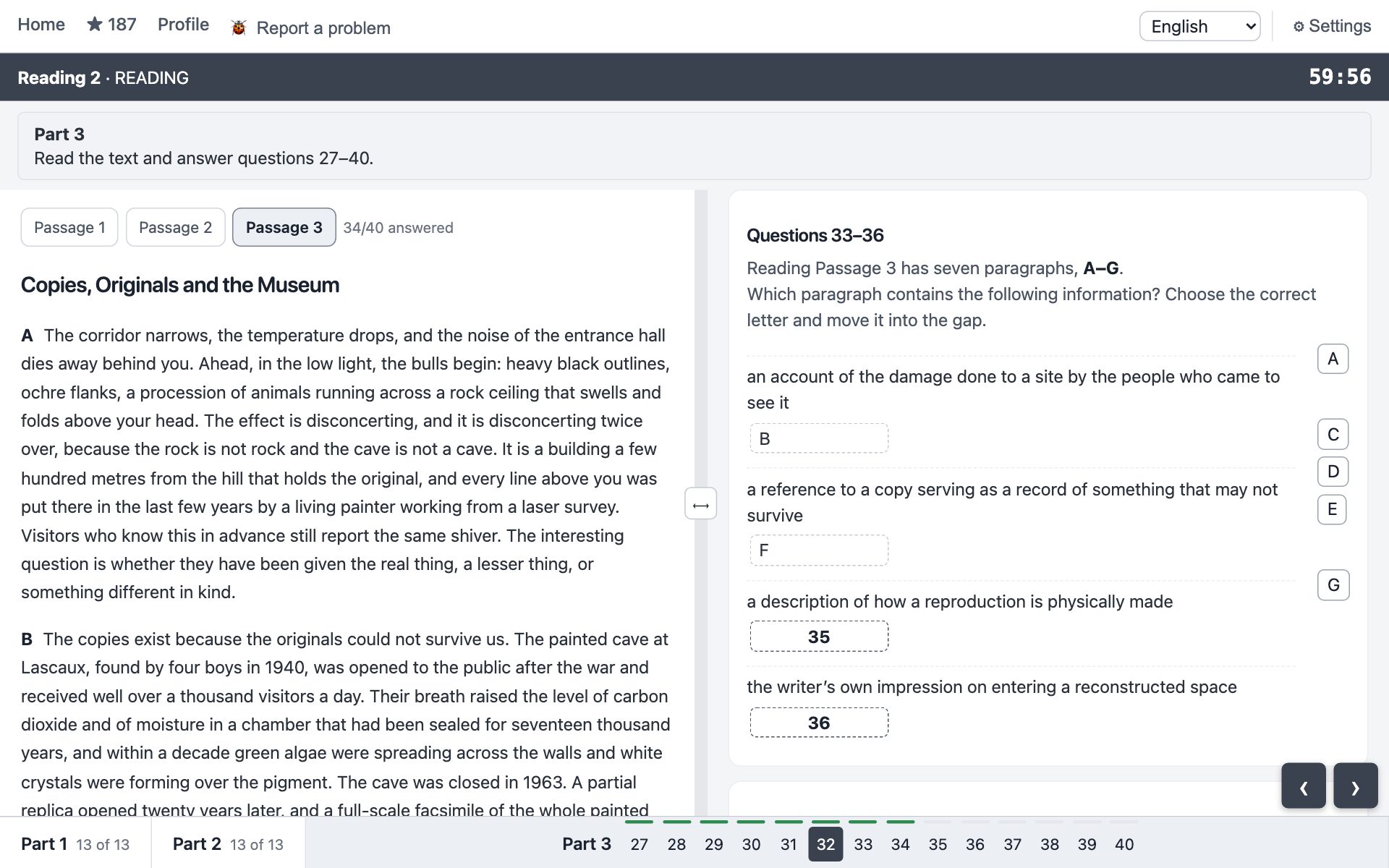
Matching Information: which paragraph says this
A list of statements about details: "a mention of the reason for a failure", "an example from another country", "a description of a method". You have to say which paragraph contains it. A paragraph can be the answer twice, and some paragraphs are not used at all. On the exam the answer goes in a grid: rows are questions, columns are paragraph letters; in our practice tool you drag the letter into a box.
- This is a task about details, not main ideas, so it is almost the opposite of Matching Headings: you are looking for a specific phrase, often in the middle of a paragraph.
- There is no order, and there are fewer statements than paragraphs. Do it last in the passage: by then you already know where things are.
- Turn each statement into a question, "where is the reason given?", and look for the words of reason: because, due to, led to.
Matching Features: who said or did what
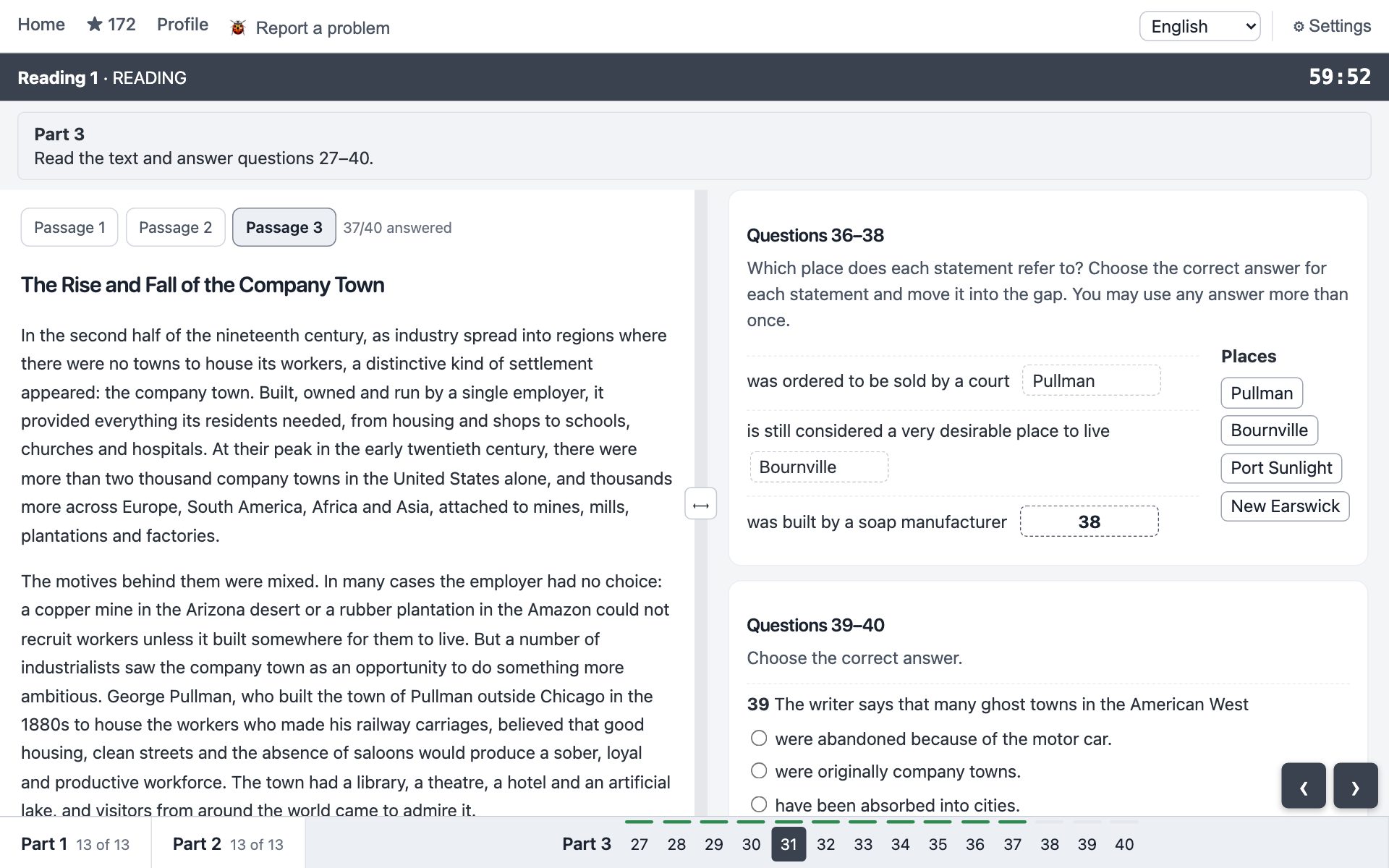
A list of names, organisations, places or theories and a list of statements. Each statement has to be assigned to its item; one item can be used several times. The answer is a letter from the list; on the computer it is usually a grid or drag-and-drop.
- First mark every mention of each name in the passage. Names are not paraphrased, and capital letters are the fastest thing to scan for. Bear in mind that the same person can appear as a surname, "the researcher" and "she".
- Then read around each mention and match it to the statements. That way you read only the parts of the passage you need.
Matching Sentence Endings: finish the sentences from a list
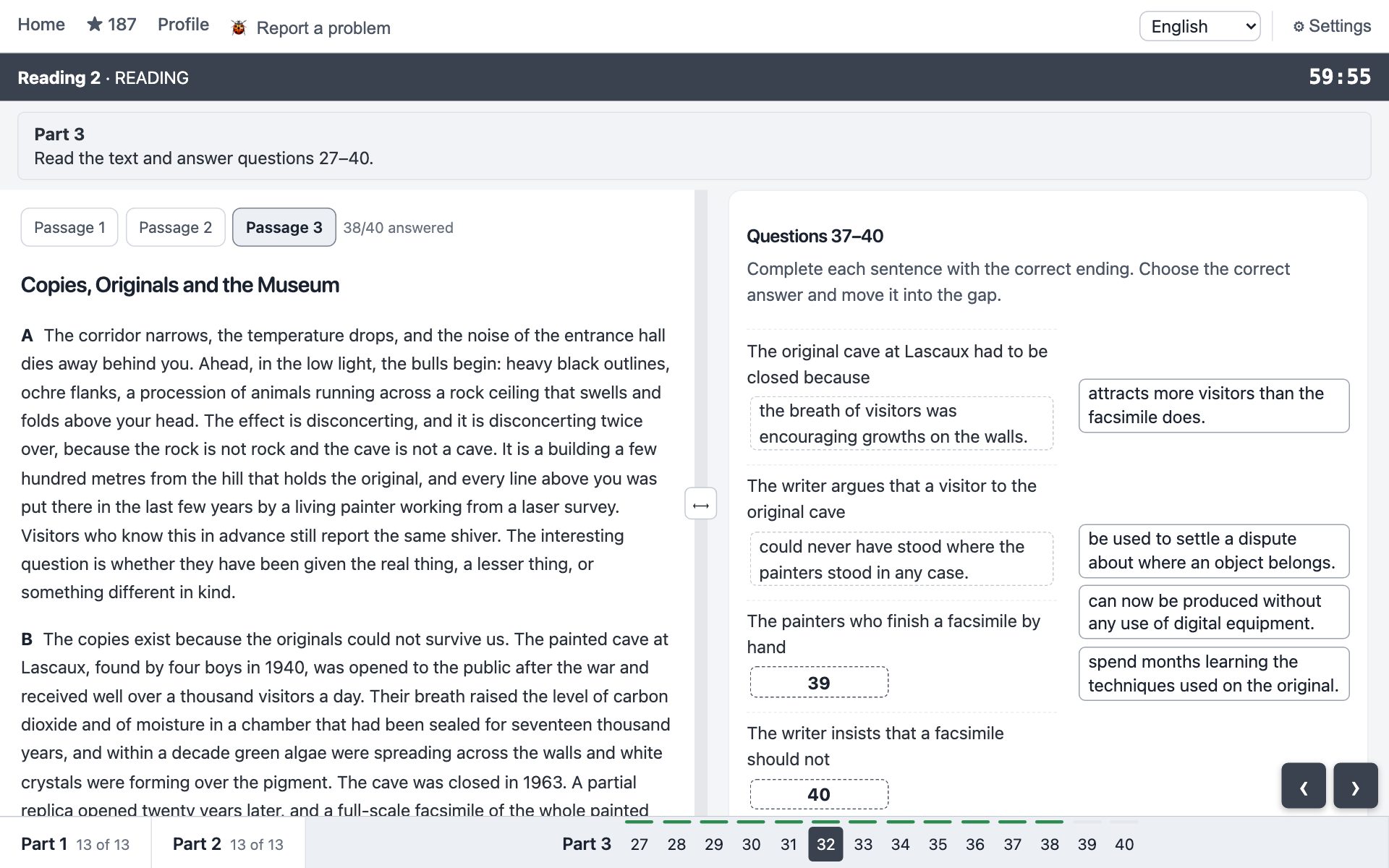
Sentence beginnings and a list of endings, with more endings than needed. The ending is dragged into the gap after the beginning. The beginnings follow the order of the text.
- First filter the endings by grammar: not every ending even forms a correct sentence with the beginning.
- Locate the part of the passage by the beginning, then check the meaning of the whole resulting sentence, not just its ending.
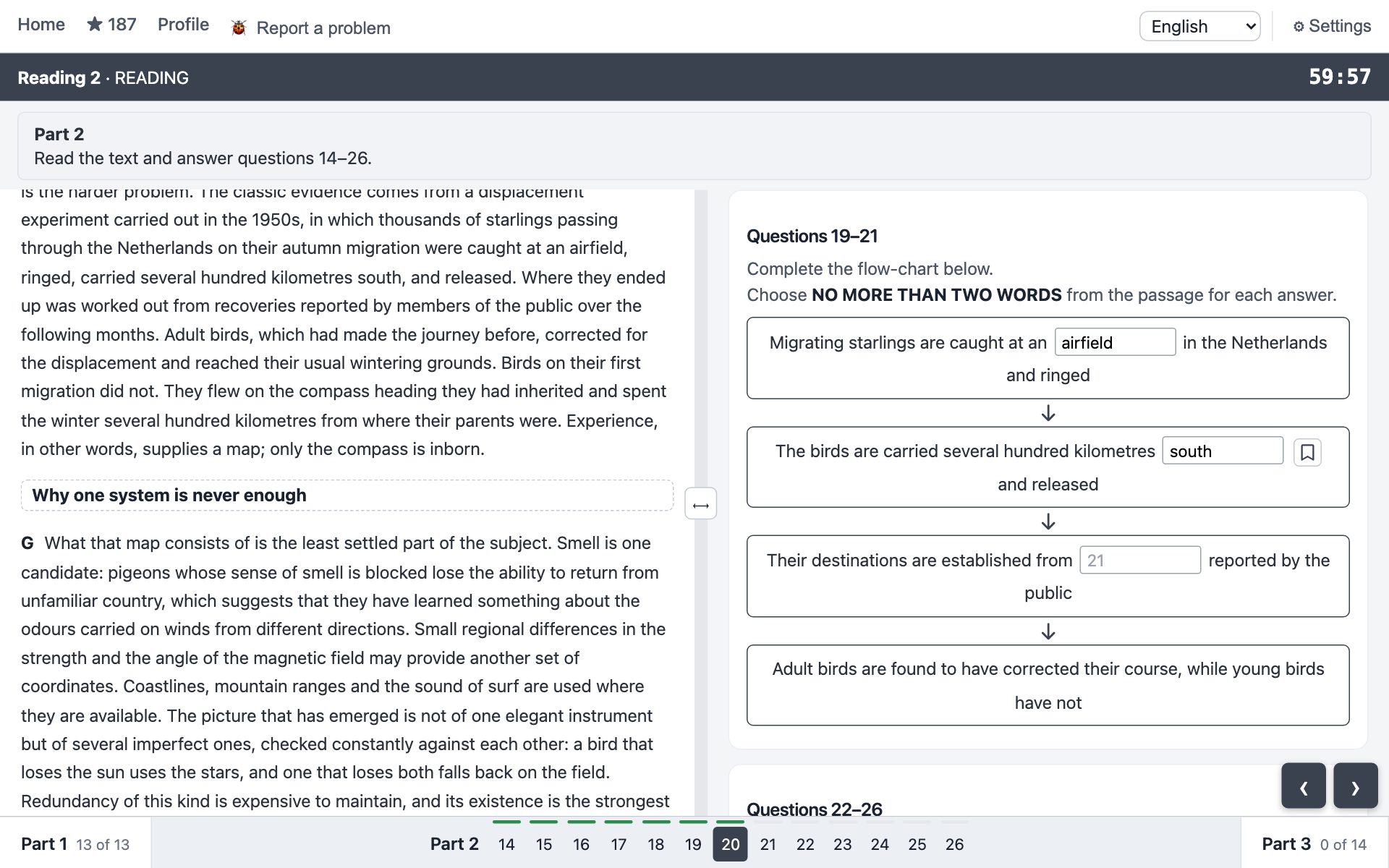
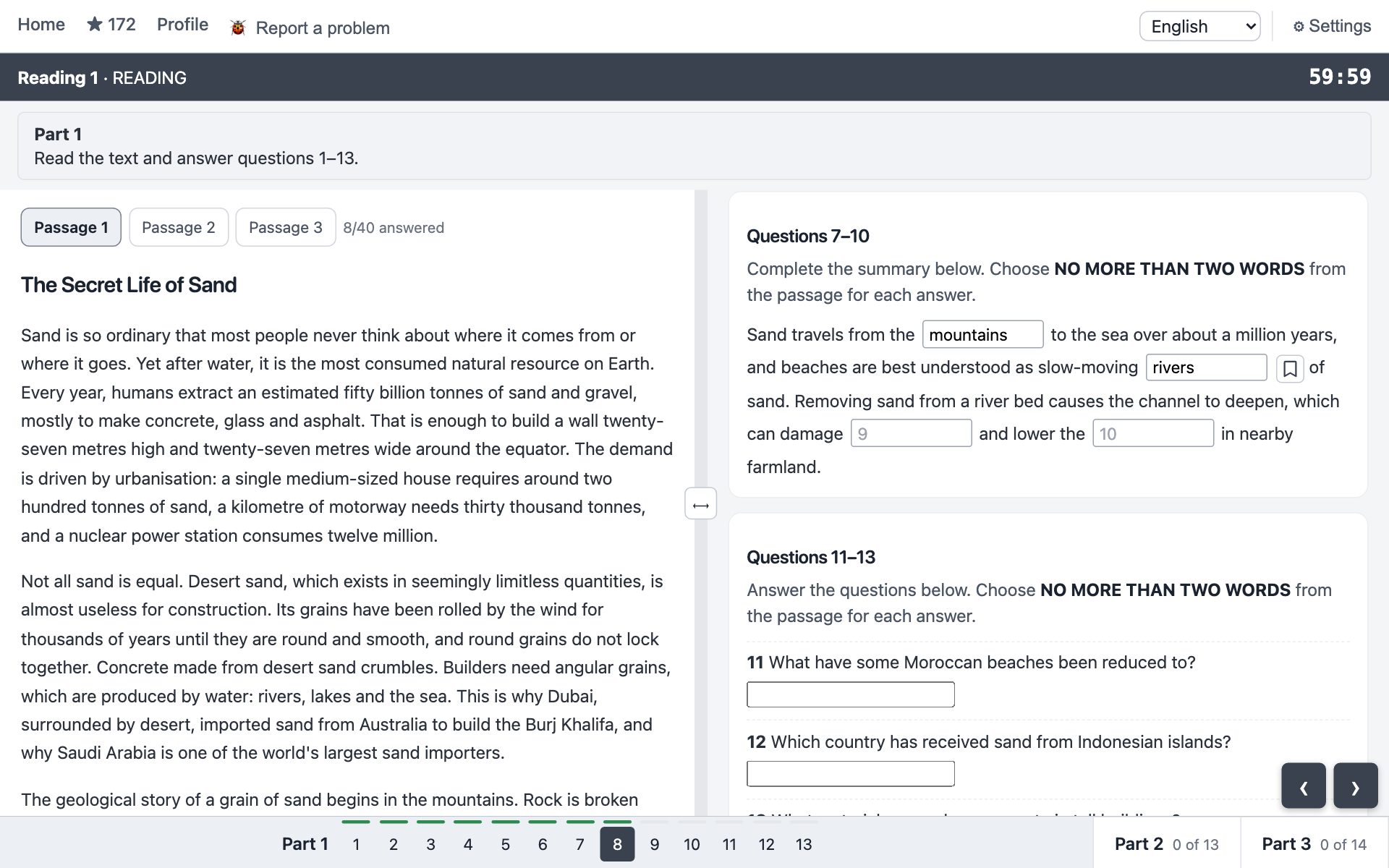
Sentence, Note, Table, Flow-chart and Diagram Completion: fill the gaps with words from the passage
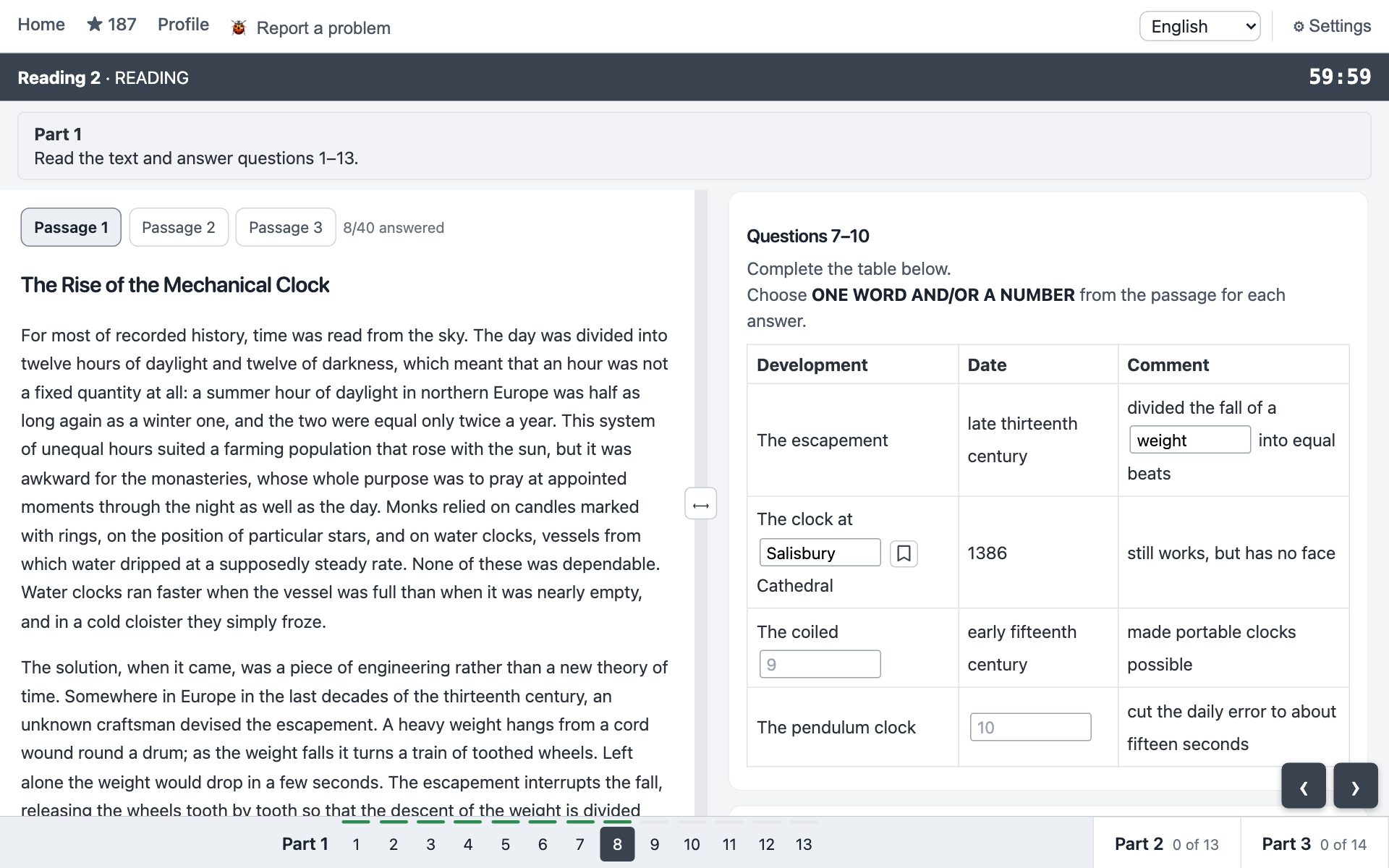
Sentences, notes, a table, a process chart or a labelled picture with gaps. The instruction sets a limit: "ONE WORD ONLY", "NO MORE THAN TWO WORDS AND/OR A NUMBER". The words are taken from the passage exactly, in the same form. The answer field sits right in the gap, with the question number visible inside it. Answers follow the order of the text; in a table, row by row.
- First decide what has to go in the gap: a noun, a number, a verb, an adjective. The sentence with the answer must be grammatical: if the gap is preceded by "a", the answer is a singular noun.
- The limit is strict: three words against a limit of two get no mark, however right the meaning. A hyphenated word counts as one; a number counts as a number.
- Copy the word from the passage letter for letter, without changing its form or "improving" it. If the passage says "rivers", the answer is "rivers", not "river".
- In a flow-chart and in notes keep to the order: in a chart it is set by the arrows and matches the passage.
Summary Completion: fill in a summary
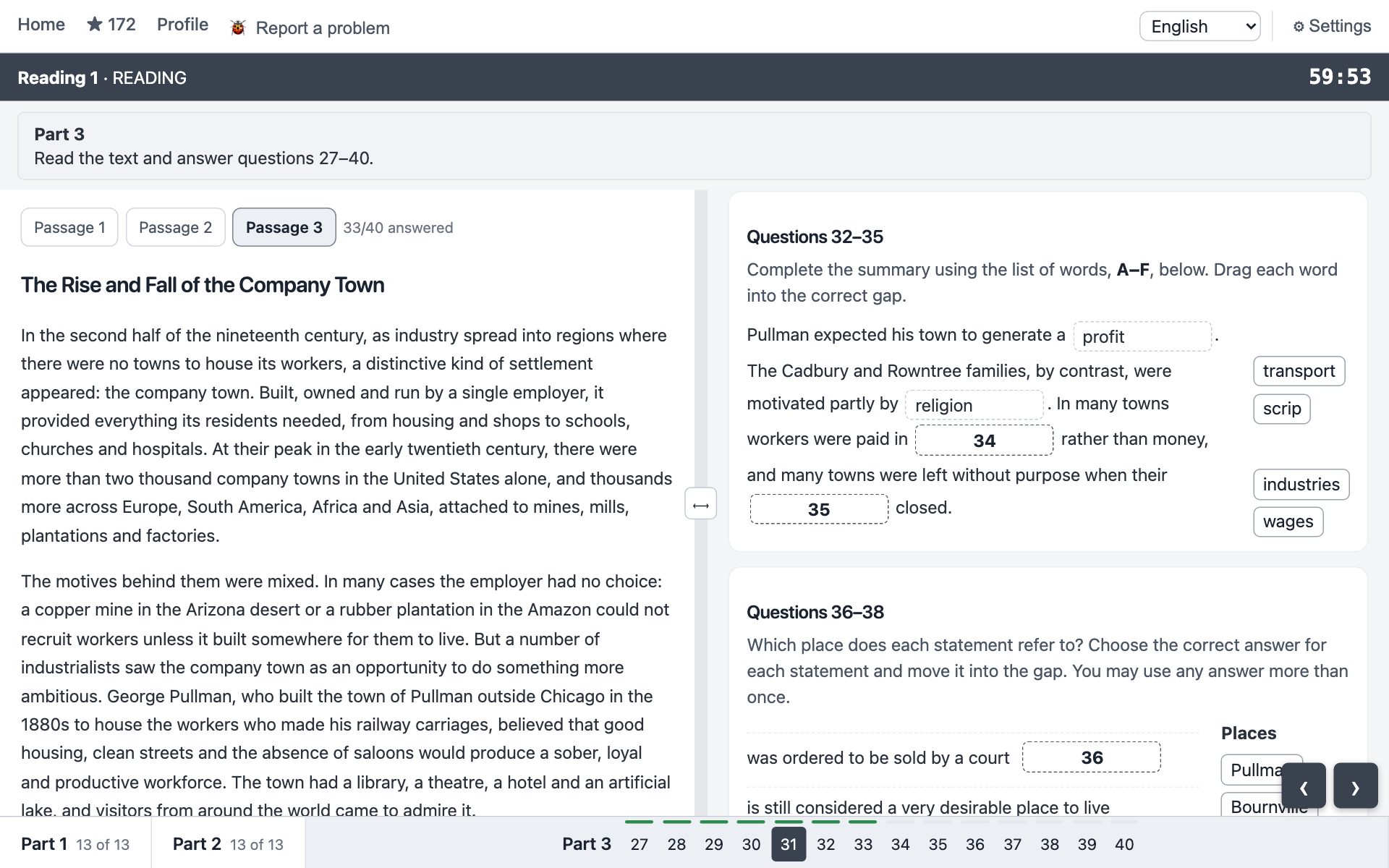
A short summary of part of the passage with gaps. Two variants: without a list, the words come from the passage as in the other Completion tasks; with a list, words A–H are dragged into the gaps, and there are more words than gaps.
- The summary is written in different words from the passage, so first find which part of the passage it corresponds to: usually one or two paragraphs, not the whole text.
- With a list, the words often differ in word class: profit, profitable, profitably. The grammar of the gap rules out half the options before you read anything.
- With a list the answer is a synonym of the word in the passage, not the word itself. Without a list it is the opposite: an exact copy.
Multiple Choice: one or several answers
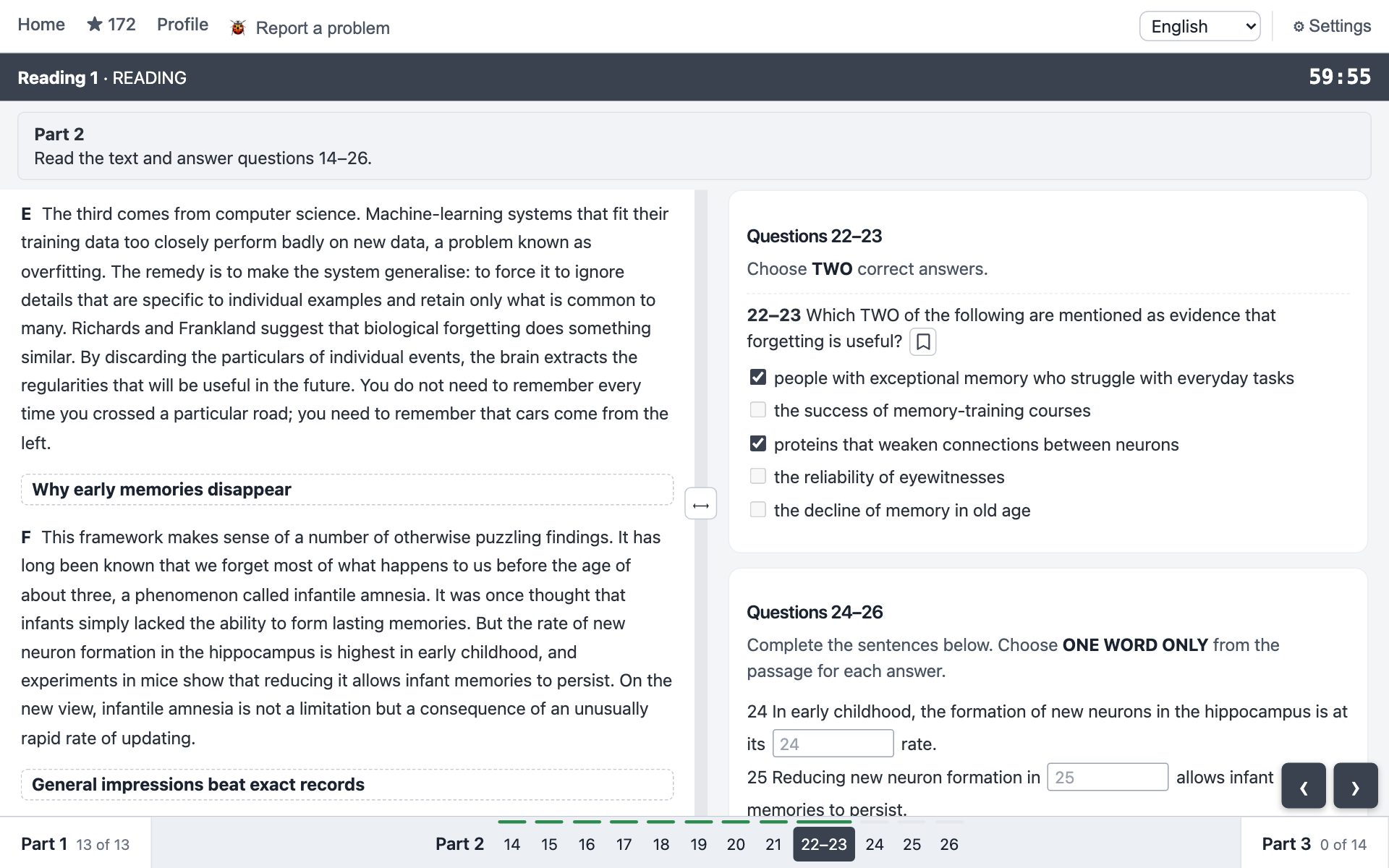
A question or an unfinished sentence and four options, one of which is correct: chosen with a radio button. The "choose TWO/THREE out of five to seven" variant uses checkboxes, and each correct answer is a separate mark. Single-answer questions follow the order of the text.
- Every wrong option is also mentioned in the passage; that is how they are built. Matching words prove nothing; check whether the option answers the question actually asked.
- Read the question without the options first, locate the spot in the passage and form your own answer, then look for it among the options. That way the options cannot mislead you.
- Typical traps: an option that is true according to the passage but answers a different question; an option where the right idea is distorted by a single word (always instead of often).
Short-answer: short answers to questions
Questions about the passage; the answer is a word or a few words from the passage within the limit, not a sentence. The questions follow the order of the text.
- The question word tells you the type of answer: who is a name, when a date, what material a noun.
- Articles and prepositions are not needed in the answer unless they fit within the limit; but if you add them, they count as words.
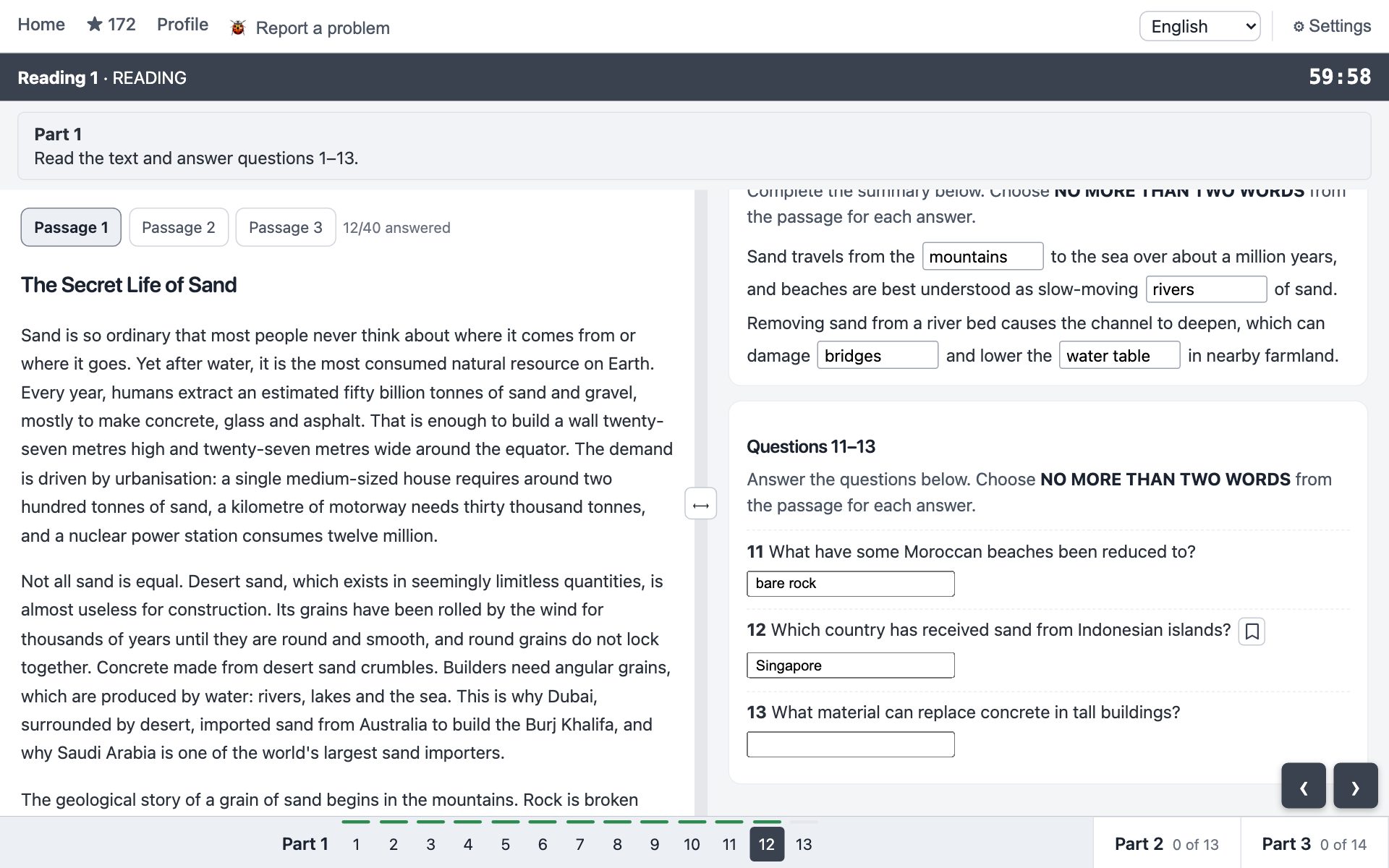
How answers are marked
- Spelling. A misspelt word gets no mark. In Reading this is the most painful loss: the right word is in front of you, and all you have to do is copy it.
- The word limit is applied literally: "NO MORE THAN TWO WORDS" means two words at most, an article counts as a word, a number counts as a number.
- Capitalisation does not matter; British and American spelling are both accepted.
- An empty answer is always zero, and there is no penalty for a wrong one. A minute before the end, fill every empty field with the most likely option.
How many correct answers you need for each band
The Academic Reading scale is slightly stricter than Listening. The exact boundaries vary a little from test to test; below is the reference table our practice tool uses. The official description of scoring is on the IELTS website.
| Correct out of 40 | Band |
|---|---|
| 39–40 | 9 |
| 37–38 | 8.5 |
| 35–36 | 8 |
| 33–34 | 7.5 |
| 30–32 | 7 |
| 27–29 | 6.5 |
| 23–26 | 6 |
| 19–22 | 5.5 |
| 15–18 | 5 |
| 13–14 | 4.5 |
| 10–12 | 4 |
For 7.0 you can get ten questions wrong; for 6.5, thirteen. The practical conclusion: do Passages 1 and 2 almost without losses, and then half the answers right in Passage 3 is enough.
How to prepare
- Full timed sections, not "one passage when there is time". Keeping the pace for 60 minutes after Listening is a separate skill, and it is only trained as a whole.
- Analyse every mistake by its cause. Could not find the part; found it but misread the paraphrase; missed the qualifier "only"; went over the limit; a typo; ran out of time. Each cause has its own cure, and after five tests you will see which two causes account for most of the losses.
- Keep a paraphrase notebook, not a word list. After each test write down the pairs "word in the question / word in the passage". That is the vocabulary that raises your band directly.
- Read academic texts every day for 15–20 minutes: popular-science articles, long reads about research. The aim is not to understand everything but to get used to dense text and to the fact that there are many unknown words.
- Train your weak types separately. Usually these are True/False/Not Given and Matching Headings. Ten tasks of one type in a row, with analysis, give more than three full tests.
- Practise on a screen. Reading a long text from a monitor, scrolling two panels and typing answers tires you differently from paper, and you need to get used to it before the exam.
Reading in Tilmashq
In our practice tool Reading works as on the computer-delivered exam: passage on the left, questions on the right, independent scrolling, a 60-minute timer, the row of question numbers with Review flags and every task type from this article, including dragging headings and words. After the section you get a band from the table above and an answer key showing what you answered and what was right, which makes it easy to analyse mistakes by cause.
Honestly about the limits: the passages and tasks are our own, written in the exam format but not taken from it. If you are preparing for General Training, our passages are academic only for now.
Read next
- IELTS Listening: format, parts, timing and every question type
- IELTS Speaking: format, the three parts, criteria and how to prepare
- IELTS Writing: format, criteria, timing and how to prepare
- Why IELTS preparation needs practice tests, not just textbooks
- How to start preparing for IELTS on your own on a small budget
Updated: 2026-09-15