IELTS Listening: format, parts, timing and every question type
Listening is the first section of the exam and the only one where you cannot go back: the recording plays once. Here is what you hear in each of the four parts, how the time is split, which question types appear and how to answer them without losing marks on details.
The format at a glance
| What | How |
|---|---|
| Length | about 30 minutes of recording, including pauses to read the questions |
| Checking time | on computer — 2 minutes; on paper — 10 minutes to transfer answers to the answer sheet |
| Parts | 4 parts of 10 questions each, 40 in total |
| How many times it plays | once, with no pause or rewind |
| Marks | 1 mark per question, the total is converted to a band from 0 to 9 |
| Academic and General Training | the Listening test is the same |
Speakers have different accents: British, Australian, North American and others. Difficulty rises from part to part: Part 1 is usually the easiest, Part 4 the densest.
What Listening looks like on computer
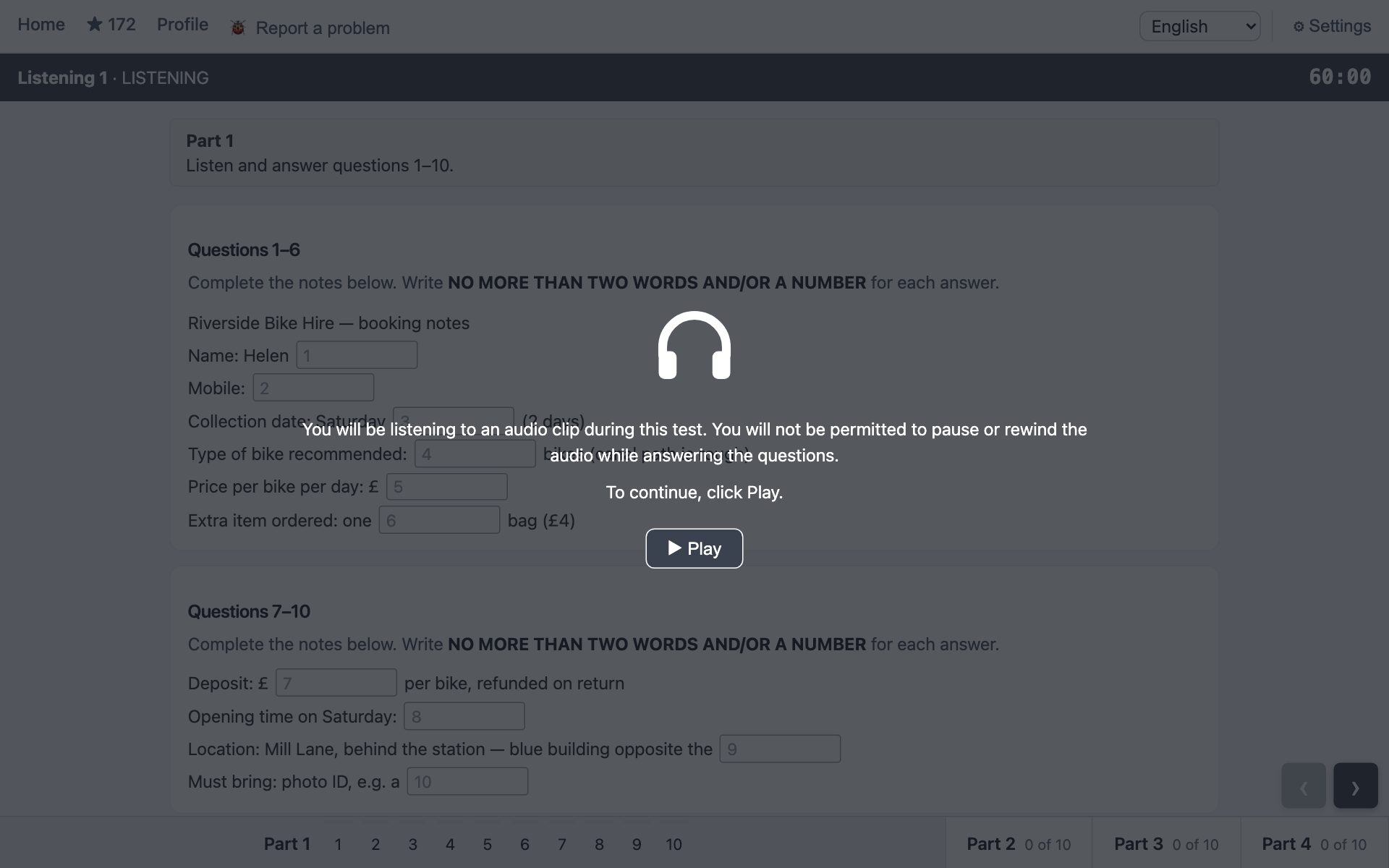
Before the start you see a screen warning that the recording cannot be paused or rewound, and a Play button. Once you press it, the recording runs through all four parts, and the screen switches to the part that is playing.
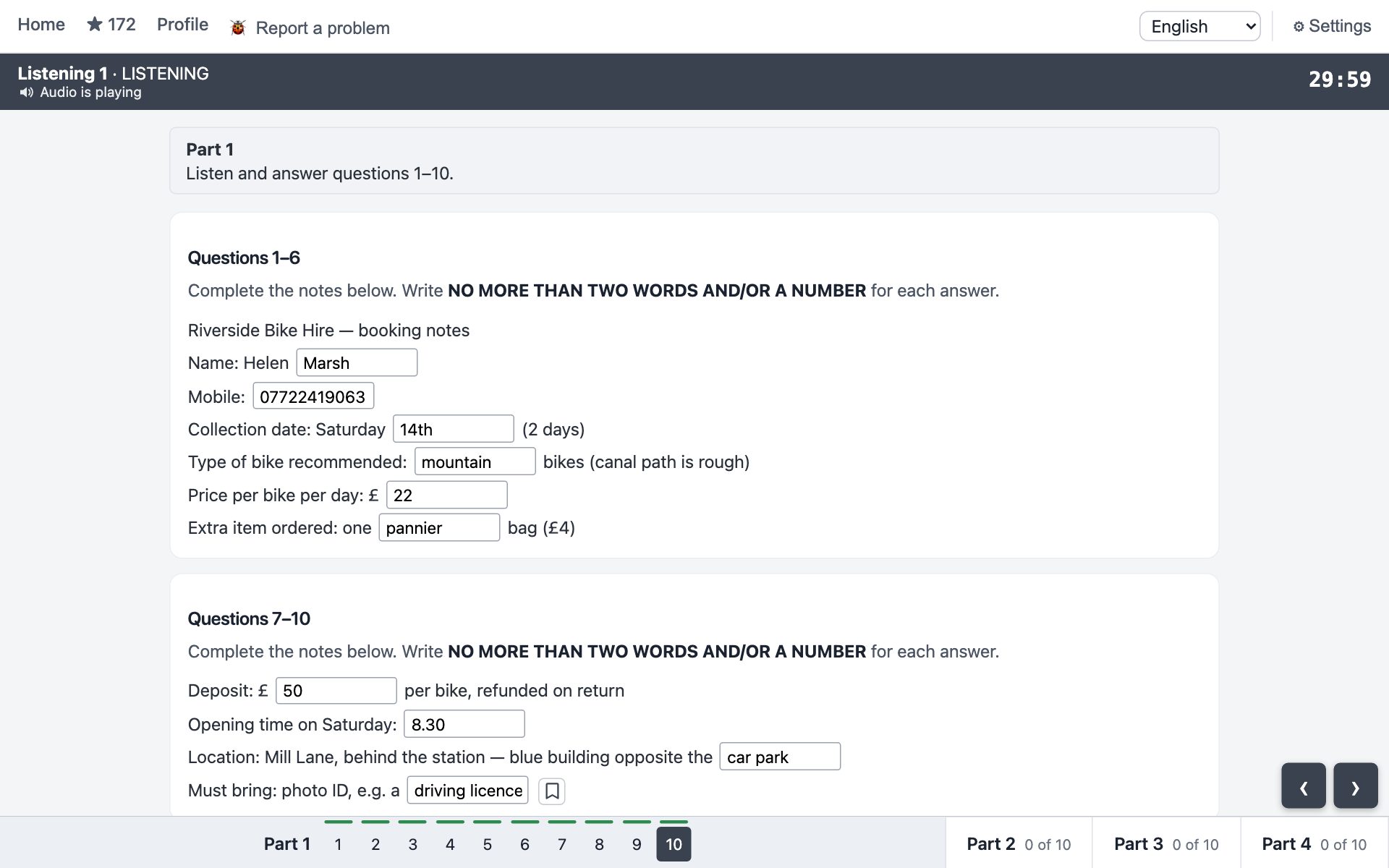
At the bottom of the screen there is a row with every question number; you can jump to any of them, including in another part. A question can be flagged so you can come back to it while checking. You answer while listening: type into a field, tick options or drag labels.
The key difference from the paper test is checking time. On paper you write in the booklet and get 10 minutes at the end to copy your answers onto the sheet. On computer you type straight into the fields, so only 2 minutes remain at the end. The rule is simple: type the answer at once, don't leave it for later.
The four parts: what you hear and what to do
Before each part, and in the middle of longer ones, there is a pause to read the next block of questions. Those 20–40 seconds are the most valuable time in the section.
Part 1 — an everyday conversation between two people
A typical situation: someone books something, signs up for a course, asks about hire or delivery terms. It is almost always a form or notes to complete: names, phone numbers, dates, addresses, prices.
- Expect dictation. Names and street names are often spelled out, phone numbers read in groups. Practise the English alphabet by ear, especially A/E/I, G/J, B/V.
- Expect corrections. A speaker gives one date or price and then changes it. Write down what the conversation settles on.
- Don't lose marks here. Part 1 has the easiest 10 questions; a misspelt familiar word costs as much as a hard question in Part 4.
Part 2 — a monologue on an everyday topic
One person talks about a place or an event: a guide describes a town, a staff member explains the rules of a sports centre, an organiser the festival programme. Maps, plans and multiple choice are common here.
- On a map, find the starting point first. The speaker nearly always begins with “we're at the entrance” or “here's the station”. During the pause, note where north is, where the entrance is and which streets are labelled.
- Listen for direction words: opposite, next to, on the corner, at the end, just before. The mistake is rarely vocabulary; it's missing “not this one, the next one”.
Part 3 — an academic discussion between two to four people
Students discuss a project, study or assignment with a tutor. They speak faster, interrupt, agree and disagree. Typical tasks are multiple choice, matching and flow-charts.
- Tell the voices apart. Before it starts, note who is who: questions often ask for a particular person's opinion.
- Don't answer on the first mention. In Part 3 every option is mentioned on purpose: one student suggests, another objects, the tutor decides. The right answer is the conclusion, not the first thing you hear.
Part 4 — an academic lecture
One lecturer talks about an academic subject: the history of an invention, a biology study, an economic process. It is usually notes, a table or a diagram to complete, 10 gaps in a row. There is usually no pause inside Part 4, so read all of its questions beforehand.
- Follow the lecture's structure. The lecturer signals transitions: first, another reason, however, finally. These words tell you the answer to the next question is coming.
- Don't get stuck. If you miss an answer, move straight to the next gap, or you'll lose two or three more.
Question types
Below are all the formats used in Listening and how you answer them on computer. The screenshots are from our Tilmashq practice app; the tasks in them were written by us, not taken from official materials.
Form, Note, Table Completion
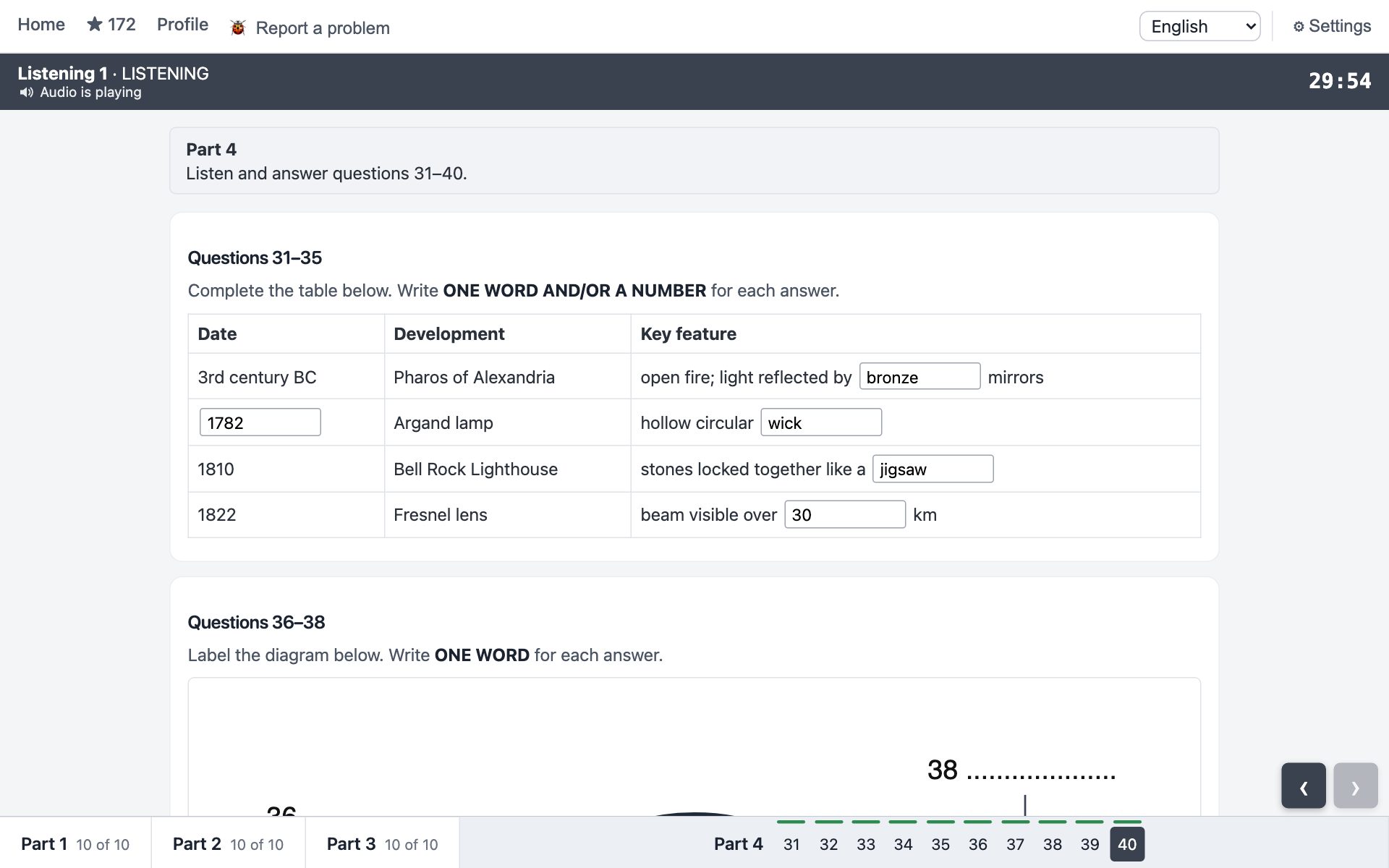
A form, notes or a table with gaps. The empty field sits right in the text with the question number inside it. The instruction gives a limit, such as “NO MORE THAN TWO WORDS AND/OR A NUMBER”.
- The limit is strict: an answer longer than the limit scores nothing, even if the meaning is right.
- Spelling counts. When checking, look at plural endings: the word must fit the sentence grammatically.
- Before the recording, predict what goes in each gap: a number, a name, a noun, an adjective. That makes the answer easier to catch.
Sentence Completion
Sentences with one gap each. The wording almost never matches the recording: listen for the same meaning in other words. Word limits and spelling work the same as in form completion.
Flow-chart Completion
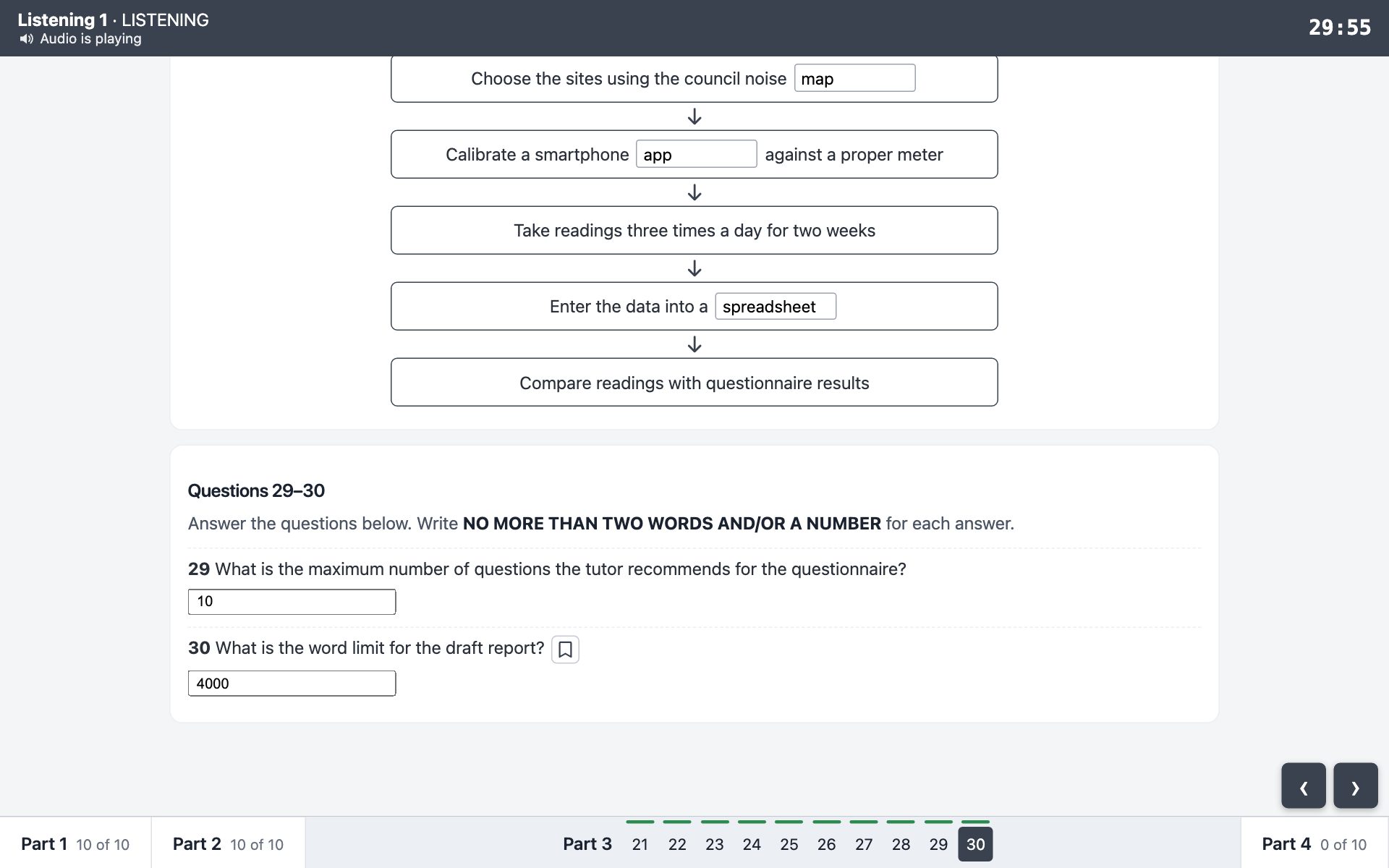
Stages of a process in boxes joined by arrows, some with gaps. The boxes follow the order of the recording, so the completed boxes help you track where the speaker is.
Short-answer Questions
A direct question with a field below it. The answer is a word or two or a number, not a sentence. Questions often ask for a quantity, a time or a name.
Map, Plan Labelling
A town map or a plan of a building or site with question numbers in some places. On computer there are two ways to answer: drag a name from a list onto the place on the map, or tick a letter in a grid where rows are questions and columns are the letters on the map. The list usually has extra options.
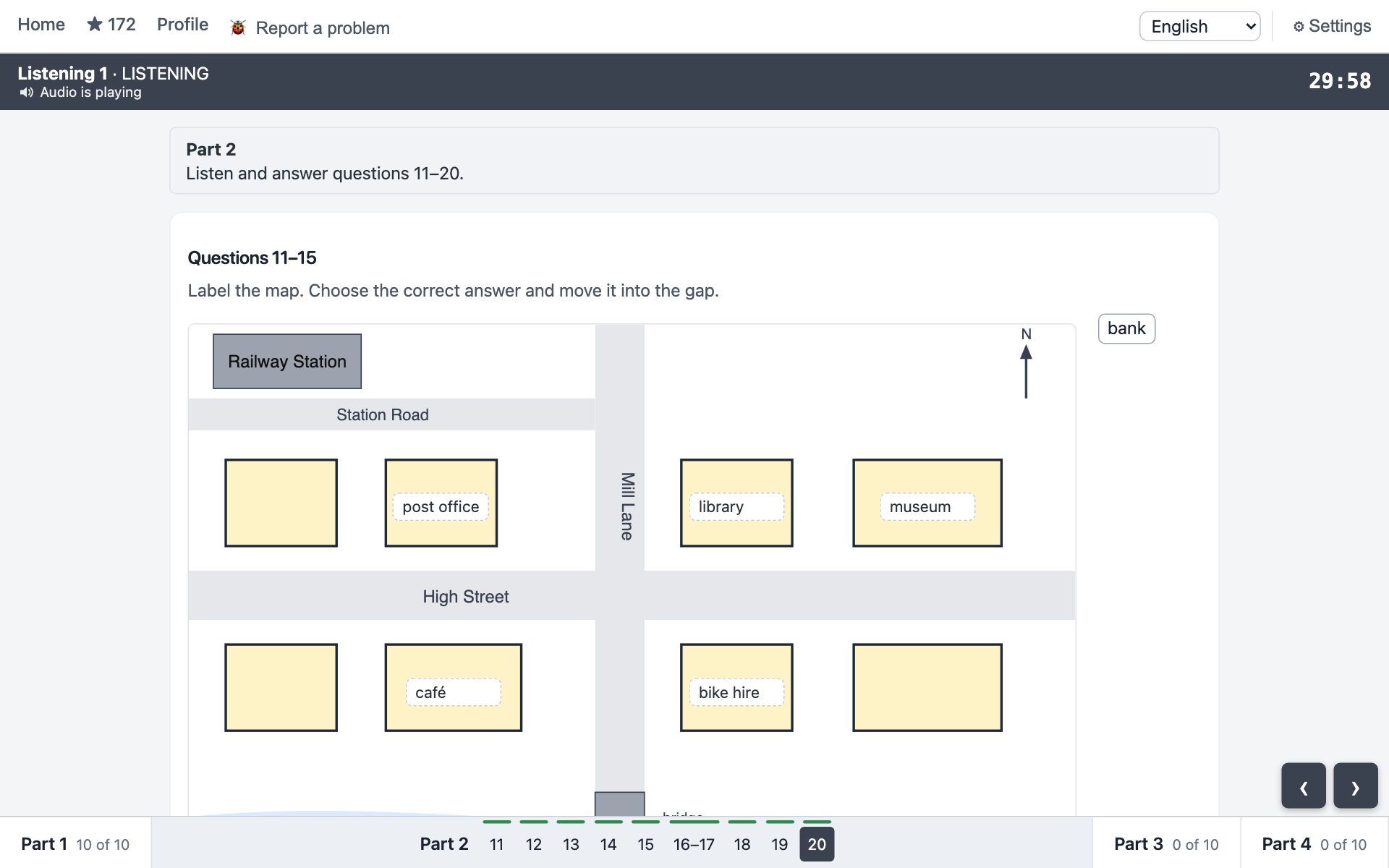
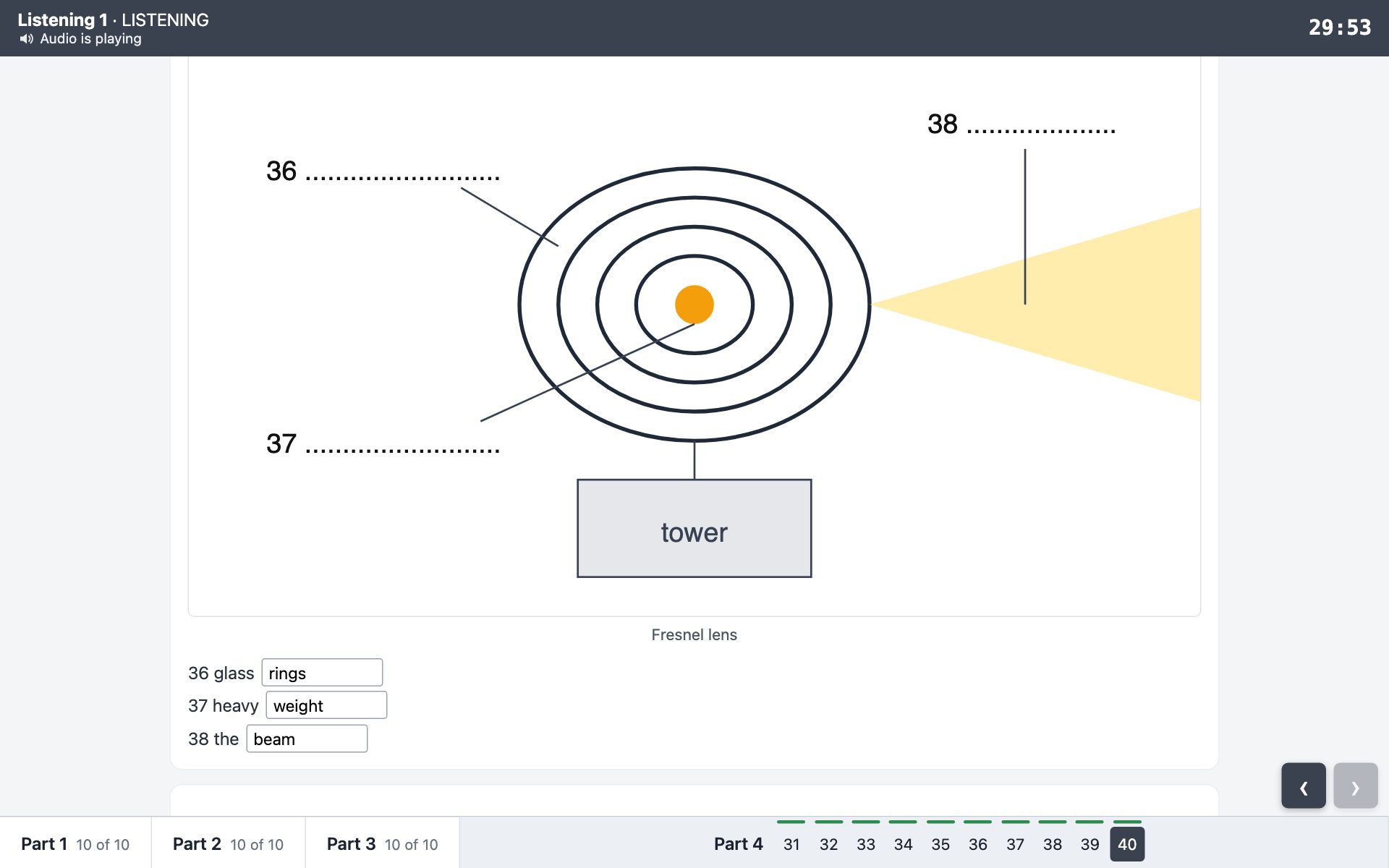
Diagram Labelling
A drawing of a mechanism or device with gaps for labels. It appears in the academic parts. Before the recording, see which parts are already labelled: the lecturer will describe the diagram from them.
Multiple Choice
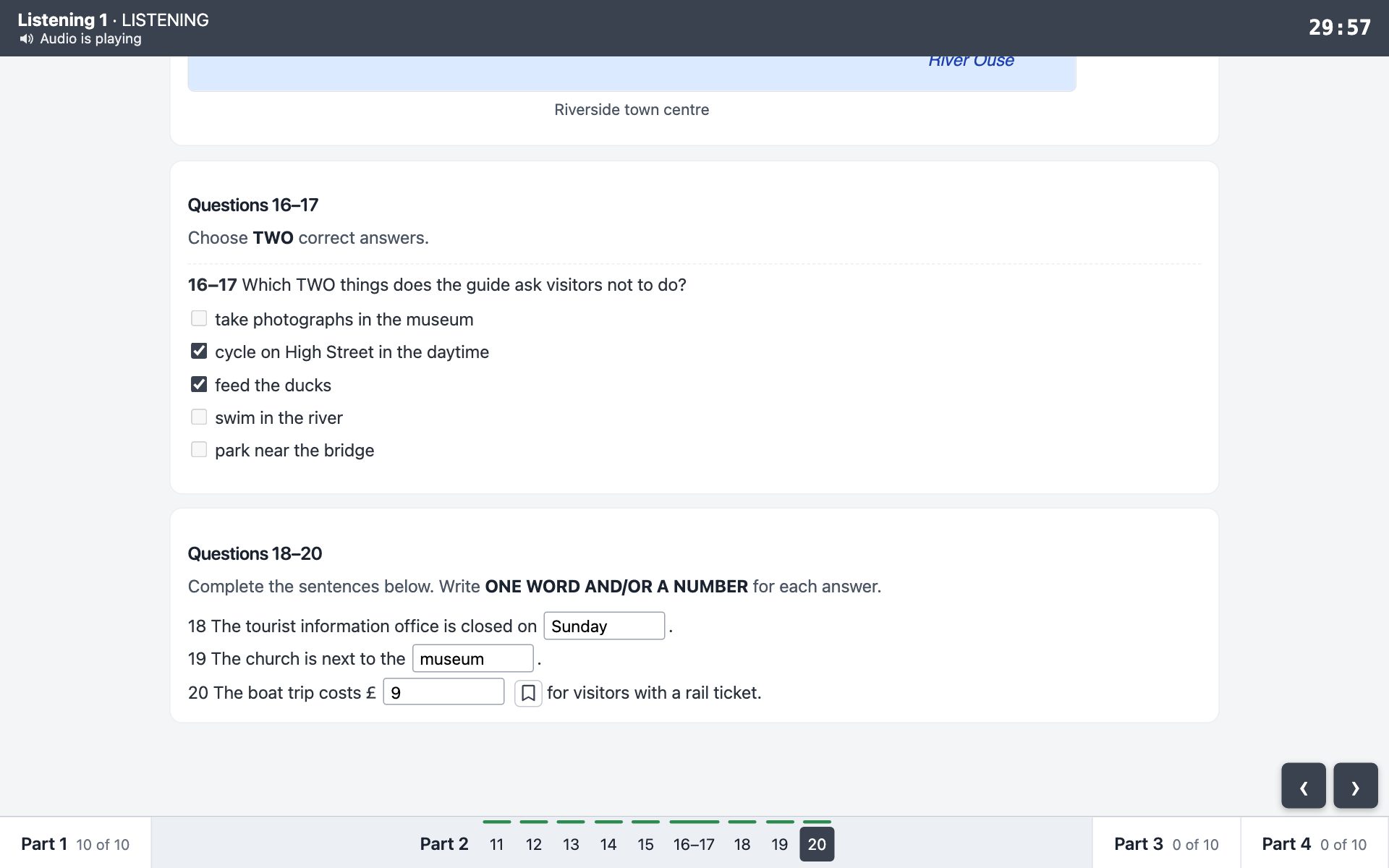
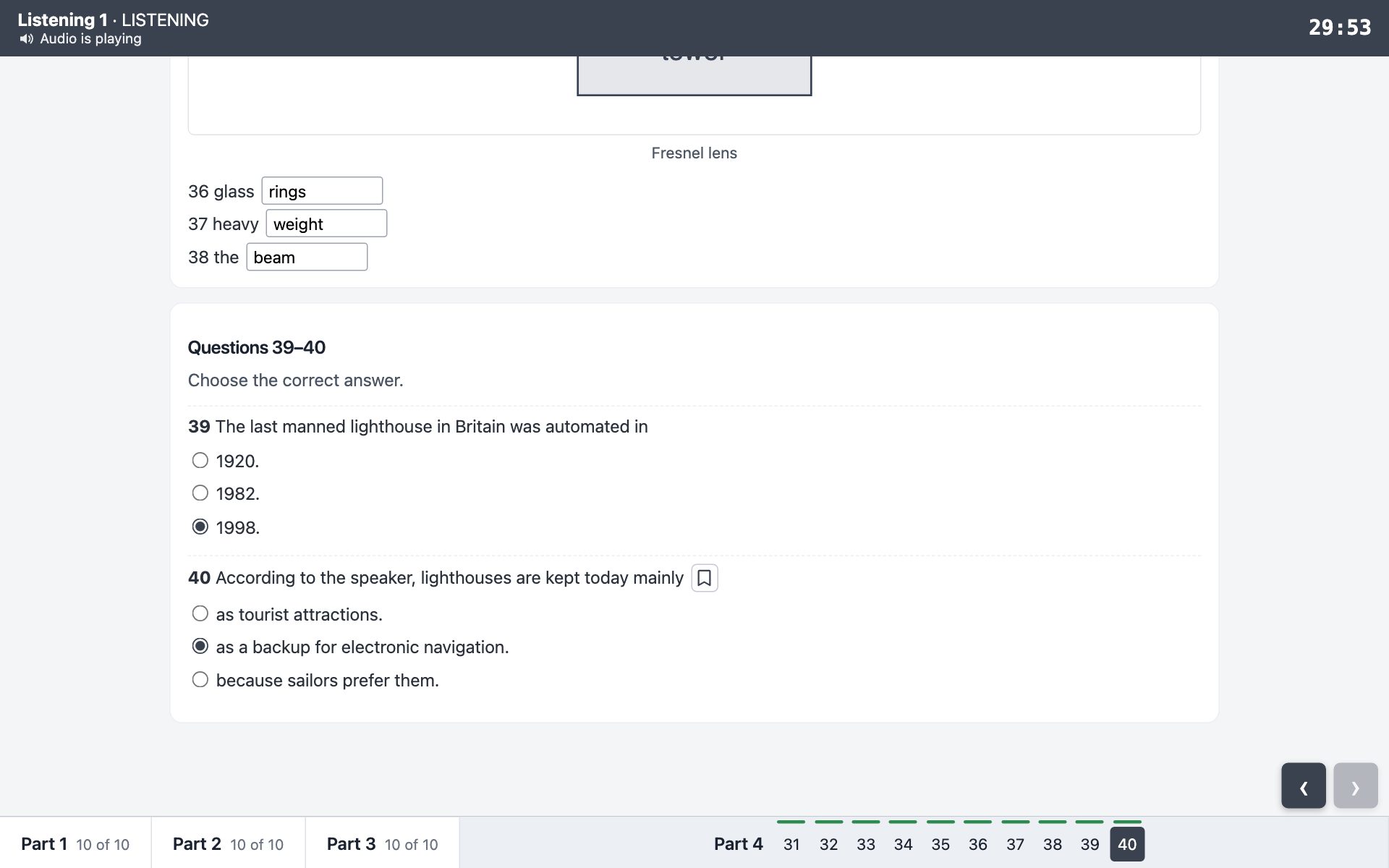
There are two kinds. Single answer: a question or sentence start with three options, choose one. Multiple answers: “Choose TWO” or “Choose THREE” from five to seven options, ticked with checkboxes, and each correct option is a separate mark.
- Read the options before the recording and note how they differ. Usually something about every option is said, but only one is right.
- In “Choose TWO” order doesn't matter, but you can't tick more than two.
Matching
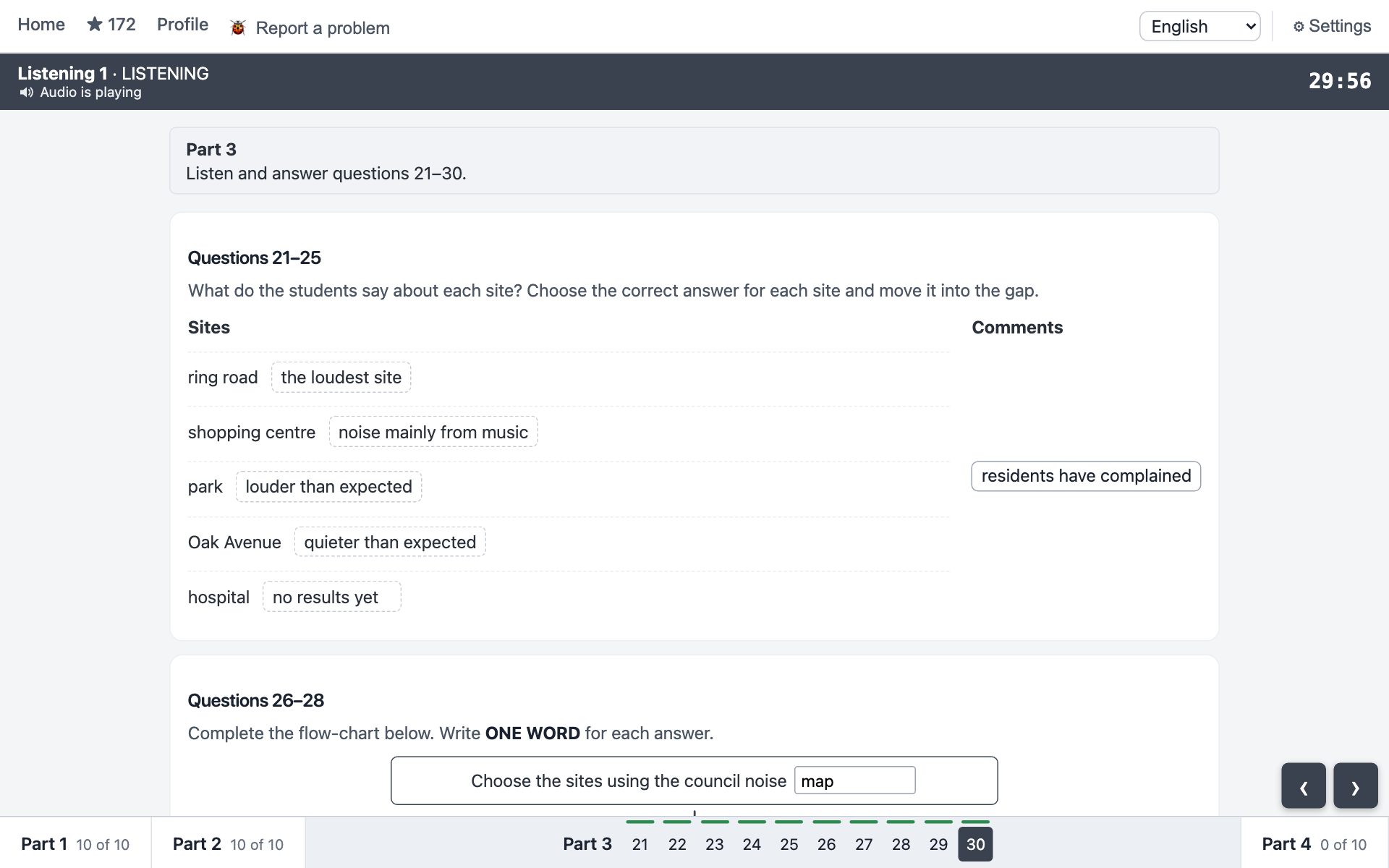
A list of items (people, places, stages) and a list of features. Match each item with a feature: on computer you drag the feature into the gap next to the item. There are more options than items, and the extra ones stay unused.
- Items are heard in list order, features in any order. Follow the items and keep the options in view.
- This is one of the hardest tasks: speakers discuss several options at once. If unsure, give the most likely one — a blank is always zero.
How answers are marked
- Word limit. “ONE WORD AND/OR A NUMBER” means one word, one number or a word with a number. An article counts as a word.
- Numbers can be written as digits — faster and with less risk of a spelling mistake.
- Spelling. A misspelt word scores nothing. British and American spellings are usually both accepted; what matters is getting the letters right.
- A blank is always zero. There is no penalty for a wrong answer, so leave no gaps at the end.
How many correct answers for which band
Correct answers are added up and the total is converted to a band. The exact scale varies slightly between tests; below is an approximate one, which our practice app uses. The official description of scoring is on the IELTS website.
| Correct out of 40 | Band |
|---|---|
| 39–40 | 9 |
| 37–38 | 8.5 |
| 35–36 | 8 |
| 32–34 | 7.5 |
| 30–31 | 7 |
| 26–29 | 6.5 |
| 23–25 | 6 |
| 18–22 | 5.5 |
| 16–17 | 5 |
| 13–15 | 4.5 |
| 10–12 | 4 |
So for 7.0 you can miss 10 questions, and for 6.5 almost 14. Not losing easy marks in Parts 1 and 2 gains more than trying to win every hard question in Part 4.
How to prepare
- Do the whole section without stopping. 30 minutes of continuous attention is a skill in itself. Single parts are good for review, but test yourself with a full section.
- Sort your mistakes by cause. Didn't hear it, misspelt it, went over the limit, picked the first option mentioned — each cause has its own fix.
- After a test, replay the hard bits with the transcript. You'll see how the answer was paraphrased in the audio.
- Listen to different accents — podcasts, lectures, news, not only British English.
- Practise on a computer. Typing while the recording plays and dragging labels takes getting used to: 2 minutes at the end won't save you.
Listening in Tilmashq
In our practice app Listening works like the computer-delivered exam: a Play screen, the recording plays once, the screen follows the part being played, number navigation and flags for checking, and every task format from this article. After the section you get a band and an answer key with explanations.
An honest note on limits: without payment most tests use a synthesised voice, and a few have a live recording. The synthesised voice sounds simpler than real speakers and doesn't cover the full range of accents, so also listen to real spoken English to train your ear.
Read next
- IELTS Writing: format, criteria, timing and how to prepare
- IELTS Writing Task 1: how to describe graphs, tables, processes and maps
- IELTS Writing Task 2: how to write an essay for band 7
- Why IELTS preparation needs practice tests, not just textbooks
- IELTS Reading: format, the three passages, timing and every task type
- IELTS Speaking: format, the three parts, criteria and how to prepare
Updated: 2026-09-15