Why IELTS preparation needs practice tests, not just textbooks
Plenty of people sit IELTS with good English and get a lower band than they expected. Usually the problem is not the language: it is that they met the exam format for the first time on exam day.
Knowing English and passing IELTS are different skills
IELTS does not just test your English, it tests how well you can show it under tight constraints. Reading gives you 60 minutes for three long academic passages and 40 questions, which is about a minute and a half per question including the reading. The Listening recording plays only once. Writing gives you an hour for two texts, and the second task counts twice as much as the first, so if you get stuck on the chart in Task 1 you may run out of time for the essay.
Someone who reads English articles with ease can still lose marks simply by running out of time, misreading the question type or writing an answer in the wrong form.
What practice actually trains
Timing
A sense of time only comes after several full tests. You learn how many minutes one Reading passage takes, when to skip a hard question and come back to it, and how much time to leave for checking your essay.
Question types
IELTS has its own question formats, and each has its traps. You understand the difference between FALSE and NOT GIVEN in Reading not from explanations but after dozens of those questions. The same goes for matching headings, table completion and choosing two answers out of five.
Answer format
Word limits such as “no more than two words”, spelling, singular or plural: all of these decide whether an answer counts. The right idea written in three words instead of two scores zero.
Stamina
Listening, Reading and Writing run back to back, about two and a half hours without a break. Concentration drops noticeably by Writing if your brain is not used to that load.
The computer format has surprises of its own
More and more people now take IELTS on a computer. One of us took the computer-delivered IELTS in Cambridge (UK) and in Denpasar (Indonesia): official test centres use the same platform, so the screen looks the same in any other country, and only the conditions in the room differ.
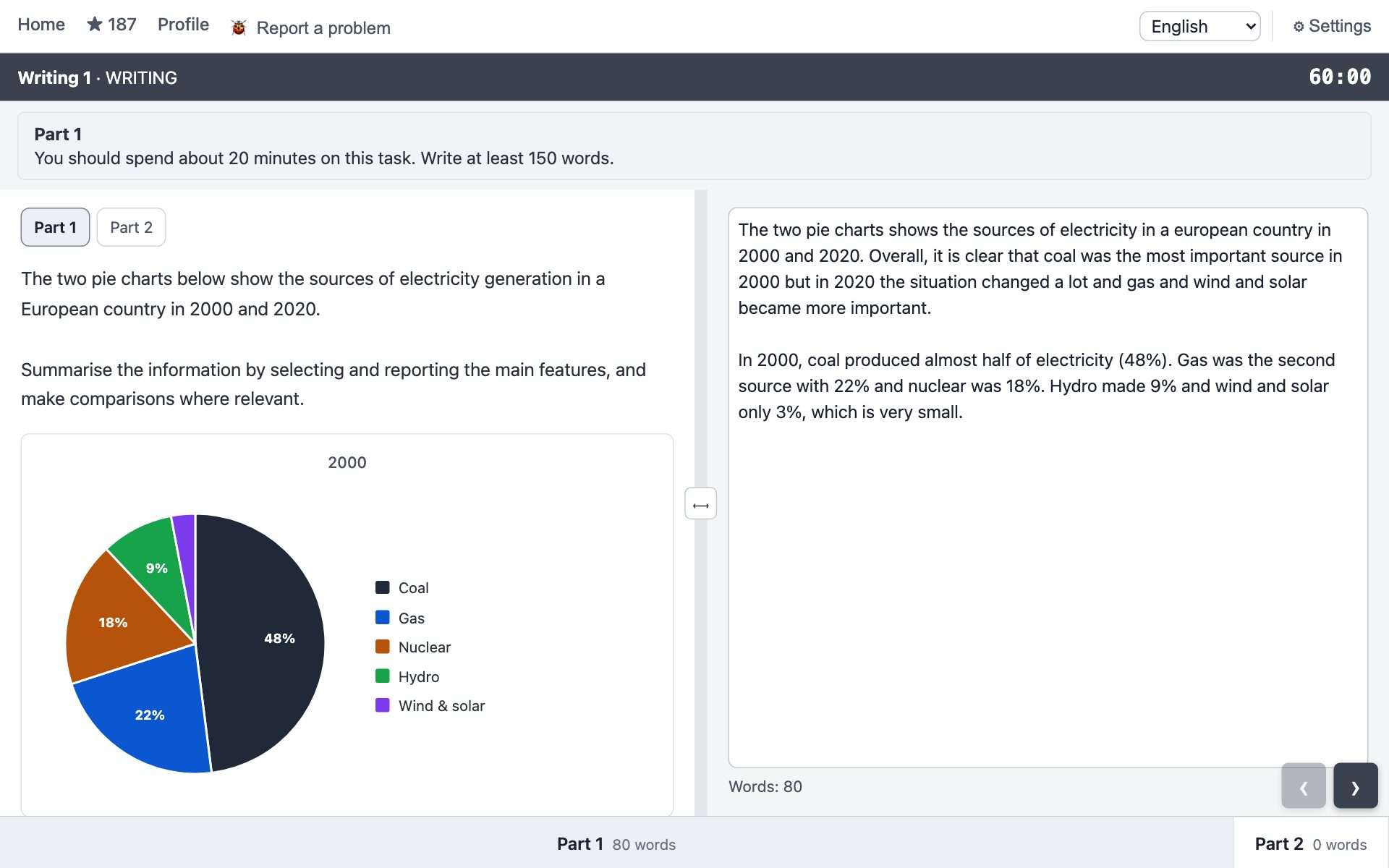
The screen feels unfamiliar if you prepared with paper books. The passage and questions sit side by side, you move between questions using the numbers at the bottom, the timer is always visible, and some answers are dragged with the mouse. Writing has no spellchecker but does have a word counter. On your first test all of this is distracting; by the fifth you no longer notice it.
How to practise effectively
- Take full tests in exam conditions. No pauses, no dictionary, no replaying the audio. Separate exercises are useful, but only a full test trains stamina and timing.
- Review every mistake. What matters is not the number of correct answers but understanding why an answer was wrong: you misheard, ran out of time or confused the question type.
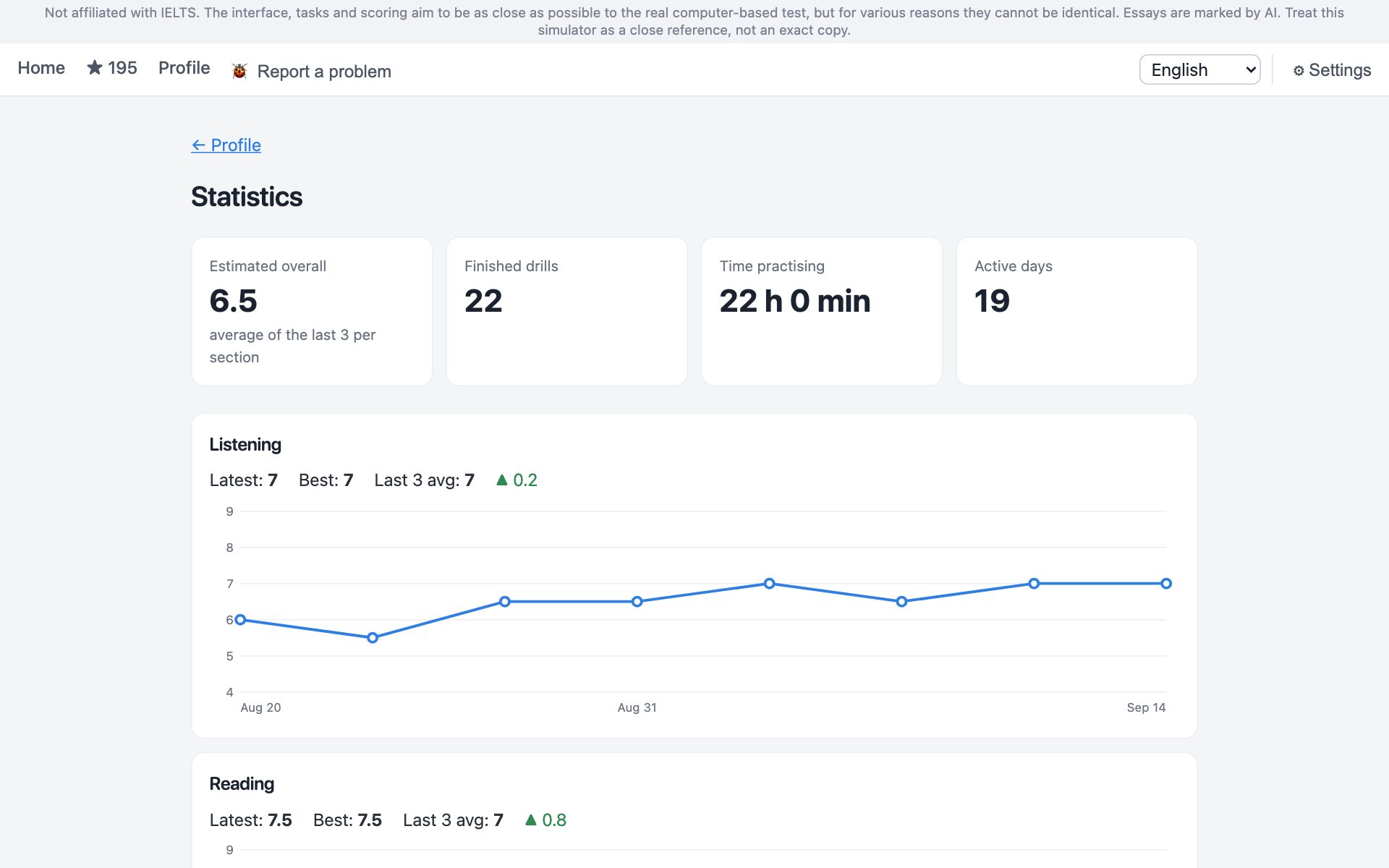
- Track your band for each section. That shows where you lose the most marks and where to spend your time.
- Writing and Speaking need feedback. You cannot mark your own essay: you need a review against the criteria, covering task response, coherence, vocabulary and grammar.
- Speak out loud, with a timer. Two minutes of talking in Part 2 feels like a long time until you try to fill it.
Where to find practice tests
Start with the free sample questions on the official IELTS website. They show what the tasks in each section look like. But there are few full tests there for regular practice.
That is why we built Tilmashq. It has full Listening, Reading and Writing tests plus Speaking, with a screen, timings and task types modelled on computer-delivered IELTS Academic: passage and questions side by side, navigation by question number, drag-and-drop answers, Listening audio played once, and essays written without a spellchecker but with a word counter. After a test you get a band for each section, an answer key with explanations, and criteria-based feedback on your essays and Speaking answers.
To be honest about the limits: the trainer is a close guide, not an exact copy of the exam. Writing and Speaking are marked by AI, which is on average stricter than an examiner, and pronunciation is not assessed yet. But it does help you get used to the format, feel the timing and find your weak spots before the real exam.
Read next
- IELTS Listening: format, parts, timing and every question type
- IELTS Reading: format, the three passages, timing and every task type
- IELTS Writing: format, criteria, timing and how to prepare
- IELTS Speaking: format, the three parts, criteria and how to prepare
Updated: 2026-09-14