
GRE in Tilmashq: the GRE Math, GRE Vocab and GRE Roots sets in the vocabulary trainer
It happens like this: IELTS is done, the documents are collected, and in small print on the master's programme page there is "GRE General Test". For many people this is the first time they meet an exam almost nobody in Tashkent talks about. The Tilmashq vocabulary trainer now has three word sets for the GRE. Below: who needs this exam, how it differs from IELTS, and how to use the sets so that you actually prepare rather than just flip cards.
Who needs the GRE
The GRE General Test is an admission exam for master's and doctoral programmes. It is asked for most often by universities in the US and Canada, especially for engineering, economics and science programmes. Sometimes Europe asks for it too: for example, some master's programmes in Germany ask for the GRE from applicants whose bachelor's degree comes from outside the European Higher Education Area — it helps the university compare candidates from different systems.
Requirements differ a lot from programme to programme: somewhere the GRE is required, somewhere "recommended", somewhere it has been dropped. Check the page of your programme, not the university's general site.
How the GRE differs from IELTS
IELTS tests whether you can study in English. The GRE tests how you reason — your English is taken for granted. The exam takes about two hours and has three parts:
- Analytical Writing — one essay arguing a position on a debatable claim.
- Verbal Reasoning — reading and fill-in-the-blank sentences. This is the main difficulty for us: the vocabulary is far rarer than in IELTS. You will hardly meet obdurate, perfunctory, garrulous in IELTS, but in the GRE they are ordinary.
- Quantitative Reasoning — school maths: arithmetic, algebra, geometry, data. The maths itself rarely scares anyone who went to school here. What scares is that it is in English: product, quotient, remainder, "between 1 and 10 inclusive" — one misread word, and a correctly solved problem is marked wrong.
Hence the three sets: words for the maths, words for Verbal, and roots that help take unknown words apart.
Three sets in Vocabulary
| Set | What is inside | What for |
|---|---|---|
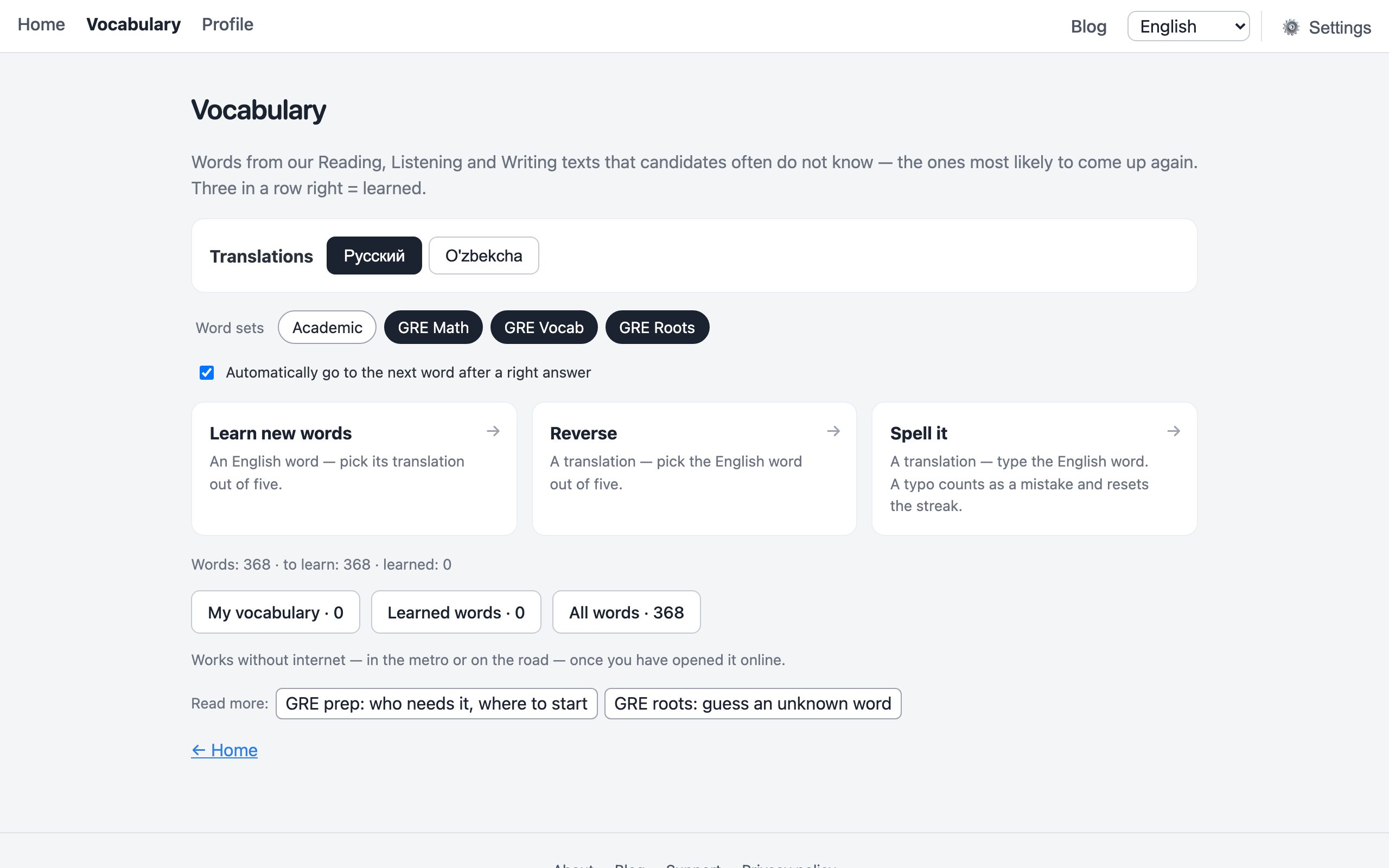
| GRE Math | 83 terms: product, factor, quotient, remainder, integer, inclusive, median… | Not to lose marks in Quant on understanding the question |
| GRE Vocab | 207 words common in Verbal tasks: obscure, superficial, obstinate, ambivalent… | Vocabulary for the blanks and for reading |
| GRE Roots | 78 prefixes, roots and suffixes: trans-, bene-, pli, loqu, -ous… with example words | To guess the meaning of words that are on no list |
Every word has a Russian and an Uzbek translation and a short example. In the roots set the card shows the root itself instead of a word, its meaning instead of a translation, and words built on it as the example.
How to turn them on
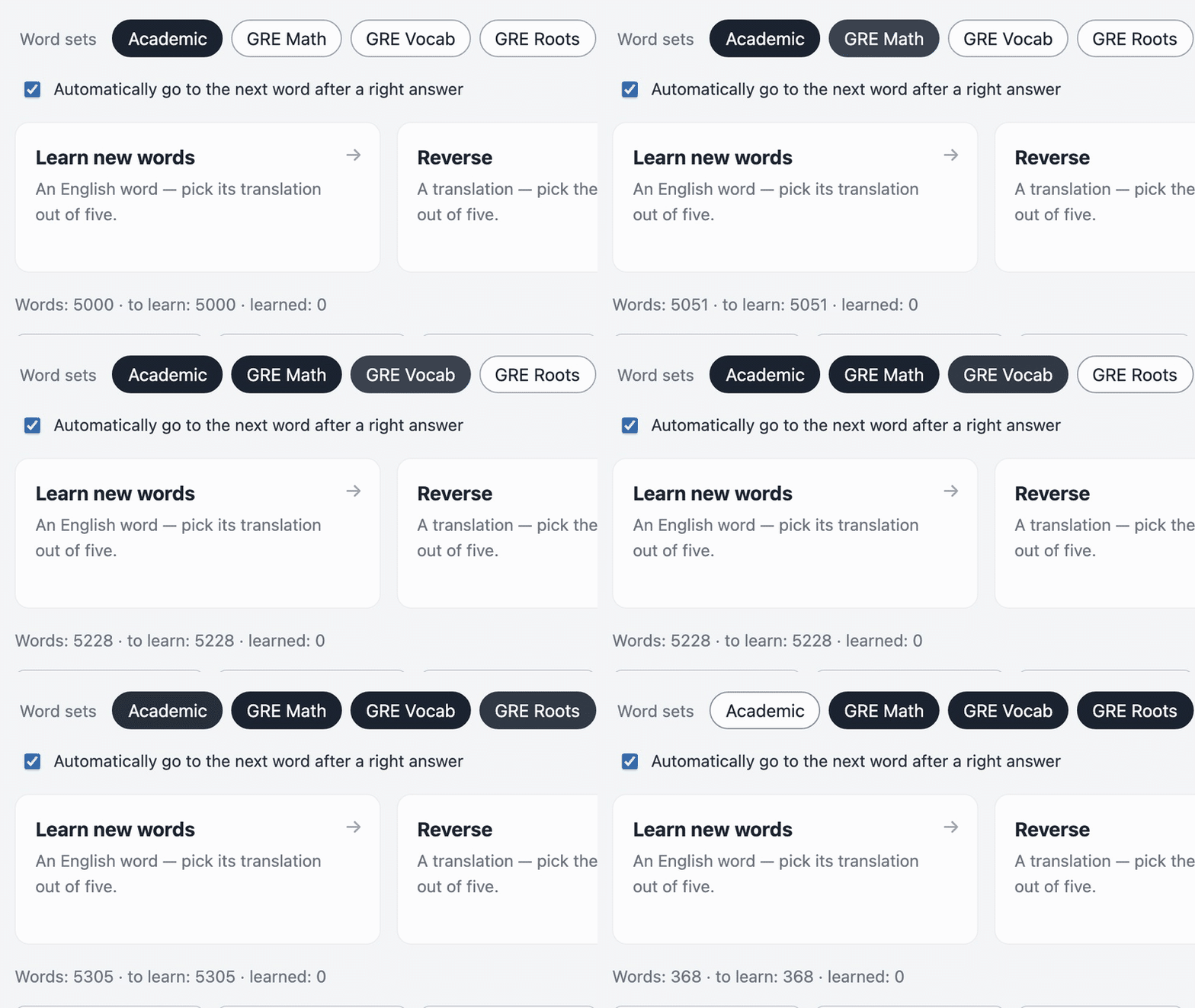
In the Vocabulary section, above the modes, there is a row of chips: Academic · GRE Math · GRE Vocab · GRE Roots. A tap turns a set on or off. Any combination works except an empty one: the last set that is on cannot be turned off. The cards in all three modes come from the chosen sets, and word progress is shared — a learned word stays learned even if you switch sets later.
Like the main vocabulary, the GRE sets work offline: open them once with a connection. More on the modes, the "three in a row" rule and offline use — in How to make your commute count: IELTS vocabulary with no internet.
How to use them: a working plan
- Start with GRE Math if Quant is ahead of you. It is the shortest set and the quickest win: 83 words in a week of metro rides. Turn on only this set and go through Learn new words, then Reverse.
- Alongside it, GRE Roots. Roots do not teach a word — they teach you to take words apart. They work best together with GRE Vocab: you meet benevolent among the words, and next to it come bene- "well" and vol "will". How exactly roots help in the exam, and why that is not guessing at random, is in a separate article: GRE word roots: how to guess an unknown word intelligently, not randomly.
- Then GRE Vocab. The largest set. Reverse mode matters most here: in the blanks you do not recognise a word, you choose it to fit the meaning of the sentence — that is closer to recall than to recognition.
- Spell it — for GRE Math and GRE Vocab, once a week. Roots do not need this mode: typing "a- / an-" from memory is pointless, recognising them is enough.
- Do not turn Academic off for good if IELTS is still ahead. The sets mix freely: Academic in the morning, GRE in the evening.
Honest limitations
- Tilmashq is an IELTS trainer. For the GRE it has only words: no GRE practice tests, Verbal tasks or Quant problems. Vocabulary is the foundation, but you will need other materials for the tasks.
- We wrote the sets by hand, and they will grow. This is not "all GRE words" — no such list exists — but common vocabulary and the main roots.
Read next
- GRE word roots: how to guess an unknown word intelligently, not randomly
- How to make your commute count: IELTS vocabulary with no internet
- IELTS Academic: how the exam works and what to read for each section
Updated: 2026-09-23