
GRE word roots: how to guess an unknown word intelligently, not randomly
Sooner or later in GRE Verbal it happens: a sentence with a blank, five options — and not one familiar word. A random pick is 20%. But most of the "hard" GRE words came into English from Latin and Greek, and they are assembled from parts that repeat across dozens of words. Know the parts, and you can take apart a word you are seeing for the first time. Below: how it works on an example, and how to train roots in Tilmashq.
A worked example
A sentence with a blank (our own task, in the style of real ones):
The senator, usually so ___ that his speeches ran far past their allotted time, surprised reporters by answering their question in just three words.
Options: loquacious · taciturn · benevolent · pugnacious · magnanimous.
Suppose none is familiar. Take them apart:
- loquacious — loqu "speak" + -ous "full of". "Full of talk", talkative.
- taciturn — tac "be silent". Silent. The opposite of talkative.
- benevolent — bene- "well" + vol "will". Kindly. The sentence is not about kindness — cross it out.
- pugnacious — pugn "fight". Quarrelsome. Not the point — cross it out.
- magnanimous — magn "great" + anim "soul". Generous. Also off.
The sentence is about how much the senator talks: long speeches and an answer of three words. Only loquacious and taciturn are about that — a pair of opposites. Three options out of five are gone; the chance is already 50%, not 20%.
The logic of the sentence decides the rest: usually so ___ that his speeches ran far past their time — the speeches drag on, so he is usually talkative: loquacious. And surprised tells you the three-word answer is unusual for him. The trap is taciturn: it describes that very answer, but the blank sits in the "usually" part. The roots narrowed the choice, and the sentence gave the answer.
Why this is not guessing
Roots do not give an exact translation — they give a direction: good or bad, for or against, about speech, movement or feeling. In GRE tasks that is often enough, because the sentence sets its own direction: however, although, far from say "the opposite", moreover, indeed say "the same way". What is left is to drop the options pointing the wrong way.
Three rules so you are not fooled:
- The sentence first, the options second. Put your own word in the blank (even in your own language: "chatty") and only then look for something close among the options.
- A root is a hint, not proof. There are false friends: pedestrian means not only "walker" but also "dull". If the breakdown argues with the meaning of the sentence, trust the sentence.
- Look for pairs. If two options are opposite by their roots (bene-/mal-, pro-/contra-, loqu/tac), the answer is often one of them.
Where to start: the most useful parts
| Part | Meaning | Examples |
|---|---|---|
| bene- / mal- | well / badly | benevolent, benign / malevolent, malign |
| in- / im- / ir- | not | impartial, irrevocable, inept |
| loqu / locu | speak | loquacious, eloquent, circumlocution |
| tac / tic | be silent | tacit, taciturn, reticent |
| ten / tin / tain | hold | tenacious, pertinacious |
| greg | flock, group | gregarious, egregious ("out of the flock" — outrageous) |
| -ous / -ose | full of | verbose, bellicose, garrulous |
Notice how whole families group by meaning. The "talkers" (loquacious, garrulous, verbose) against the "silent ones" (taciturn, reticent) — the GRE uses such families all the time, especially in tasks where you pick two synonyms out of six.
How to train in Tilmashq
In Vocabulary, turn on the GRE Roots chip — 78 prefixes, roots and suffixes. The card shows a part, for example pli / plic / plex, the options are meanings, and the example lists words built on it.
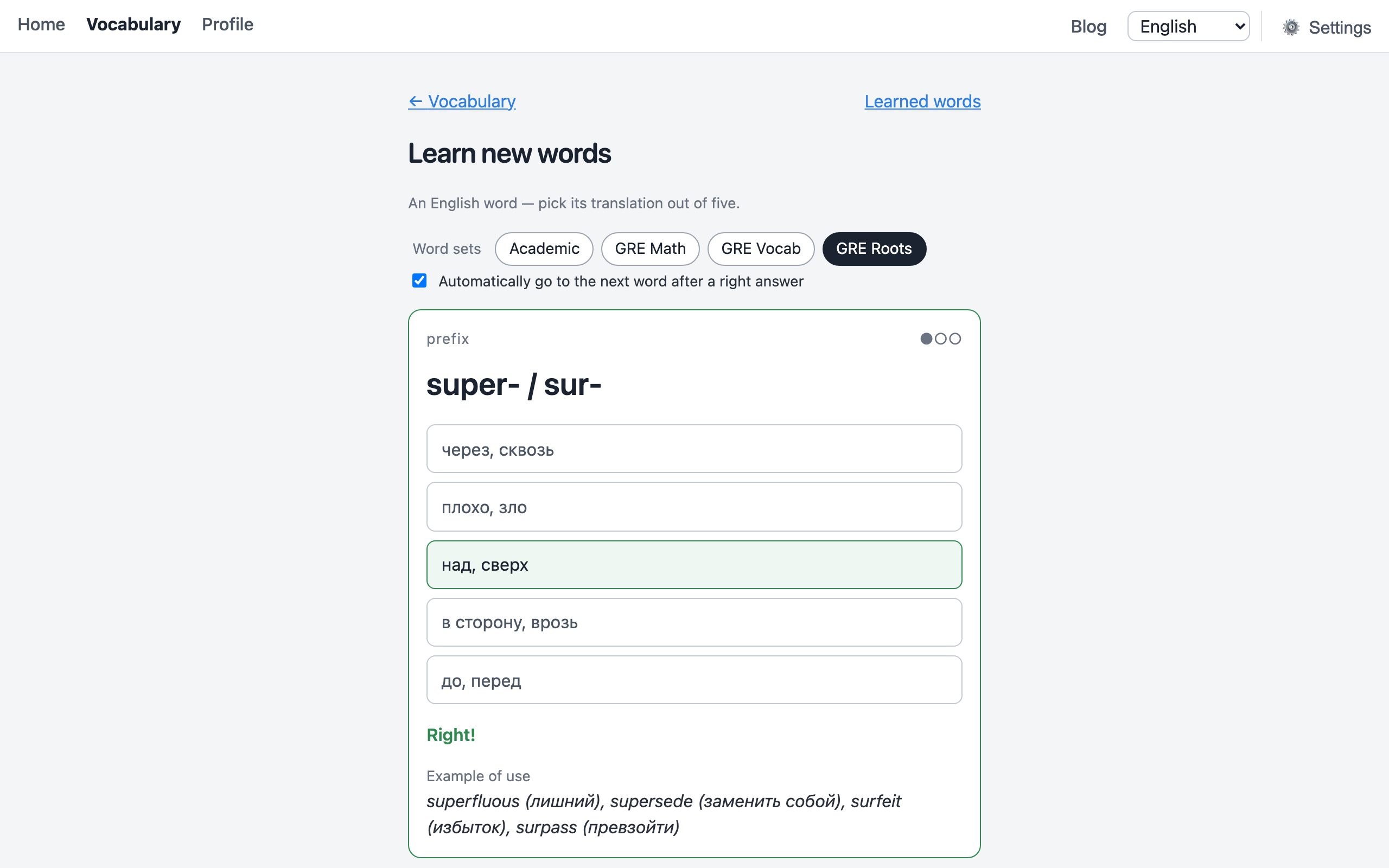
- Learn new words and Reverse are the main modes for roots. Spell it is not needed for them.
- Turn them on together with GRE Vocab. Roots cut off from words are forgotten. When root cards and word cards come mixed, you see a root at work straight away: learn ten, and a couple of cards later there is tenacious.
- Read the examples. After answering, stay on the example line for a couple of seconds and try to take one of those words apart. If there is no time, untick the automatic move to the next word.
- With every new GRE word ask yourself: what is it made of? That habit is what works in the exam.
Who needs the GRE, how the exam works and what other sets the trainer has — in GRE in Tilmashq: the GRE Math, GRE Vocab and GRE Roots sets in the vocabulary trainer.
Read next
- GRE in Tilmashq: the GRE Math, GRE Vocab and GRE Roots sets in the vocabulary trainer
- How to make your commute count: IELTS vocabulary with no internet
Updated: 2026-09-23