Articles
How to prepare for IELTS Academic: format, scoring and practical advice.
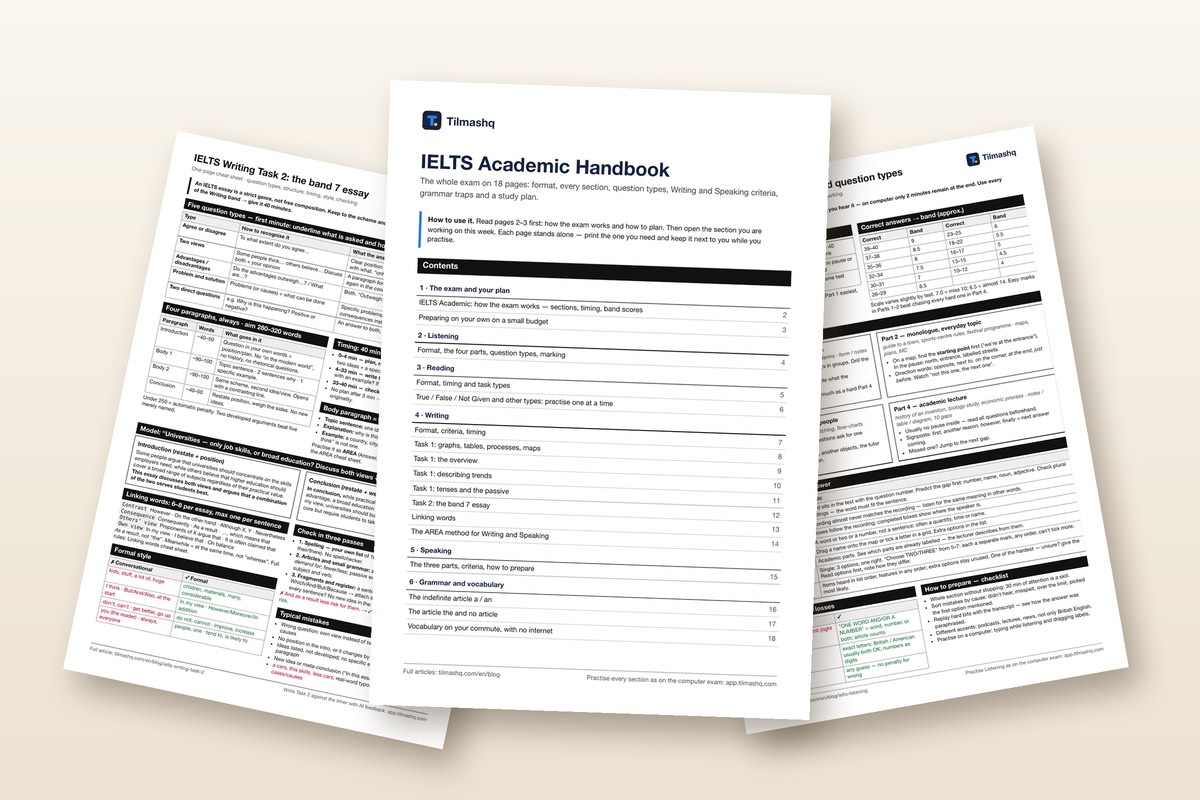
Short IELTS preparation guide PDF: the whole exam on 18 pages — Listening, Reading, Writing, Speaking and a study plan, free download
A simple IELTS Academic prep guide in one free PDF: format and timing, every Listening and Reading question type, Writing Task 1 and Task 2 by the criteria, Speaking, articles and a 4-week study plan. In English, Russian and Uzbek.

IELTS Academic: how the exam works and what to read for each section
The whole exam on one page: four sections, timings, the order of the test day, how answers turn into a band and how the overall score is calculated. Plus a map of the blog: where to start for Listening, Reading, Writing and Speaking, and how to plan your preparation.
Rewrite my IELTS essay at a higher band: see your own Writing at band 6, 7, 8 and 9, with the reason for each score
A new feature in the free Tilmashq IELTS simulator: AI rewrites your own Writing essay at the band you pick (6 to 9) and explains why it earns that score. Every version is saved, so you can switch and compare. How to use it, what it costs and what it cannot do.

The article the in IELTS: every rule with examples, when no article is needed, an exercise with answers and a free trainer
The definite article for learners whose first language has no articles: general ideas with no article and specific ones with the (society vs the society), second mention, one of a kind, superlatives, the number of vs a number of, the elderly, names of countries and rivers, go to school vs the school. The in Writing Task 1. A three-question check and an exercise with answers.

Grammar for IELTS Writing Task 1: which tense to use, the passive in processes and maps, Present Perfect, an exercise with answers
The minimum grammar for Writing Task 1: Past Simple for graphs with past years, Present Simple for processes and diagrams with no dates, Present Perfect for “then and now” maps, Future Simple and is expected to for forecasts, active and passive in a process. Irregular trend verbs (rise/rose/risen), the mistakes has rose, was increased, is happened. A three-question check and an exercise with answers.

A/an article exercises with answers: 15 IELTS sentences and a free trainer
An exercise on the indefinite article a/an with answers and explanations: 15 sentences from essays, Writing Task 1 and Speaking — jobs, descriptions, numbers and frequency, trends, a or an by sound, uncountable nouns, a few and few. 55 more in the free Tilmashq trainer with drag and drop and instant checking.

The article a/an in IELTS: every rule with examples, an exercise with answers and a free trainer
A/an for learners whose first language has no articles: when it is required, when it is wrong, a or an by sound, jobs and descriptions, uncountable nouns (information, advice, research), numbers and frequency (a hundred, twice a week), a few vs few, fixed phrases, trends in Writing Task 1. A three-question check and an exercise with answers.

GRE in Tilmashq: the GRE Math, GRE Vocab and GRE Roots sets in the vocabulary trainer
IELTS is done, and the master's programme also asks for the GRE. Who needs it, how GRE Verbal differs from IELTS, and how to train GRE vocabulary in Tilmashq with three word sets — even offline.

GRE word roots: how to guess an unknown word intelligently, not randomly
Five options in a GRE task, and not one familiar word. Latin and Greek roots help cut the extras: your chance goes from 20% to 50% and more. A worked example and the GRE Roots set in Tilmashq.

Linking words in IELTS Writing: where however and therefore belong, a paragraph rewritten and typical mistakes
Linking words in IELTS Academic Writing: the three grammatical types (However, although, despite) and a sentence pattern for each, punctuation with however, common mix-ups like despite of and although… but, cohesion without linkers through this and synonyms, and how many linkers an essay and Task 1 really need. An overloaded paragraph rewritten, plus typical mistakes.

How to describe trends in IELTS Writing Task 1: sentence patterns, prepositions and a worked graph with a full answer
How to describe changes on graphs in IELTS Academic Writing Task 1: four sentence patterns and when to use each, prepositions with numbers, how strong a change is, line shape, peaks and crossovers, multiples and percentage points. One line graph worked through, a full answer and common mistakes.

The overview in IELTS Writing Task 1: how to find the main features of a graph in two minutes, with a worked example
How to write the overview in IELTS Academic Writing Task 1: six questions to ask the chart in two minutes, how to spot the overall trend, highs and lows, peaks and changes of leader, how to group the data and fit it all into two sentences with no numbers. A worked line graph, frames and common mistakes.

How to build an answer in IELTS Writing Task 2 and Speaking: the AREA method with examples and free practice
AREA — Answer, Reason, Example, Answer again — is a simple scheme for a developed answer. How it works in Task 2 body paragraphs and in Speaking Part 3, where a shorter version is enough for Part 1, which mistakes it fixes, and how to practise it in Tilmashq.

IELTS question types: practise True/False/Not Given and other formats one at a time, free 5-minute drills
How to practise IELTS question types one at a time: why a full test score does not explain mistakes, what drilling one format (True/False/Not Given, matching headings, completion) gives you, how the free Tilmashq mini-drills work with a reason under every question, no timer and offline, and how to fit them into preparation.

IELTS vocabulary offline: a trainer for your commute with no internet and how to learn in 15 minutes a day
How to learn IELTS vocabulary on the road: what not to do on a phone in the metro, why words are the one thing that fits a commute, how the Tilmashq vocabulary trainer works offline, and how to fit it into the week.

IELTS Writing: format, criteria, timing and how to prepare
How the Writing section of IELTS Academic works: two tasks, word minimums, weighting, the four marking criteria, what the computer format changes, how to split the 60 minutes, how to learn vocabulary and where to get feedback.

IELTS Writing Task 1: how to describe graphs, tables, processes and maps, a band 7 sample and where to practise with feedback
A detailed guide to Task 1 in IELTS Academic Writing: seven task types, a four-paragraph structure, a 20-minute plan, verb tenses, four sentence patterns, vocabulary for trends and shares, a band 7 sample answer and typical mistakes.

IELTS Writing Task 2: how to write a band 7 essay, structure, samples and essay checking against the criteria
A detailed guide to Task 2 in IELTS Academic Writing: the five question types and what each requires, a 40-minute plan, a four-paragraph structure, how to build a body paragraph, sample introduction and conclusion, linking words by function, formal style, a 5-minute check and typical mistakes.

IELTS Listening: format, parts, every question type and where to take a computer-delivered practice test
A detailed guide to computer-delivered IELTS Academic Listening: the four parts and what you hear in each, timing, how the band is calculated, every question type and how to answer it.

IELTS Reading: format, the three passages, all 14 task types with screenshots and where to practise
A detailed guide to computer-delivered IELTS Academic Reading: how to split the time between passages, how the three passages differ, how paraphrase works in the questions, all 14 task types with screenshots and tactics for each, the band table and a preparation plan.

IELTS Speaking: format, the three parts, criteria and how to practise on your own
A detailed guide to IELTS Speaking: how long the interview lasts, what is asked in Parts 1, 2 and 3, how to prepare a cue-card answer in one minute, the four assessment criteria and what really separates 6.0 from 7.0, plus working methods for preparing on your own.

Computer-delivered IELTS practice tests: what they train and where to take them for free
IELTS practice tests for self-study: why good English alone does not give a high band, the four things a mock test trains (timing, question types, answer format, stamina), what surprises the computer-delivered format holds, five rules for effective practice and where to find tests in the computer format.

IELTS self-study plan: how to prepare on your own from scratch on a small budget
A step-by-step IELTS self-study plan with free resources: work out the band you need, take one full practice test, pick one resource per skill, build a simple week, what not to cut corners on and how not to drown in materials.


