IELTS Writing Task 2: how to write an essay for band 7
Task 2 carries two thirds of the Writing band and deserves 40 minutes. The good news: an IELTS essay is not free composition but a strict genre with a clear scheme. Whoever keeps to the scheme gets 6.5–7.0 without rare words. Below is the whole mechanism: question types, a plan, the structure of each paragraph, examples, linking words, style, checking and typical mistakes. The overall format of the section and the criteria are covered in IELTS Writing: format, criteria, timing and how to prepare.
What the task looks like
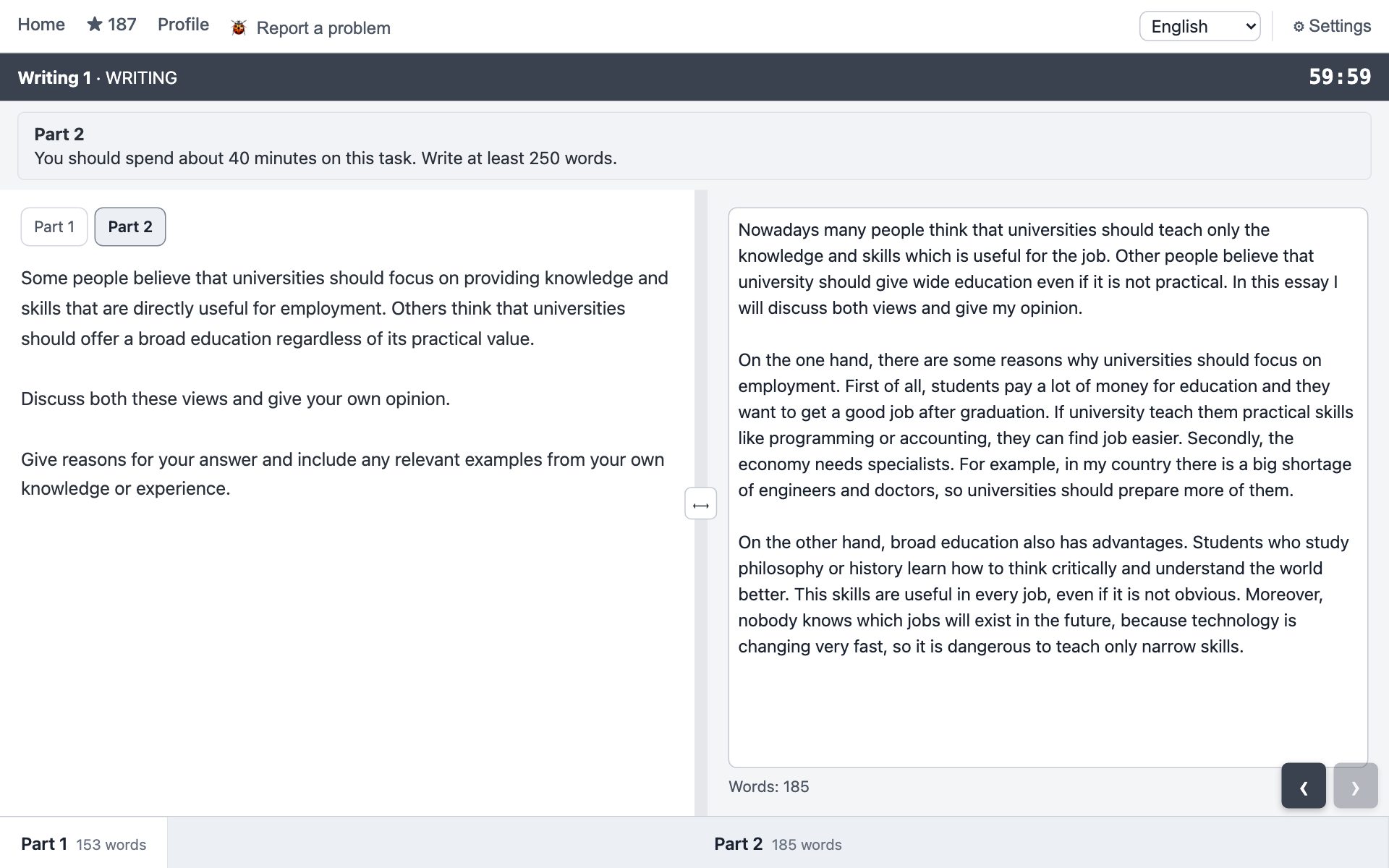
The task is always built the same way. First a short statement on a general topic: education, work, technology, cities, the environment, health, family, media. Then the question you have to answer. At the end, a request to give reasons and examples from your own knowledge or experience. Minimum 250 words, recommended time 40 minutes.
The topic is always one that any adult can discuss without specialist knowledge. The examiner does not care what you think; what matters is how clearly you said it and supported it.
Five question types
| Type | How to recognise it | What the answer must contain |
|---|---|---|
| Agree or disagree | You are asked to what extent you agree with a statement | A clear position from the first paragraph and arguments for that position. You may agree partly, but then say with what exactly. The words “only”, “all”, “always” in the statement are an invitation to argue with them. |
| Two views | “Some people think… others believe…”, discuss both and give your own opinion | A paragraph for each view, presented fairly, plus your own opinion, stated in the introduction and repeated in the conclusion. |
| Advantages and disadvantages | Do the advantages outweigh the disadvantages, or simply “what are the advantages and disadvantages” | Both. If asked “do they outweigh”, you need a “yes” or “no” and an explanation of why. |
| Problem and solution | What problems does this cause and what can be done, or causes and solutions | Specific problems (or causes) and specific solutions that are linked to each other: the solution answers the problem you named. |
| Two direct questions | For example “why is this happening” and “is it a positive or negative development” | An answer to both questions, usually a paragraph for each. |
The most common reason for a low band on the first criterion is answering the wrong question. In a two-views task people write only their own view. In problems and solutions they describe consequences instead of causes. They miss the word “only” in the statement and agree with everything. Spend the first minute underlining in the question what exactly is being asked and how many parts the question has.
Structure: four paragraphs, always
| Paragraph | Words | What goes in it |
|---|---|---|
| Introduction | ~40–50 | Two or three sentences: the question in your own words and your position or plan. No “in the modern world”, no history of the issue, no rhetorical questions. |
| Body 1 | ~90–100 | The first sentence names the idea of the paragraph. Two sentences explain why this is so. One sentence gives a specific example. |
| Body 2 | ~90–100 | The same scheme for the second idea or the second view. Starts with a contrasting link. |
| Conclusion | ~40–50 | Restate the position and weigh the sides. No new ideas: if an argument comes to mind at the end, it belongs in the body. |
Aim for 280–320 words. Under 250 is an automatic penalty that wipes out all the quality. Much more is not needed either: every extra sentence is one more possible error for the same content. Two developed arguments beat five that are merely named.
For a two-views question some people add a separate paragraph with their own opinion as the third body paragraph, making five in total. That is acceptable, but the scheme “two bodies and a conclusion with an opinion” is easier to hold in 40 minutes.
The body paragraph: idea, explanation, example
A body paragraph is one idea developed to the end. The frame:
- Topic sentence. One idea, stated directly: Supporters of job-focused degrees point out that students expect a return on their investment.
- Explanation. Two sentences answering “why is this so” and “what follows from it”.
- Example. One or two sentences with something specific: a country, a city, a case, a well-known phenomenon. “Many people think” does not count as an example.
- Optionally a bridge to the next paragraph or a short consequence.
An example is cheap words. A sentence like For instance, the London Underground allows residents of the outer districts to reach the centre in half an hour adds twenty words and a point on the first criterion without requiring any new ideas. The example does not have to be textbook truth; a plausible case from your country or experience is enough.
Timing: 40 minutes
- 0–4 min. A plan, not text. Underline the question. Decide your position. Write down two ideas and a specific example for each. The first city or country that comes to mind will do. From then on you are not inventing thoughts but expanding a plan: the time goes on writing, not on thinking.
- 4–33 min. Write from the plan. Introduction, body 1, body 2, conclusion. At minute 20, a check: is the first body finished? does it have an example? If not, insert it now, not “later”.
- 33–40 min. Check in three passes, a minute and a half to two minutes each, described below.
If the plan will not come together after three minutes, take a simpler position. The examiner marks clarity, not originality: “both approaches are useful, but the second matters more” is a perfectly good position for 7.0.
How to write each paragraph
Introduction
Two sentences. The first is the statement from the task in your own words, not a copy. The second is your position or plan: This essay argues that… / This essay discusses both views and argues that… / While X has clear benefits, I believe its drawbacks are more serious. The examiner must see your opinion already in the introduction.
Topic: some people think universities should teach only what will be useful at work, others think education should be broad. Discuss both views and give your own opinion.
Some people argue that universities should concentrate on the skills employers need, while others believe that higher education should cover a broad range of subjects regardless of their practical value. This essay discusses both views and argues that a combination of the two serves students best.
Body
Supporters of job-focused degrees point out that students invest years and considerable sums of money in their education and expect a return in the form of employment. If a programme teaches accounting or software development directly, graduates enter the labour market with skills they can use from the first day. In Uzbekistan, for example, IT graduates with practical portfolios find work far more quickly than those whose studies were purely theoretical.
On the other hand, a broad education develops abilities that no single profession can provide. Students who study history or philosophy learn to evaluate evidence and construct arguments, and these skills remain useful when specific technologies become outdated. Many programmers trained ten years ago now work with tools that did not exist when they graduated, and it is their general ability to learn, not the particular language they studied, that keeps them employed.
Take the first paragraph apart by the scheme: the first sentence names the idea, the second explains the mechanism, the third gives a specific example with a country. The second paragraph opens with a contrasting link and is built the same way, except that the example here is not a country but a well-known phenomenon.
Conclusion
Starts with In conclusion or On balance, restates the position in different words and weighs the sides. Not a single new idea.
In conclusion, while practical training gives graduates an immediate advantage, a broad education protects them over a whole career. In my view, universities should build degrees around a professional core but require students to take courses outside their field.
Linking words by function
You need six to eight linking words per essay, at most one per sentence. An essay where every sentence starts with “Moreover” or “Furthermore” reads like a memorised template, and the coherence band falls rather than rises.
| Function | Linking words |
|---|---|
| Contrast | However, … / In contrast, … / On the other hand, … / While it is true that X, Y / Although X, Y / Admittedly, … / Nevertheless, … |
| Consequence | Consequently, … / As a result, … / Therefore, … / …, which means that … |
| Addition | Moreover, … / Furthermore, … / In addition, … / Not only does X…, but it also … |
| Other people's view | Advocates / Proponents of X argue that … / Supporters of this view point out that … / It is often claimed that … |
| Example | For instance, … / A clear example of this is … / This is evident in … |
| Concession | Admittedly, … / It is true that …, but … / Even if … |
| Your own view | In my view, … / From my perspective, … / I believe that … / On balance, … |
| Summing up | In conclusion, … / To conclude, … / Overall, … |
Small things that lose marks: As a result takes “a”, not “the”. Meanwhile means “at the same time”, not “whereas”. However at the start of a sentence is followed by a comma and begins a new sentence; it does not continue the previous one after a semicolon.
Formal style
| Conversational | Formal |
|---|---|
| kids, stuff, thing, a lot of, huge | children, materials, factor / issue, many / a great deal of, considerable |
| I think | In my view, I believe that |
| But, … / And, … / Also, … at the start of a sentence | However, … / Moreover, … / In addition, … |
| don't, can't, it's | do not, cannot, it is |
| get better, get worse, go up | improve, deteriorate, increase |
| let's say, thru, gonna | for example, through, going to |
| you (addressing the reader) | people, individuals, one |
Rhetorical questions, irony in inverted commas and addressing the reader are out. Your own opinion can and should be expressed when it is asked for: I believe / In my view are perfectly formal. Soften your claims: tend to, is likely to, in many cases sound more academic than “always” and “everyone”.
Checking in the last 5–7 minutes
Three passes, each with its own job. A single pass “for everything at once” finds half as much.
- Spelling against your own list. Everyone has 10–15 words they consistently misspell: government, believe, conclusion, environment, which, their / there. There is no spellchecker in the exam. Look for your own words specifically.
- Articles and small grammar. Every singular countable noun: where is its article? demand for, not “on”; fewer with countables, less with uncountables; the passive with the third form; no comma between subject and verb.
- Sentence fragments and register. Does a sentence start with “Which”, “And”, “But” or “Because”? Attach it to the previous one with a comma. Does every sentence have a finite verb? Does the conclusion contain no new idea?
What a fragment is. A sentence must answer “who?” and “does what?”. And as a result less risk for them has no verb at all. Which might not be true has a verb, but “which” makes it a subordinate clause with no main clause. The fix: As a result, they face a lower risk. …success in life, which might not be true for many.
Typical mistakes
This list was collected from real essays over a month of preparation: the mistakes recur for most people and cost more than they seem to.
- Answering the wrong question. Your own view instead of two, consequences instead of causes, the second part of the question missed.
- The position is not stated in the introduction or changes by the end.
- Too few words. 218 words with excellent argument is a penalty that wipes out the quality. 250 is the minimum, 280 the target.
- Ideas listed without development. Five arguments of one sentence each are worse than two arguments with an explanation and an example.
- Not a single specific example.
- Both views in one paragraph. In a two-views essay the first body contains both points of view at once, and the structure breaks.
- A journalistic tone. Scene-setting in the introduction (“in today's fast-changing world”), rhetorical questions, irony, “you”, contractions.
- Sentence fragments. “Which means that…” and “And as a result…” as separate sentences.
- Too many linking words or links with the wrong meaning: “Meanwhile” instead of “However”.
- A new idea in the conclusion.
- A meta-conclusion. “In this essay we discussed…” restates the structure instead of the position.
- Articles and agreement. “a cars”, “this skills”, “university teach”, “less cars”. The errors are small, but there are many and they are systematic.
- Spelling. Especially mistakes that produce a real word: “carer” instead of “career”, “cases” instead of “causes”. The eye does not catch them; only a deliberate search does.
How to practise Task 2
Two essays a week, 40 minutes against a timer, without a dictionary and without a spellchecker, rotating the question types. Pick an uncomfortable topic: familiar topics pull you into journalism, unfamiliar ones force you to keep to the scheme. After every essay, add the spelling mistakes to your list and choose at most three things to fix in the next one. Every two or three weeks it helps to see your own essay rewritten one band higher: your own text raised to 7.5 teaches faster than any theory.
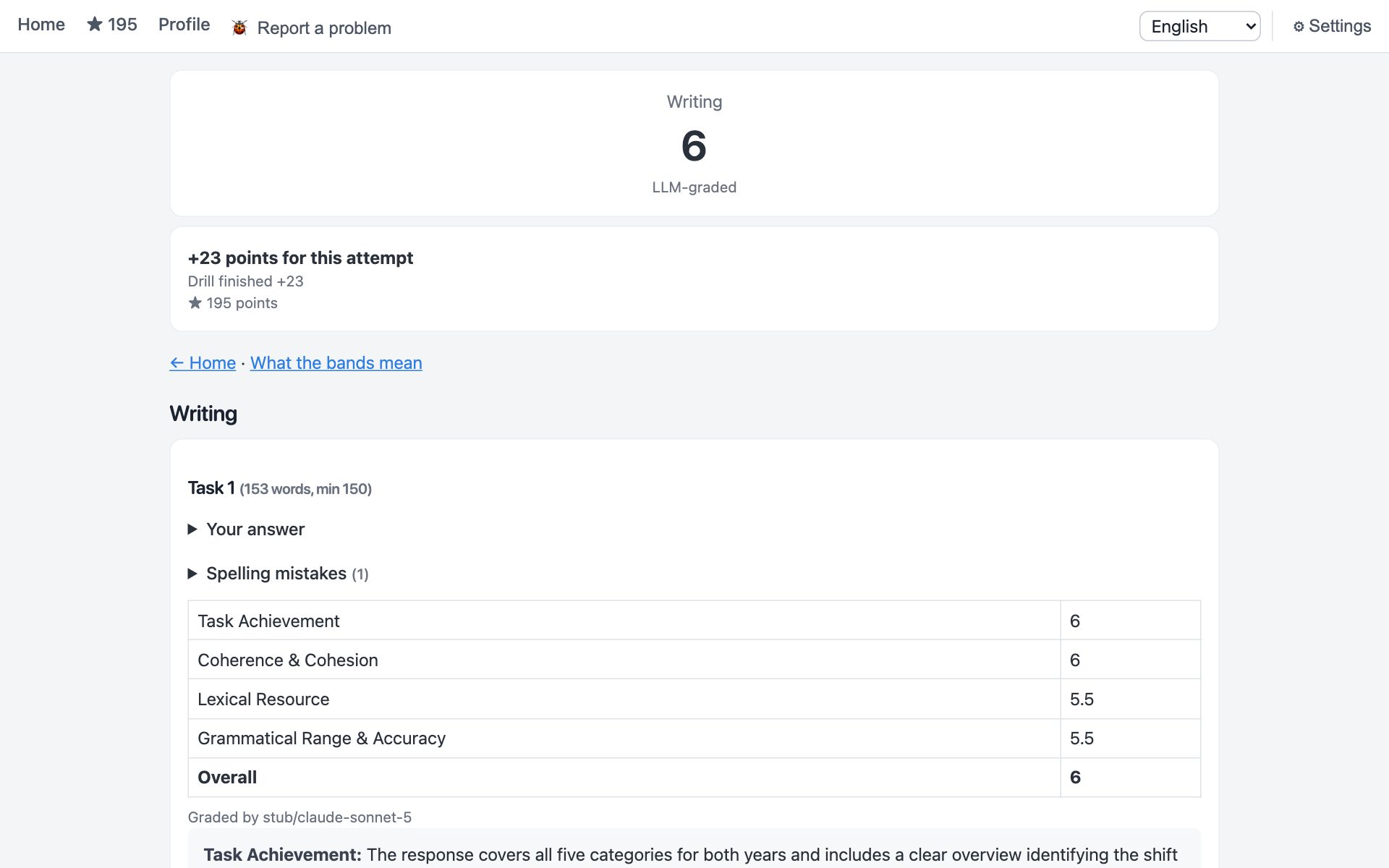
Tilmashq has all five Task 2 types on a screen like the exam one. After your answer you get a band for the four criteria, a list of spelling mistakes, a commentary with quotations and corrections, and a version of your essay rewritten to the target band. The marking is done by AI, on average stricter than an examiner, so read the band as “not lower than”. The tasks are our own, not from the exam.
Read next
- IELTS Writing: format, criteria, timing and how to prepare
- IELTS Writing Task 1: how to describe graphs, tables, processes and maps
- How to start preparing for IELTS on your own on a small budget
- IELTS Listening: format, parts, timing and every question type
- IELTS Reading: format, the three passages, timing and every task type
- IELTS Speaking: format, the three parts, criteria and how to prepare
Updated: 2026-09-16