
The AREA method: how to build an answer in IELTS Writing and Speaking
The most common weak paragraph in IELTS looks like this: a claim, then straight into a story. Or a claim and a reason, with nothing to show it. The English can be decent and the Task Response and Coherence marks still stick at 6. AREA is a four-step scheme that closes that gap. It works the same on paper and out loud: in the body paragraphs of an essay and in Speaking Part 3 answers.
What AREA is
| Letter | What it does | The question it answers |
|---|---|---|
| Answer | The main point, tied directly to the question | What do you think? |
| Reason | Explains why it is true — the mechanism, not the same idea in other words | Why? |
| Example | One specific, believable case that shows the reason | What does it look like in real life? |
| Answer again | Back to the question: the point is proved | So what? |
The last letter is taught in two ways. In a written paragraph it is a return to the point. In speech it is often Alternative — a short nod to the other side. Both are covered below: they do not contradict each other, they suit different kinds of answer.
One caveat: AREA is a teaching scheme, not an exam requirement. The examiner is not looking for four letters. They mark whether the idea is developed, whether the sentences connect and whether the answer addresses the question. AREA is simply the shortest route to all three.
Writing: body paragraphs 1 and 2 in Task 2
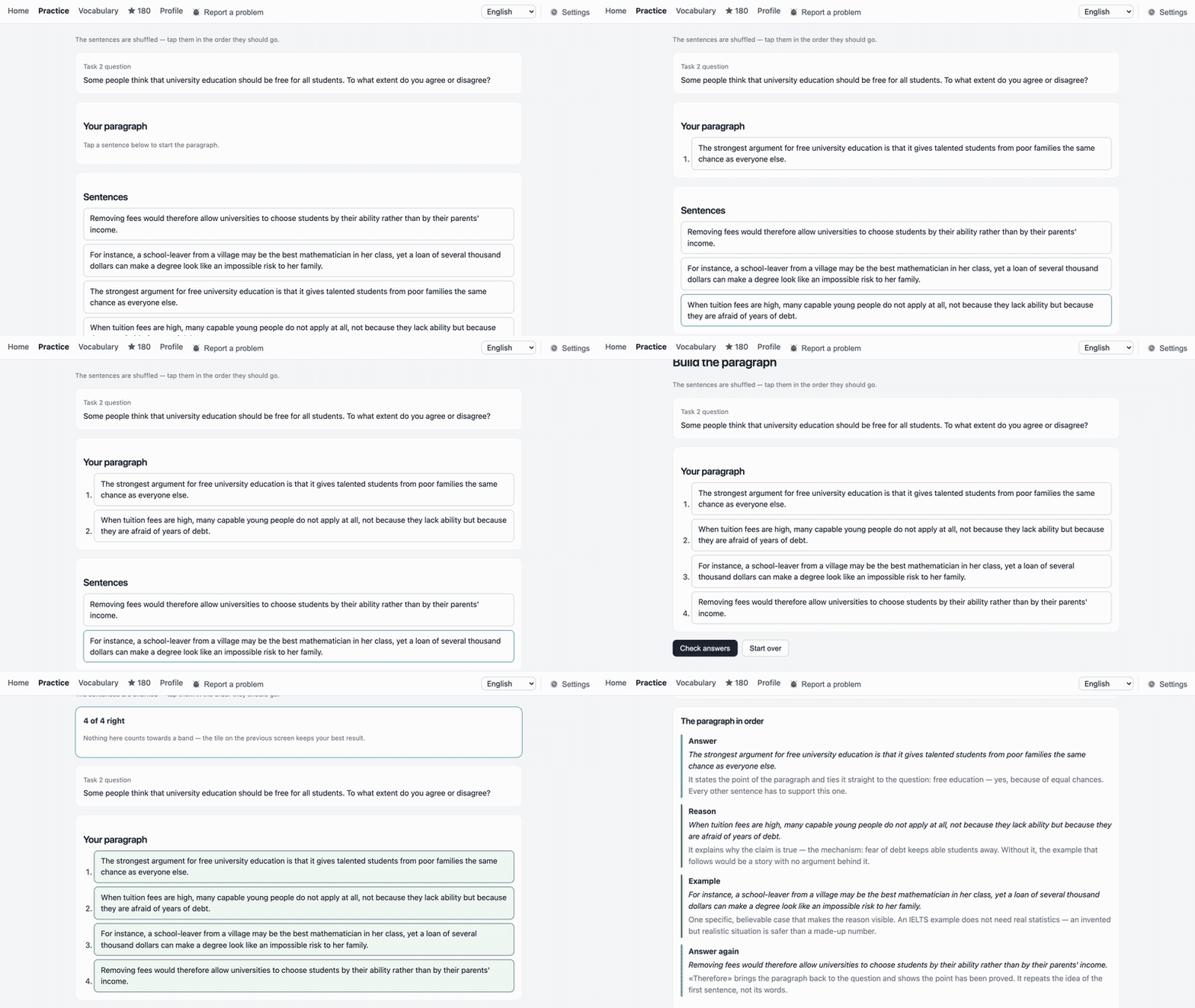
In a four-paragraph essay the scheme belongs in both body paragraphs — one idea per paragraph. Here is a paragraph for the question «Some people think that university education should be free for all students. To what extent do you agree or disagree?»:
- Answer: The strongest argument for free university education is that it gives talented students from poor families the same chance as everyone else.
- Reason: When tuition fees are high, many capable young people do not apply at all, not because they lack ability but because they are afraid of years of debt.
- Example: For instance, a school-leaver from a village may be the best mathematician in her class, yet a loan of several thousand dollars can make a degree look like an impossible risk to her family.
- Answer again: Removing fees would therefore allow universities to choose students by their ability rather than by their parents' income.
Four sentences, about 90 words — exactly the body paragraph length described in IELTS Writing Task 2: how to write an essay for band 7.
The mistakes AREA fixes in writing:
- An example instead of a reason. A claim, then a story about a friend. Without the Reason the example proves nothing; it is just an anecdote.
- A reason with no example. The paragraph sounds right but stays abstract. The examiner sees the idea but not that you developed it.
- A «general» example. For example, many people… is not an example, it is another generalisation. An example is one person, one place, one situation.
- An invented statistic. Nobody can check facts in the exam. A believable situation is safer than a made-up percentage.
- A sentence on the topic but off the point. The sneakiest one: a sentence about universities in a paragraph about universities that does not support the paragraph's point. It costs marks under Coherence and Cohesion.
Speaking: all of it in Part 3, a shorter version in Part 1
Part 3 is where AREA matters most in speech. The questions are general, about society, and a yes-or-no answer is the direct road to 6.0. The examiner expects reasoning of four to six sentences, and without it asks «Why?» or «Can you give an example?» — a sure sign the answer was too short.
Question: Should university education be free? An answer built on the scheme:
- Answer: I think it should, at least for students who can't afford it.
- Reason: Otherwise a lot of clever young people simply don't apply, because the idea of a big loan scares their families.
- Example: I know a guy from my school who was brilliant at physics, but he went straight to work because his parents couldn't take that risk.
- Alternative: Of course, someone has to pay for it, so maybe it should depend on the family's income rather than being free for everyone.
In speech the last A is a caveat, not a repeat. It sounds natural and shows what earns a high band in Part 3: seeing both sides. It is the same «position → reason → example → caveat» plan described in IELTS Speaking: format, the three parts, criteria and how to prepare. A personal example is fine in Part 3 as long as it illustrates the general idea rather than replacing it.
Part 1 is short questions about you. Full AREA turns into a monologue there, and Part 1 needs a conversation. A shorter ARE is enough: answer, reason, a touch of example — two or three sentences. Do you like cooking? — Yes, quite a lot. It helps me switch off after work. Last weekend I tried making plov for the first time, and it actually turned out well.
Part 2 is a talk from a cue card, and a different tool does the work there: the points on the card itself. AREA helps at most in the last sentence, when you explain why it mattered.
Why it is easier to practise on paper
The scheme is the same, but on paper you can see it. A sentence can be marked, labelled and checked for the gap: no example, a reason that repeats the answer, a sentence that has drifted. In speech the same thing is blurred by pauses and linking words, and a missing step is hard to notice even on a recording. So the order is: learn and drill the scheme in Writing, then carry it into Speaking — answering Part 3 questions in writing first, then out loud.
How it works in Tilmashq
The Practice section has a block called «Writing: paragraph structure (AREA)». The exercises are built on Task 2 body paragraphs, and every sentence comes with an explanation of why it is where it is.
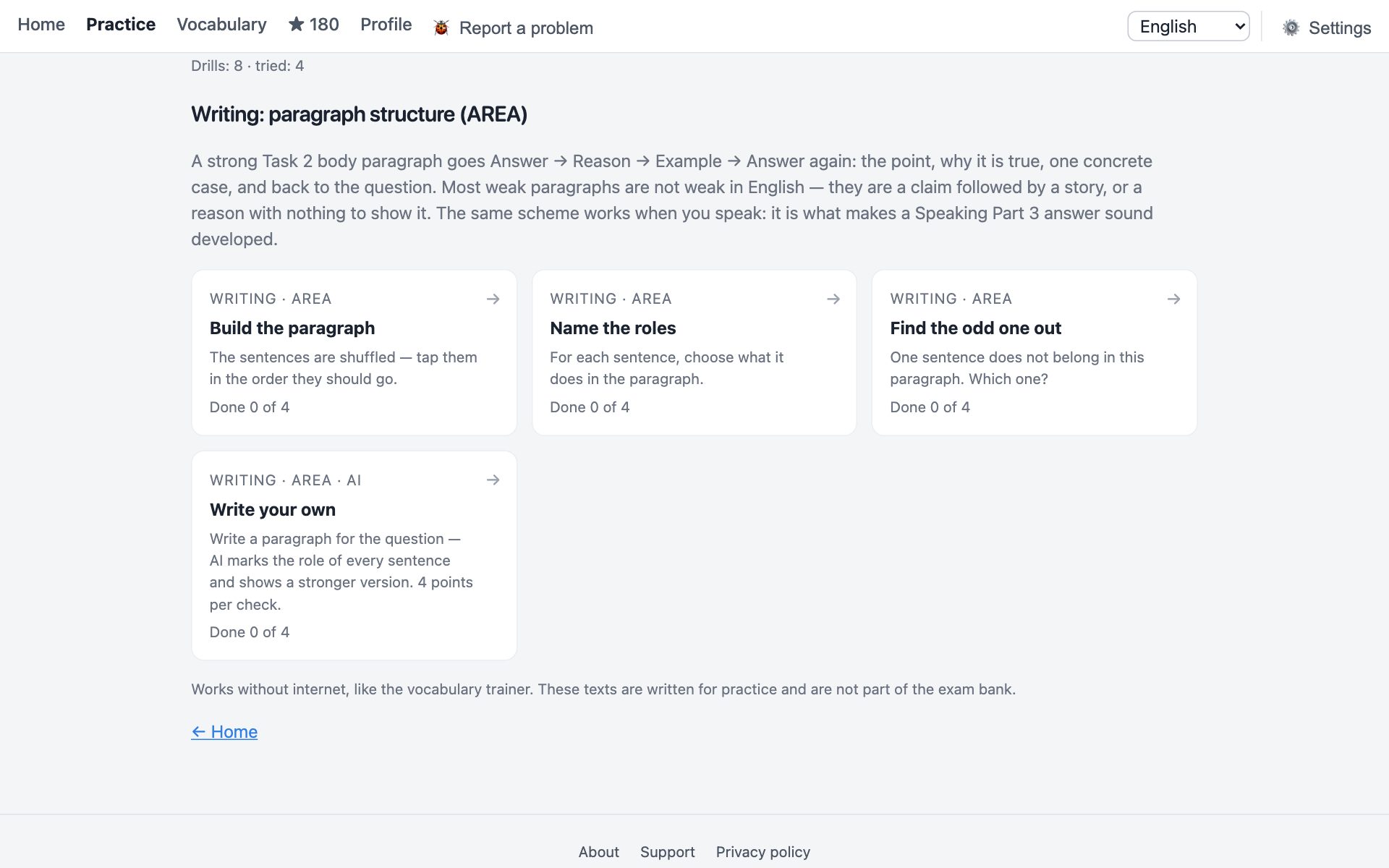
- Build the paragraph. The sentences are shuffled — tap them in the right order.
- Name the roles. For each sentence choose what it does: Answer, Reason, Example or Answer again.
- Find the odd one out. One sentence does not belong. In half of the paragraphs it is deliberately on the topic but off the point — exactly where marks are lost.
- Write your own. You write a paragraph for the question; the AI marks the role of each sentence, shows which AREA parts are missing and rewrites the paragraph with your own ideas. No band: one paragraph is not an essay.
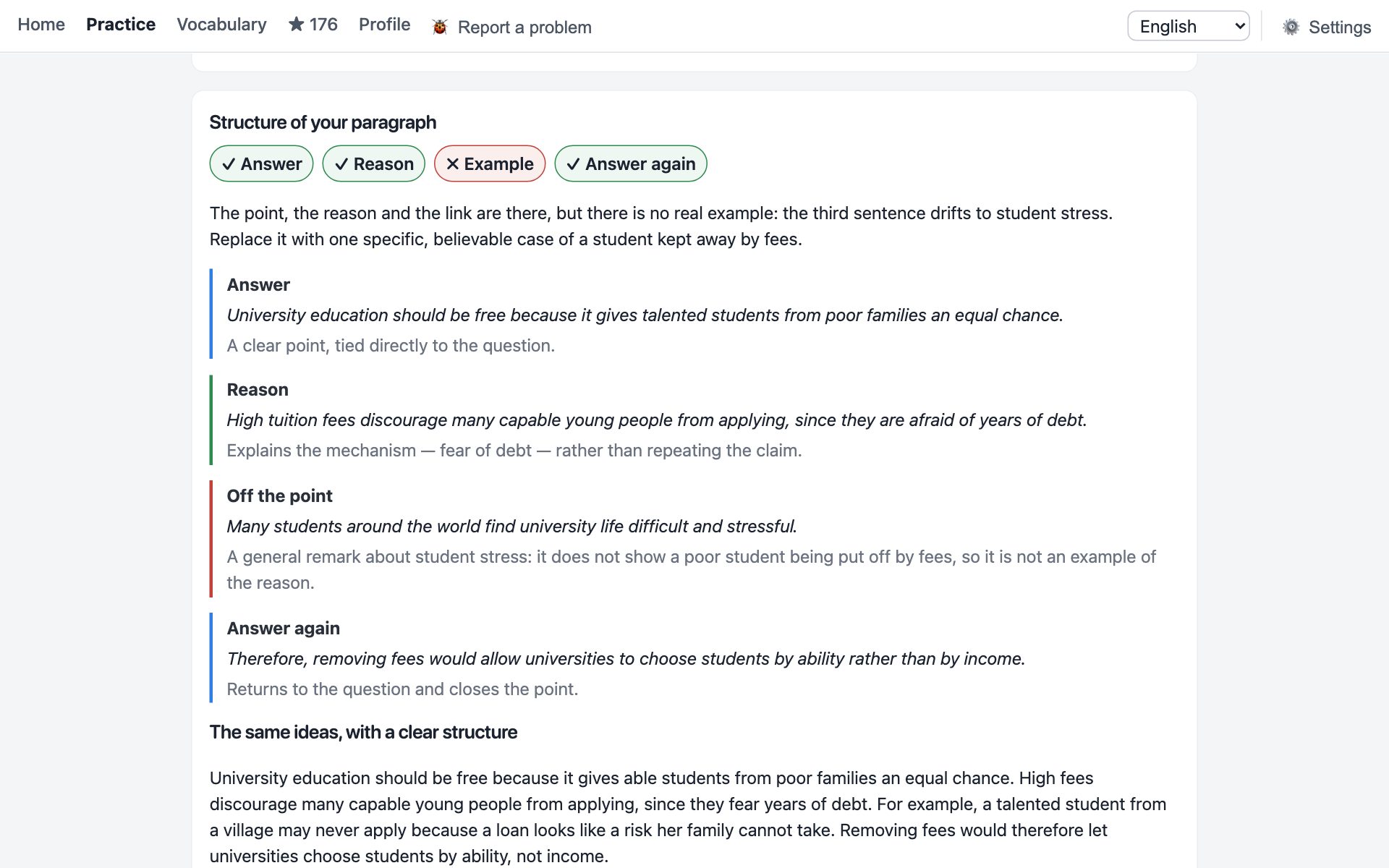
The first three exercises are free and work offline. Checking your own paragraph costs 4 points: the text is sent to AI for review via OpenRouter, so consent is asked before the first check. Tilmashq stores neither the paragraph nor the result — they stay only in your browser.
An honest limit: the AI sees structure well, but it is not an examiner. It names a sentence's role confidently, and in borderline cases — an example on the edge of a generalisation, say — it can be wrong either way.
How to practise AREA
- Start with Name the roles. Until you can see the scheme in someone else's paragraph, writing your own to it is hard.
- Then Find the odd one out. It teaches you to check each sentence against the paragraph's point, not against the essay's topic.
- Every few days, write your own for a Task 2 question. First without help, then compare with the rewrite.
- For Speaking, one Part 3 question a day: an answer to the scheme in writing, then out loud without looking. After a couple of weeks the scheme starts to kick in on its own.
Read next
- IELTS Academic: how the exam works and what to read for each section
- IELTS Writing Task 2: how to write an essay for band 7
- IELTS Speaking: format, the three parts, criteria and how to prepare
- IELTS Writing: format, criteria, timing and how to prepare
- True/False/Not Given and the other question types: practise them one at a time
Updated: 2026-09-16