IELTS Writing: format, criteria, timing and how to prepare
Writing is most often the weakest section: Listening and Reading largely take care of themselves, but in one hour of writing you have to describe a chart and produce an essay by rules nobody ever explained. This article covers the whole format in order: what to write and in how many minutes, which criteria decide the band, how to split the hour and where to start preparing. Each task has its own detailed guide: Task 1, describing a chart and Task 2, the essay.
Two tasks in 60 minutes
Writing gives you 60 minutes and two tasks. There is no separate timer for each: you decide when to move from the first to the second, and you can go back. That is exactly why the biggest mistake in the exam is to linger over the chart and leave twenty minutes for the essay.
| Task | What to write | Minimum words | Recommended time | Weight in the band |
|---|---|---|---|---|
| Task 1 | A description of a chart, table, process diagram or map | 150 | 20 minutes | one third |
| Task 2 | An essay with arguments on a given topic | 250 | 40 minutes | two thirds |
Task 2 counts twice as much as Task 1. If you get 6.0 for the chart and 7.0 for the essay, the result rounds to 6.5, and the other way round is also 6.5, but the chart will cost you noticeably more effort. So when time runs short, it is the essay that saves you.
In Task 1 you are expected to report what is shown: the overall picture and the key figures, with no reasons or opinions. In Task 2 you are expected to give a clear position on the question, two or three developed arguments with examples, and a conclusion. These are different genres with different grammar, and they need to be prepared separately.
The four marking criteria
Each task is marked on four criteria, all weighted equally, and the band for the task is their average. Below is our own summary, not the official wording; the descriptors themselves are published on the IELTS website.
| Criterion | What earns the marks |
|---|---|
| Task Achievement (Task 1) / Task Response (Task 2) | Whether you answered what was asked. In Task 1: there is an overview and key figures, and every category is mentioned. In Task 2: a clear position, developed arguments, examples, and an answer to every part of the question. The penalty for too few words sits here too. |
| Coherence and Cohesion | Logic and flow: paragraphs with one idea each, a clear order, linking words where they belong rather than in every other sentence, references back to earlier points without repetition. |
| Lexical Resource | Vocabulary: precise words, natural collocations, variety without straining, spelling and word formation. |
| Grammatical Range and Accuracy | Grammar: different sentence types, correct tenses, articles, agreement, punctuation. Both variety and the proportion of error-free sentences count. |
The practical conclusion: impressive words earn a quarter of the band, whereas too few words, no position in the essay or a missing overview in the chart description knock out a whole criterion at once. Complete the task first, then polish it.
It helps to know what separates a 6 from a 7. At 6 the task is broadly done but with gaps: there is an overview, but it contains figures and inaccuracies; arguments are named but not developed; linking words are present but mechanical; errors are noticeable although the meaning is clear. At 7 everything that was asked for is fully done, the paragraphs are logical, the words are precise with only occasional slips, and most sentences are error-free. The difference lies not in rare words but in completeness and care.
What the computer format changes
More and more people take IELTS on a computer, and Writing gains from this more than any other section: typing is faster than handwriting, and the text can be edited. But there are features you need to get used to in advance.
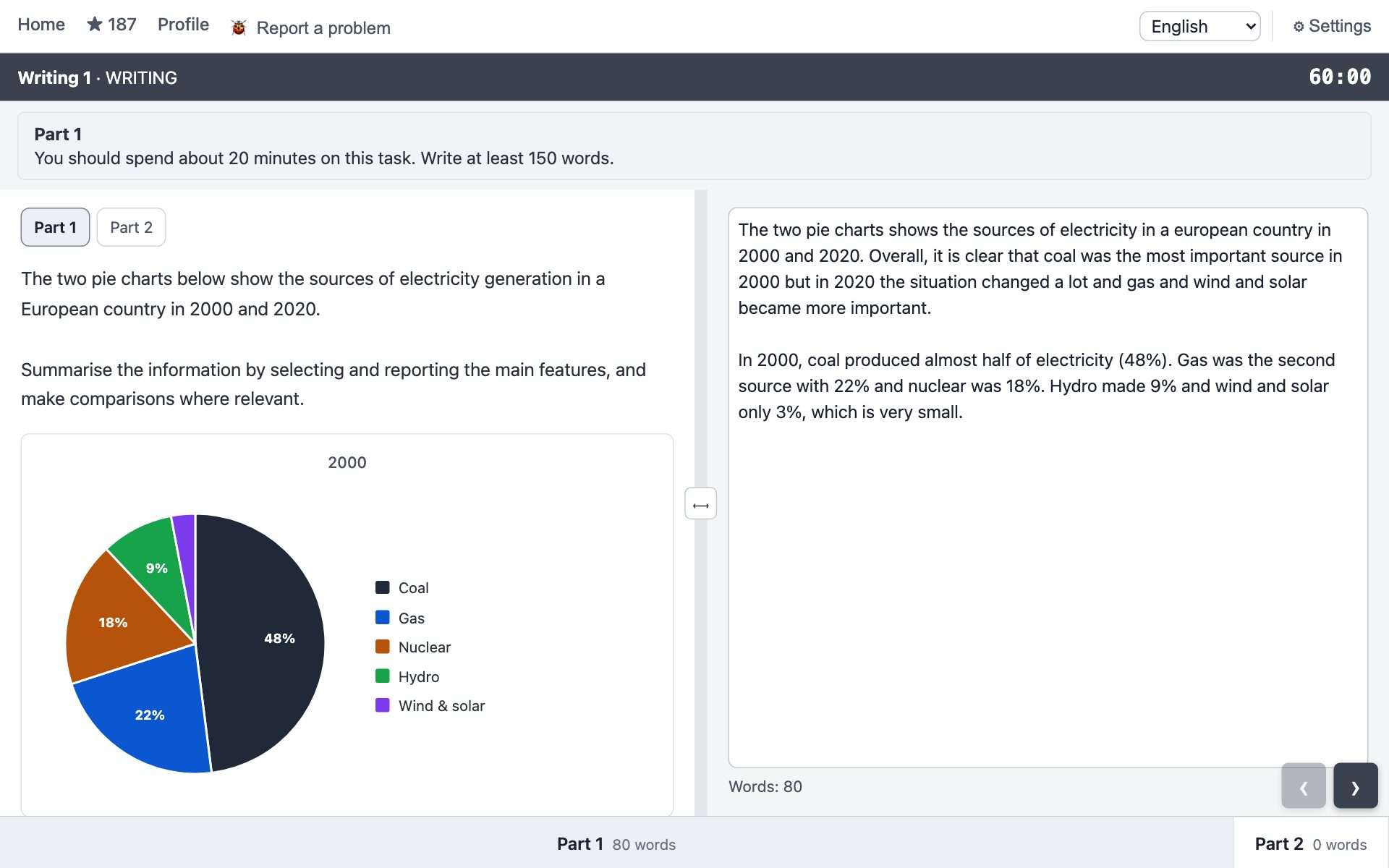
- There is a word counter under the answer box. You do not need to count by hand, but there is no way to fool yourself either: 240 words are visible at once.
- There is no spellchecker. The red underlines everyone is used to will not be there in the exam. You need to know your typical mistakes in advance and look for them deliberately.
- You can cut, copy and paste within the answer box, and paragraphs are easy to move around. Copying words from the task is pointless: the task wording pasted into your answer does not count towards the word total.
- The task and the answer box sit side by side, you switch between Task 1 and Task 2 using the numbers at the bottom of the screen, and the order is not restricted.
- The timer is always visible. The section closes when it runs out; there is no “submit early” button.
How to split the hour
| Minutes | What you do |
|---|---|
| 0–3 | Task 1: read the picture, note down the key facts and split them into two groups. |
| 3–15 | Task 1: write four paragraphs from your list of facts, without going back. |
| 15–20 | Task 1: check the figures against the picture, tidy up typos. After this you do not return to the chart. |
| 20–24 | Task 2: a plan on paper or in the answer box: position, two ideas, one example for each. |
| 24–53 | Task 2: write from the plan. Halfway through, check whether the first body paragraph is finished and whether it contains an example. |
| 53–60 | Task 2: three checking passes: spelling, articles, sentence fragments. |
Doing Task 1 first is convenient because the chart is quicker and easy to cap at twenty minutes. Some people start with the essay to give the main task a fresh head. Both approaches work, provided you hold the line strictly: 20 minutes for the chart, not a minute more.
Task 1 in brief
Seven kinds of picture: line graph, bar chart, pie chart, table, two pictures at once, process diagram and map. The answer is always four paragraphs: an introduction in your own words, an overview with no figures, and two paragraphs of data and comparisons. No conclusion is needed. The main traps: describing how the chart is built instead of the data, putting numbers in the overview, explaining causes, and confusing percentages with percentage points.
In detail, with a sample answer, a table of verb tenses and vocabulary for describing trends: IELTS Writing Task 1: how to describe graphs, tables, processes and maps.
Task 2 in brief
Five question types: agree or disagree, discuss two views, advantages and disadvantages, problem and solution, two direct questions. The answer is always four paragraphs: an introduction with your position, two body paragraphs built as “idea, explanation, example”, and a conclusion with no new ideas. Aim for 280–320 words. The main traps: answering the wrong question, a position not stated in the introduction, ideas listed without development, a journalistic tone, sentence fragments.
In detail, with a 40-minute plan, sample paragraphs and a bank of linking words: IELTS Writing Task 2: how to write an essay for band 7.
How to learn vocabulary for Writing
Vocabulary for Writing is not learnt from lists of “100 clever words” but by function: what exactly you are doing in the sentence. A chart description has few functions: rise, fall, stability, comparison, shares, time. For the essay the key vocabulary is linking words, phrases for expressing opinion, and formal replacements for conversational words. A few rules that work in the exam.
- Learn the word with its collocation. Not “significant” but “a significant increase in”, not “demand” but “demand for”. Half of all vocabulary errors are the right word in the wrong company.
- Learn the word with its family. rise — a rise, decline — a decline, grow — growth, sharply — a sharp. One root covers several sentence types.
- Learn in pairs. doubled — halved, rose — fell, advantage — drawback, support — oppose. The opposite case comes up just as often in the exam.
- Keep your own list of mistakes. After every text, write down the words you spelt wrong. Everyone has their own 10–15 persistent errors, such as “goverment” or “belive”; a list of your own words is worth more than any published collection.
- Use it the next day. A new word that does not make it into a text within a week will be forgotten. Three to five new words per essay is enough.
- Countability. spending, information, advice, research, equipment have no plural. One “spendings” repeated eight times in a text drags the whole criterion down.
- Read academic texts. The Reading passages in IELTS Academic are written in the style expected in the essay. Note down not rare words but phrases: is widely regarded as, plays a key role in, there is growing evidence that.
Specific vocabulary tables are in the articles on each task: verbs and adverbs for trends, fractions, words for processes and maps; linking words by function and formal replacements.
How to practise
Writing cannot be learnt by reading about it. You need texts written against a timer and a review of the mistakes after each one. A workable rhythm for people who study or work: two or three texts a week, one of them a Task 1, and once a week both tasks back to back in 60 minutes under exam conditions.
The main difficulty of preparing on your own is feedback. You do not see your own spelling and articles, and you consider your own structure logical. The options: a teacher, a friend with a high band, or automated marking by the criteria. We built the last of these into Tilmashq: after Task 1 and Task 2 you get a band for each of the four criteria, a list of spelling mistakes, a commentary with quotations and corrections, and a version of your own text rewritten to the target band. Seeing your own text rewritten to 7.0 teaches faster than any theory.
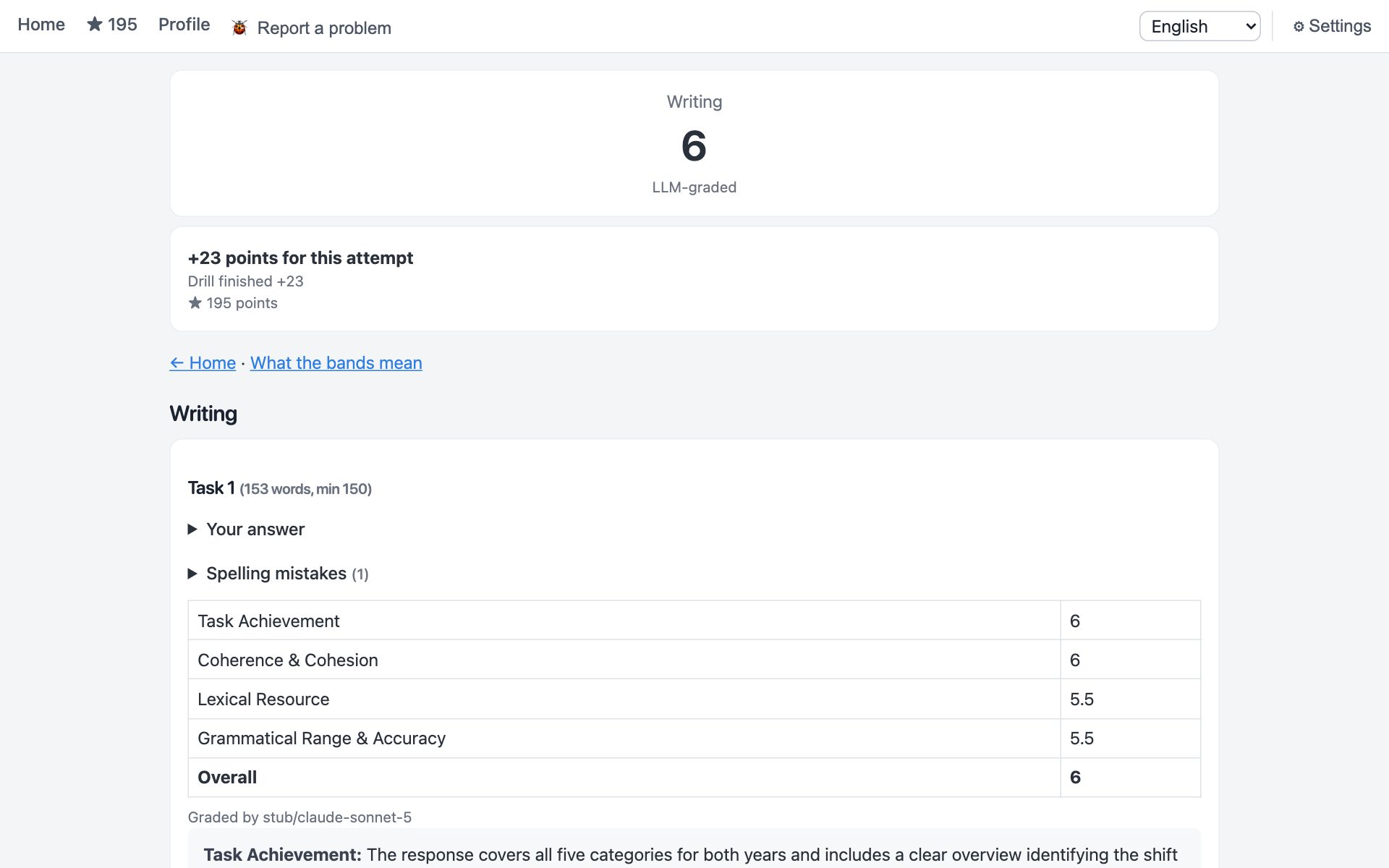
Honestly about the limits: the marking is done by AI, and on average it is stricter than an examiner, so a band in the trainer should be read as “not lower than”. The tasks in the trainer are our own, not from the exam, but they match the real format: all seven kinds of Task 1 and all five Task 2 question types, a screen with no spellchecker and with a word counter, and a timer for the section.
Read next
- IELTS Writing Task 1: how to describe graphs, tables, processes and maps
- IELTS Writing Task 2: how to write an essay for band 7
- Why IELTS preparation needs practice tests, not just textbooks
- How to start preparing for IELTS on your own on a small budget
- IELTS Listening: format, parts, timing and every question type
- IELTS Reading: format, the three passages, timing and every task type
- IELTS Speaking: format, the three parts, criteria and how to prepare
Updated: 2026-09-16