IELTS Speaking: format, the three parts, criteria and how to prepare
Speaking is the only section where you talk to a live examiner, and the only one where you cannot go back and correct yourself. It is also the shortest and the most predictable: three parts with a known structure and four criteria you can learn. Here is what happens in each part, how it is assessed, what separates 6.0 from 7.0, and how to prepare when there is nobody to talk to.
The format in brief
| What | How |
|---|---|
| Duration | 11–14 minutes |
| Form | a one-to-one interview with a certified examiner; the conversation is audio-recorded |
| Parts | 3: short questions about you, a monologue from a cue card, a discussion of an abstract topic |
| When | on the same day as the written sections, or on another day within a week before or after |
| Computer-delivered format | Speaking is still done with an examiner, in person or by video link at some centres |
| Academic and General Training | Speaking is the same |
| Scoring | a whole band on each of four criteria; the result is the average, rounded to 0.5 |
The examiner works from a script: they read the questions from a sheet, pick topics from a fixed set and keep each part to time by the clock. So they may cut you off mid-sentence and move to the next question. That is not a judgement on your answer, it is the procedure. Think of them as a host, not as someone you need to convince.
Part 1: introduction and short questions (4–5 minutes)
The examiner introduces themselves, checks your ID, then asks questions on three familiar topics, three or four questions each. The first topic is almost always about you: work or study, your home town, where you live. Then two everyday topics: food, weather, transport, music, gifts, sleep, photographs, walking, friends.
What makes a good answer:
- Length: two or three sentences. A one-word answer gives the examiner nothing to assess; a minute-long monologue will be stopped. The formula: answer + reason + a detail or example. "Do you like cooking?" "Not really, to be honest. I can cook a few basic dishes, but after work I'd rather order something. At weekends, though, I sometimes make plov for the family."
- Naturalness matters more than correctness. Part 1 tests whether you can talk about everyday things without preparation. A memorised answer is obvious straight away, and the examiner will simply change the topic.
- A range of tenses. The questions are deliberately set in different tenses: "Did you like it as a child?", "Will you keep doing this?". Answer in the same tense as the question; that is how grammar gets tested.
- If you did not understand the question, ask for it again: "Sorry, could you say that again?" That is fine once or twice. The examiner will not explain words.
Part 2: the cue-card monologue (3–4 minutes)
You get a card with a topic, paper and a pencil, one minute to prepare, and then you speak for one to two minutes. The card always has the same structure: a task "Describe a…", three prompts under "You should say:", and a closing "and explain why…". After two minutes the examiner stops you and asks one or two short questions on the topic.
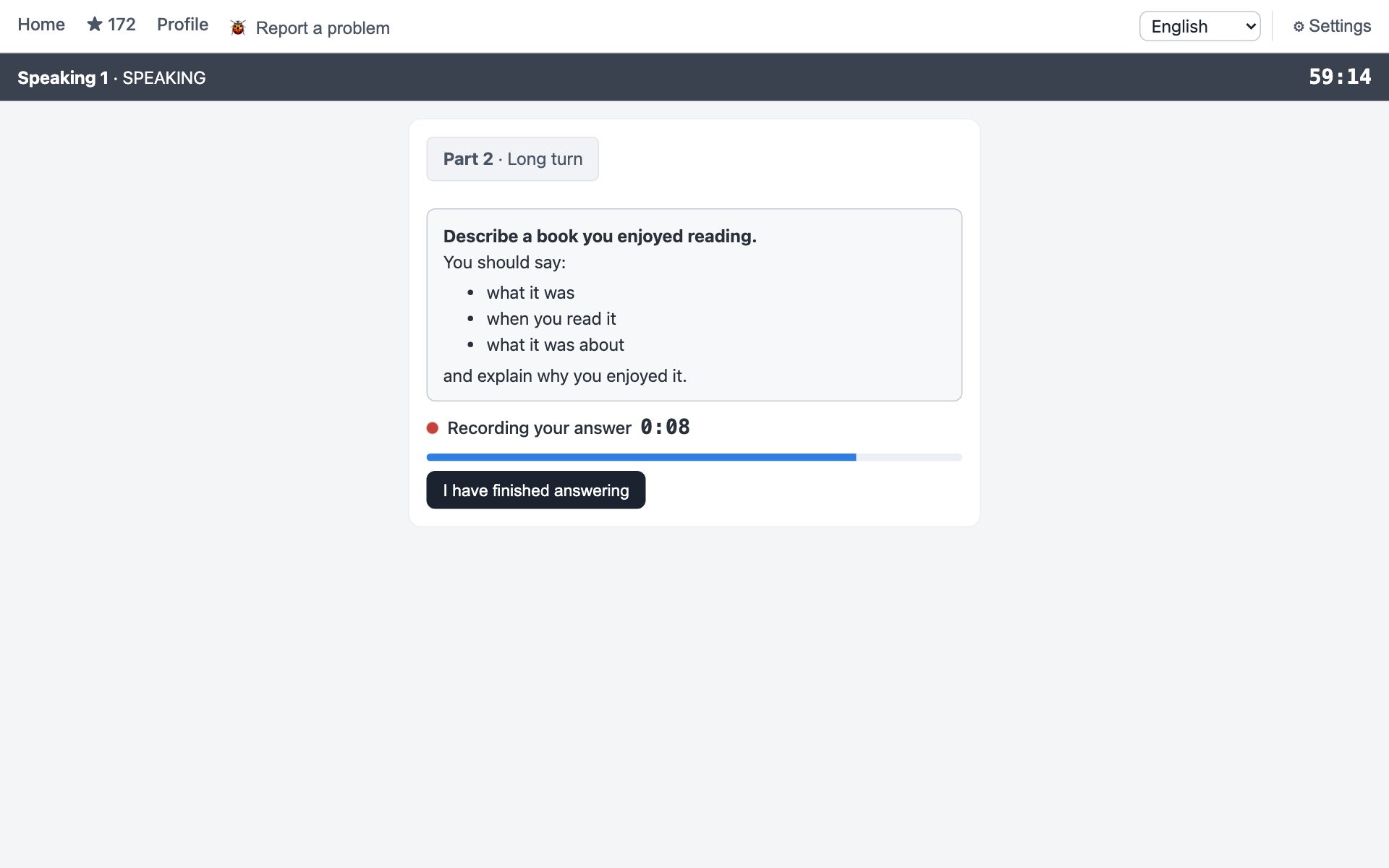
Cue-card topics are predictable: a person, a place, an event, an object, an experience. "Describe a person who influenced you", "a place you would like to visit", "a time you helped someone", "a skill you learned", "a book you enjoyed". The task does not test truthfulness: you can describe an invented trip if that makes it easier to talk.
How to use the preparation minute
- Write keywords, not sentences: two or three for each prompt on the card. You will not have time to write sentences, and reading from the sheet is a bad idea.
- Decide what to talk about in the first ten seconds. Do not pick the "best" example, pick the one you have the most to say about. It helps to have ten or fifteen personal stories ready in advance that fit different cards: one trip covers "a place", "an event" and "a person you travelled with".
- Leave room for "explain why". The last prompt produces the longest and most complex sentences, and candidates often never reach it.
How to talk for two minutes
- Follow the structure of the card: the prompts from top to bottom are a ready-made plan. Transitions: "The first thing I should mention is…", "What made it special was…", "Looking back, the reason I…".
- Tell a story, do not list facts. One concrete scene with details ("it was raining, the bus was late, and my phone had just died") gives more vocabulary and grammar than three general statements.
- Keep talking until you are stopped. Falling silent after a minute is worse than being interrupted in the second. If the story ends early, add how it affected you or what you would do differently.
- Past tenses and their forms. Most cards are about the past: this is the natural place to show had been, was going to, used to, would have.
Part 3: the discussion (4–5 minutes)
The examiner asks four to seven questions linked to the cue-card topic, but no longer about you: about people and society in general. After "a book you read" they will ask why people read less, whether schools should make children read, whether e-books will replace paper. This is the hardest part, and it is where a 7.0 is decided.
Part 3 questions come in several types, and each has its own answer pattern:
| Question type | Example | How to build the answer |
|---|---|---|
| Opinion | Should governments fund the arts? | position → reason → example → a concession, "having said that…" |
| Comparison | How is family life different from 50 years ago? | then → now → why it changed |
| Reasons | Why do people move to big cities? | two or three reasons with "the main reason is… another factor is…" |
| Prediction | Will people still read books in 30 years? | a hypothesis with "I imagine…, it's likely that…, unless…" |
| Evaluation | Is it a good thing that children use tablets? | pros → cons → where you stand in the end |
- Talk about people, not about yourself. "I think people in general…", "In my country, most families…". A personal example works as an illustration, but not as the whole answer.
- Answer length: four to six sentences. In Part 3 the examiner asks follow-ups like "Why?" and "Can you give an example?". That is a signal the answer was short.
- Admitting a question is hard is fine: "That's a difficult one. I suppose it depends on…". That is speech too, and it buys seconds to think. Silence buys nothing.
- Do not argue with the question or refuse to answer. "I've never thought about it", and then a version anyway.
The four criteria and what lies behind them
The examiner gives a whole band on each of four criteria; the final score is their average, rounded to the nearest 0.5. Below is our own account of what they look at; the official descriptions are on the IELTS website.
Fluency and Coherence
Whether you can speak at length without painful pauses and whether the speech hangs together. An important nuance: pauses are judged by their cause. A pause to think through an idea is fine even at 8. A pause to find a word or a verb form is what lowers the band. Self-corrections are not penalised in themselves, but if there are many, fluency suffers. At 7 speech flows without noticeable effort and linking words are used flexibly, if sometimes deliberately; at 6 the speaker is willing to talk at length but loses coherence in places, repeats and self-corrects.
Lexical Resource
Whether you have enough words to discuss any topic, and how precise they are. At 7 there are collocations and less common words used appropriately, and the ability to paraphrase when a word will not come. At 6 the vocabulary is enough for extended answers, but precision suffers. Memorised "clever" idioms out of context pull the score down, not up: the examiner can hear they were inserted for the sake of it.
Grammatical Range and Accuracy
Two dimensions: the variety of structures and the number of errors. At 7 complex sentences are used often and are mostly error-free; at 6 they are attempted, but with errors that usually do not block understanding. The practical goal is not "learn every tense" but to use five or six structures confidently and accurately: conditionals, relative clauses with which/who, the passive, used to, comparisons, reported speech.
Pronunciation
What is assessed is not accent but intelligibility: word stress, rhythm, intonation, dividing speech into meaningful chunks. At 7 speech is understood without effort and individual sound errors do not get in the way. Typical problems that are audible at once: wrong stress in long words (comFORTable, deVELopment), flat intonation where a question sounds like a statement, and words pronounced "letter by letter".
What really separates 6.0 from 7.0
The difference is usually not vocabulary. Candidates at 6.0 know almost every word a 7.0 candidate uses. The difference is in how the speech sounds as a whole:
- Extension. At 7.0 every Part 1 answer is three sentences and every Part 3 answer is five. At 6.0 they are one each, and the examiner has to pull the rest out with questions.
- The cause of pauses. At 7.0 thinking pauses fall between ideas; at 6.0 they fall inside a sentence, while searching for a word.
- Accuracy of complex structures. At 6.0 "If I would have more time" turns up every other answer; at 7.0 complex sentences are mostly right.
- Natural linking. At 6.0 it is "firstly, secondly, in conclusion" in spoken language; at 7.0 it is "well, actually, the thing is, I mean, having said that".
- Readiness for the abstract. At 7.0 the candidate reasons about causes and consequences in Part 3; at 6.0 they slide back to personal experience.
Typical mistakes
- Memorised answers. Examiners are trained to recognise them and steer away with extra questions. What you should learn is not answers but stories, topic vocabulary and structures.
- Repeating the whole question. "Do I think cities will grow? Yes, I think cities will grow." Paraphrase if you need time: "Whether they'll keep expanding? I'd say so, yes."
- One long answer instead of a dialogue in Part 1. This part needs short, lively answers, not a monologue.
- Speaking too quietly or too fast. Speeding up does not add fluency, it adds errors and damages pronunciation.
- Silence after "I don't know". Not knowing is allowed; silence is not.
- A yes/no answer to a question about society in Part 3. That is a reasoning question and needs reasons and examples.
How to prepare when there is nobody to talk to
Speaking is only trained by speaking, but a partner is not essential. Methods that work:
- Record yourself and transcribe. Two minutes on a cue card into a voice recorder, then write down word for word what you hear. This is the most unpleasant and the most useful practice: on paper every "I am agree", every pause and repetition is visible. After ten recordings the typical errors disappear on their own.
- A bank of 10–15 stories. Think through personal stories in advance: a trip, a person who influenced you, a hard decision, a skill you learned, a favourite place, a gift, a failure. For each, five or six keywords and one unusual detail. Most Part 2 cards are covered by this set.
- The "one minute to prepare, two minutes to answer" drill against a timer, one card a day. It is the feel of two minutes you need to build: most people fall silent at forty seconds the first time.
- Vocabulary by topic, not by list. Take twenty frequent Part 1 and Part 3 topics, education, work, technology, the environment, cities, family, health, the arts, and for each collect ten phrases you would actually use: not "ubiquitous" but "become part of everyday life".
- Shadowing for pronunciation. Listen to a piece of natural speech, a podcast or an interview, and repeat after the speaker with a one-second delay, copying the stress and intonation. Ten minutes a day changes the rhythm of your speech within a month.
- Five structures to automatic. Choose five complex structures and put each into every Part 3 answer at least once until you stop making mistakes in them.
- Answer Part 3 questions in writing, one or two a day: the plan "position → reason → example → concession" is easier to drill on paper and then carry over into speech.
Speaking in Tilmashq
In our practice tool Speaking works as an interview: the examiner asks the questions aloud and their text is not shown on screen, just as in the exam. Three parts; in Part 2 a cue card with the topic, a minute to prepare and up to two minutes to answer with a countdown. What you say is not shown during the test: the transcript appears only at the end, and it cannot be edited. After that you can request a review: a band for fluency and coherence, vocabulary and grammar, comments with examples from your answers, and your own Part 2 answer rewritten to the target band.
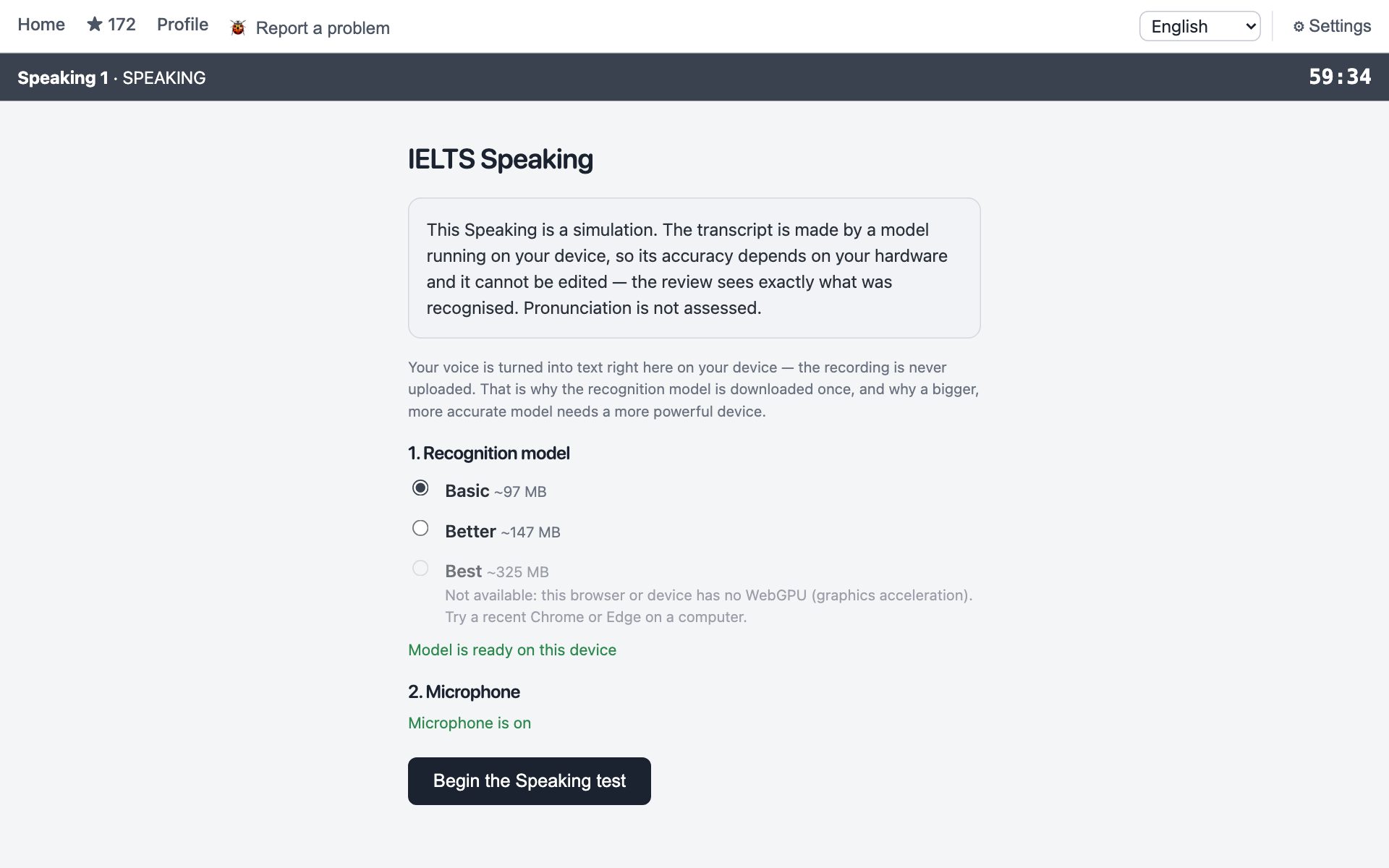
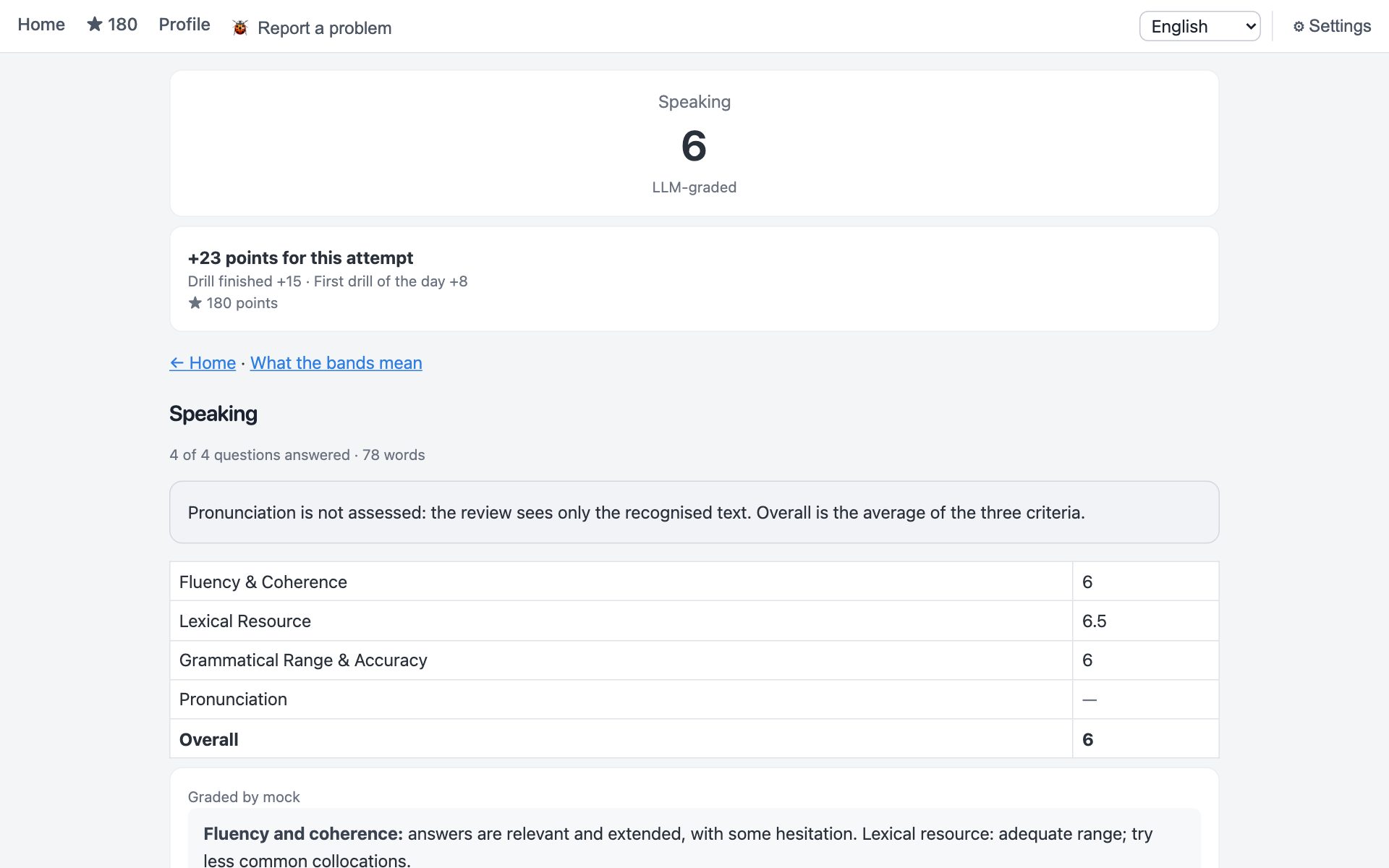
Honestly about the limits. Speech is recognised right in the browser; the recording is not uploaded or stored, and only the text goes for review, and only if you request it. The flip side: pronunciation is not assessed at all, and fluency is judged from a transcript, in which pauses cannot be heard. The review comes from AI, which is on average stricter than an examiner, so read the band as "not lower than". And the tool does not replace a live conversation: an examiner reacts to your answer, while the tool asks the next question. For pronunciation and live reactions you need a person, at least occasionally; for answer structure, vocabulary, grammar and the habit of talking for two minutes straight, the tool is enough.
Read next
- IELTS Writing Task 2: how to write an essay for band 7, the same logic of argument as in Part 3
- IELTS Listening: format, parts, timing and every question type
- IELTS Reading: format, the three passages, timing and every task type
- IELTS Writing: format, criteria, timing and how to prepare
- How to start preparing for IELTS on your own on a small budget
Updated: 2026-09-15