
True/False/Not Given and the other question types: practise them one at a time
Ten practice tests in, and Not Given is still being confused with False. That is not laziness or a shortage of practice: a full test tells you how many answers were right and says nothing about why. You can see the mistake; you cannot see the mechanism, so the next test repeats it. Below: why this happens, what practising a single question type adds, and how the mini-drills in Tilmashq work.
Why a score on a full test teaches you nothing
Picture an ordinary evening of preparation. You take a Reading test, get 28 out of 40 and band 6.5, and look at the key: questions 4, 9, 17 and 23 are wrong. What have you learned? That four answers were not the right ones. The key says «the correct answer is NOT GIVEN», but not the thing that matters: by what sign you could have told it from FALSE without guessing.
What follows is predictable. On the next test you meet Not Given again, and reason about it exactly the way that went wrong last time. Ten tests in a row build stamina and timing, but not the mechanics of a particular format: those need an explanation, and during a test there is neither the time nor the patience for one.
There is a second problem — rare types. Matching sentence endings and flow-chart completion do not turn up in every test. Wait for them to appear in practice tests and your first proper meeting with the format will happen on exam day.
What practising one type gives you
Every IELTS question type has its own internal logic, and that logic can be put into words. A few examples that save most people a band or so:
- True/False/Not Given. Hedging — believe, suggest, may — usually means the claim is not settled. A statement that makes such an idea certain is more often NOT GIVEN than FALSE: the text does not deny it, it simply never asserts it.
- Matching headings. When a yet or a however sits in the middle of a paragraph, the heading almost always belongs to the second half. The first half is the bait.
- Sentence completion. Read the words around the gap. If the sentence already says «minutes», then «thirty minutes» is three words and scores nothing — with an answer that was right in substance.
- Matching features. «You may use any letter more than once» is not a polite formality. The habit of avoiding a letter you have already used costs real marks.
None of these can be derived from a line that reads «correct answer: C». Each of them, though, sticks the first time if the explanation sits next to your own mistake — while you still remember why you chose the other option.
How it works in Tilmashq
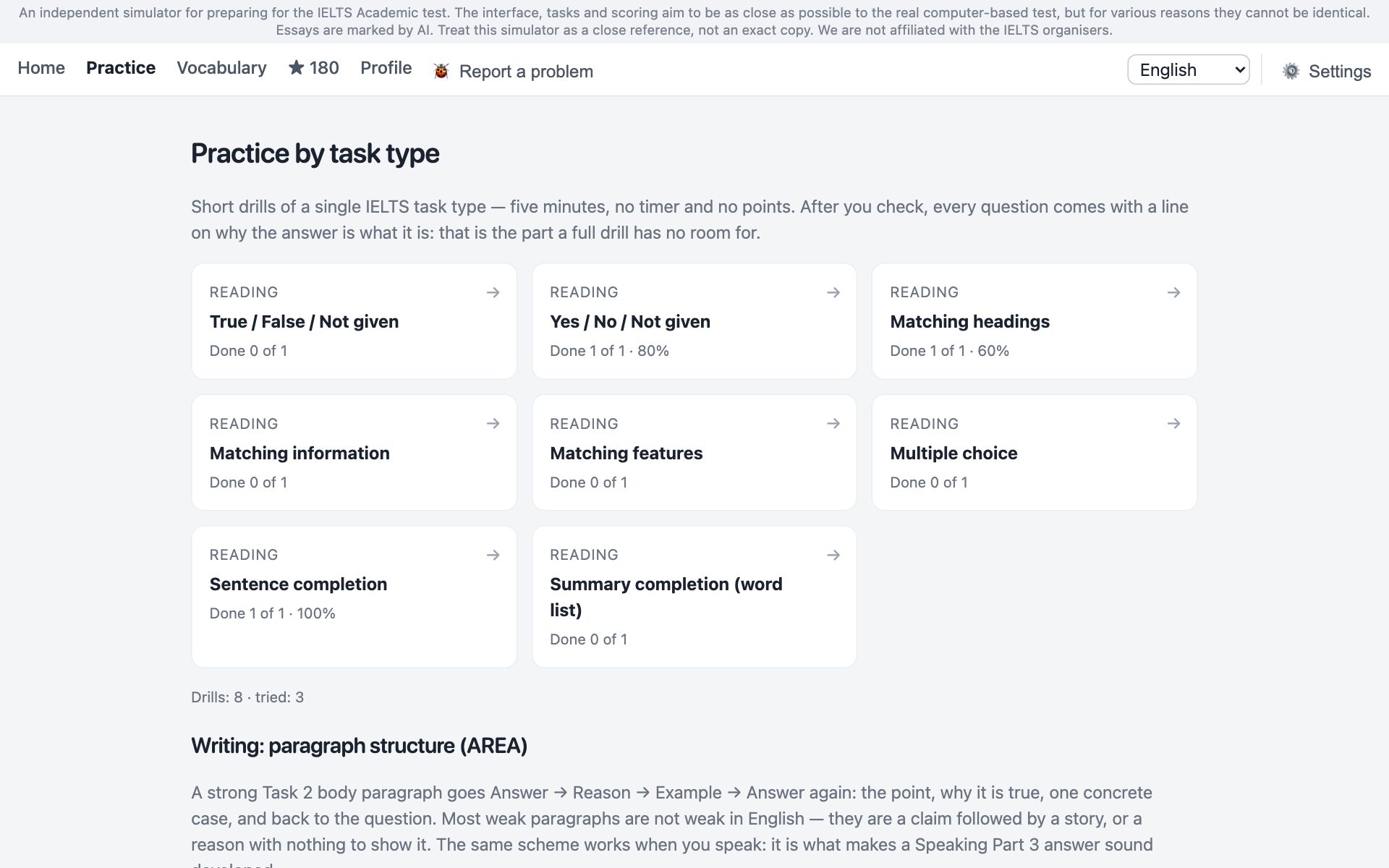
The trainer has a Practice section in the menu, laid out by question type: one tile per format, showing how many drills of that type you have done and how accurately.
Open practice by question type
One mini-drill is a short text and a single group of questions of one format. Five minutes, no timer, and you can stop at any point. The questions look and behave exactly as they do in the exam: headings are dragged into the gaps above the paragraphs, words from the box into the summary, a letter is taken by one question unless the task says otherwise. It is the same engine as the full tests, so what you practise is the mechanics of the screen, not an abstraction.
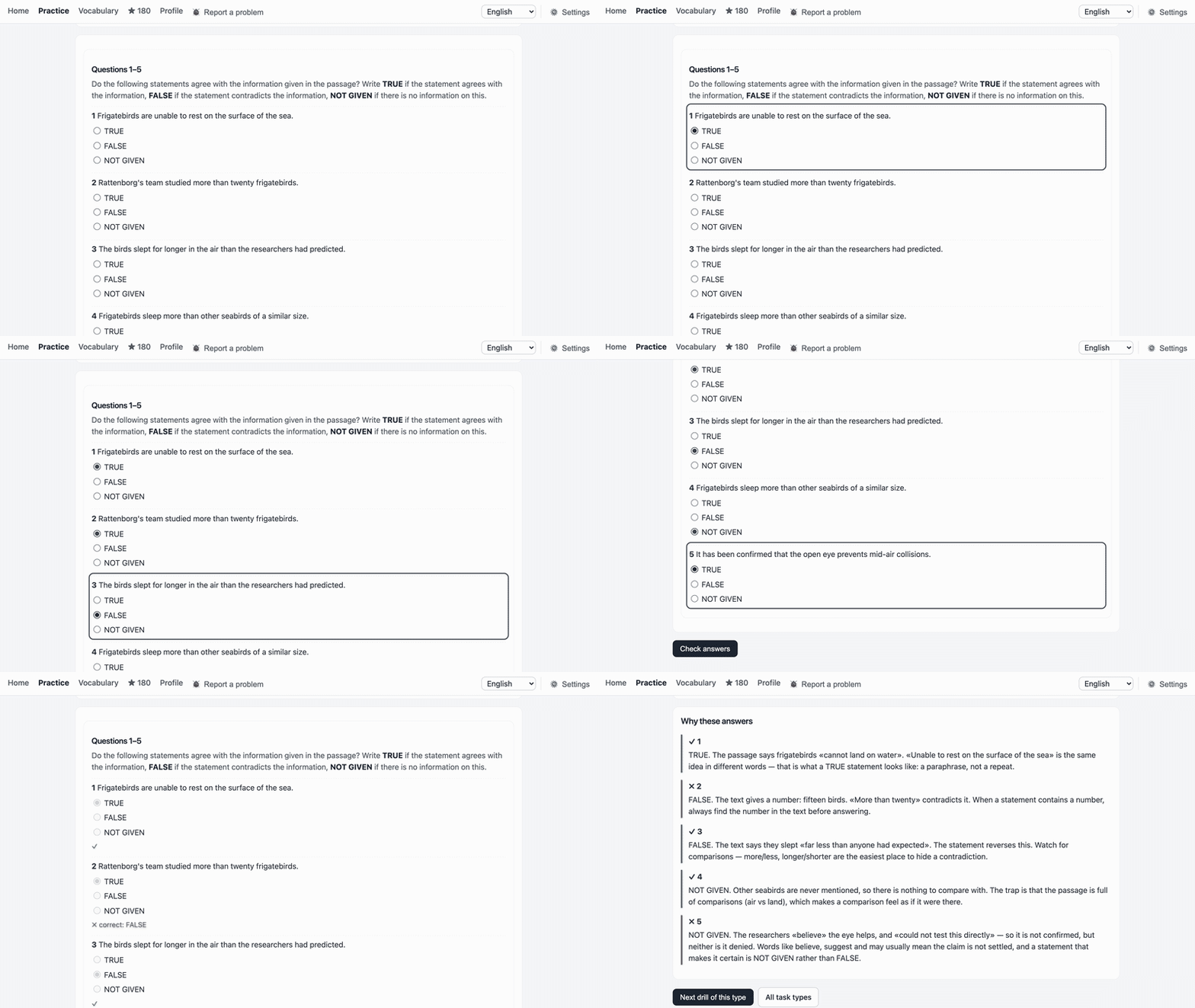
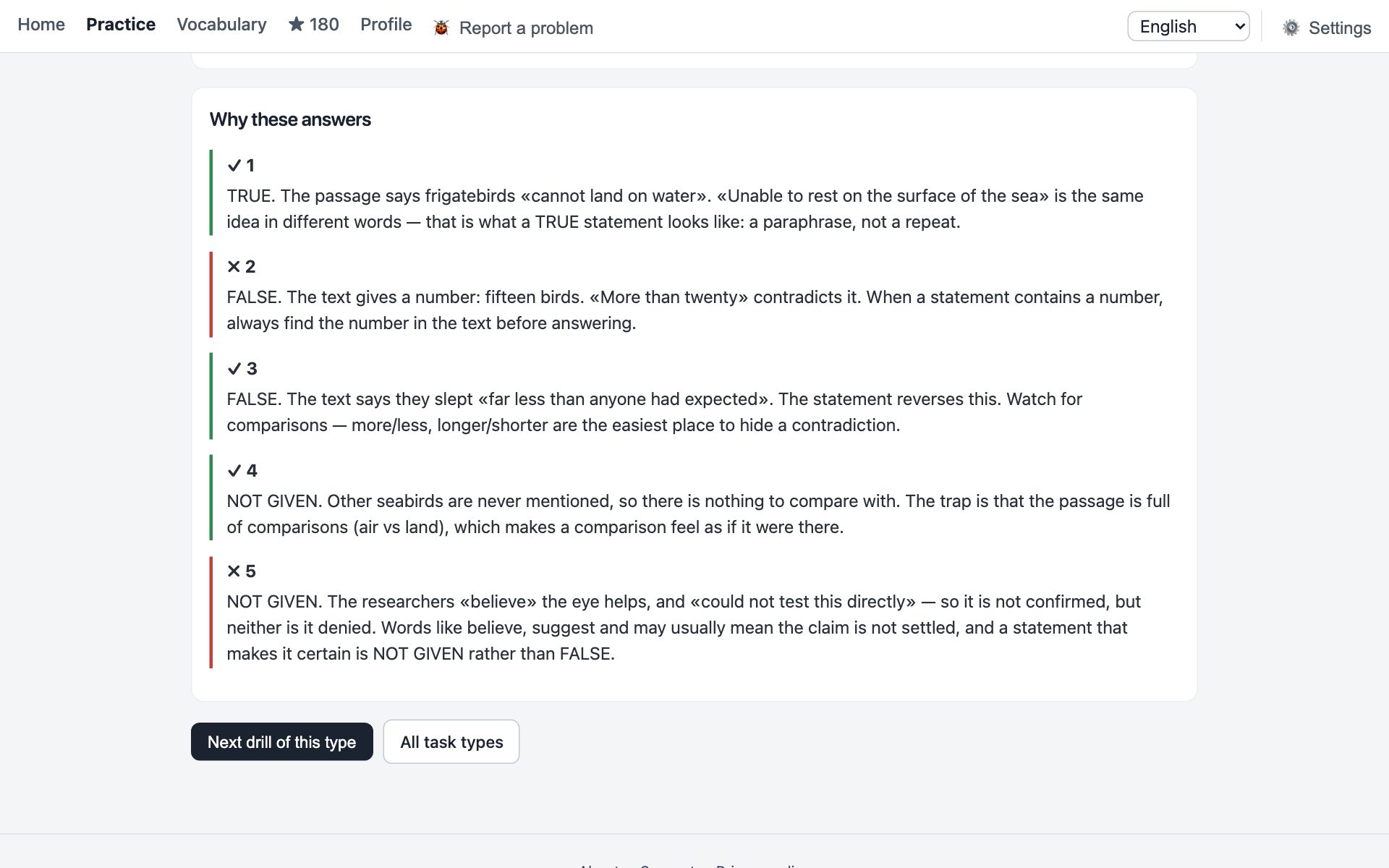
The part that matters starts after the Check button. Under every question a line appears: why the answer is what it is, and what would have led you to it. Not «the correct answer is NOT GIVEN», but «the researchers believe the eye helps and could not test this directly — so the claim is not confirmed, but it is not denied either».
Free, untimed and offline
Mini-drills neither spend points nor earn them, do not create an attempt and do not affect your band. The tile keeps your best result, and that is all. This is deliberate: practising a format should not compete with a full test for the internal currency — or people would start saving it exactly when they need the practice most.
The texts and questions are stored in the browser the first time you open the section, so after that it works with no connection, just like the vocabulary trainer. On the metro, in a queue: five minutes on one format.
Two honest limits. First, the texts here are short and written for practice — this is not a full 900-word Reading passage, and it does not build stamina. Second, the section currently covers Reading question types; the Listening formats need audio and will come separately.
How to fit it into your preparation
- After every practice test, look at which question type the mistakes were in and do one mini-drill of that type — while you still remember what you were thinking when you got it wrong.
- Before your first meeting with a rare format. Matching features and summary completion with a word list are easier to work out in advance on five questions than for the first time in the exam.
- On the road and in gaps — alongside the vocabulary trainer. One drill takes about as long as a few metro stops.
- But not instead of full tests. Timing, fatigue and the ability to spread 60 minutes are trained only by a whole section. Mini-drills close a different gap: the mechanics of a format.
How to build a week out of this is in How to start preparing for IELTS on your own on a small budget. A full walk through the question types themselves, with examples, is in IELTS Reading: format, the three passages, timing and every task type.
Read next
- IELTS Academic: how the exam works and what to read for each section
- IELTS Reading: format, the three passages, timing and every task type
- Why IELTS preparation needs practice tests, not just textbooks
- How to make your commute count: IELTS vocabulary with no internet
- How to start preparing for IELTS on your own on a small budget
- The AREA method: how to build an answer in IELTS Writing and Speaking
Updated: 2026-09-16