How to make your commute count: IELTS vocabulary with no internet
A student in Tashkent spends an hour to an hour and a half a day on the road — six to eight hours a week. In the metro the connection drops, in a marshrutka you are shaken about, and neither a Reading passage nor an essay fits on a phone in those conditions. One thing, though, fits the road perfectly: words. Below is what to learn, what not to waste the time on, and how the vocabulary trainer in Tilmashq works without internet.
What not to do on the road
- Full tests and timed sections. Reading and Listening need quiet and 30–60 uninterrupted minutes. A test broken by one stop scores below your real level and only spoils your statistics.
- Essays. Typing 250 words on a shaking phone is a chore, and an essay without a review of its mistakes teaches almost nothing.
- Random "100 words for IELTS" videos. Words with no context and no repetition are gone in a week — and in the metro the video will not even load.
What to do: vocabulary
Vocabulary is the one part of preparation that splits well into two- or three-minute pieces and needs no quiet. Five cards per station. Over a week those short bursts add up to more than an hour of real work on words — as much as an evening lesson.
Not every word list is equally useful, though. Three conditions without which flashcards become a game for its own sake:
- The words must come from exam texts. Not "the top 3,000 English words" (you know those), but the vocabulary of academic Reading passages and Listening lectures: proportion, absorb, sediment, scarce, deliberate. Those are the words standing between you and the right answer.
- Repetition until learned, not a single pass. A word sticks when you recognise it several times in a row. One right answer means nothing.
- You must be able to spell it, not only recognise it. In Listening and Reading a misspelt answer is a wrong answer. Recieve for receive costs a mark.
How Tilmashq does it
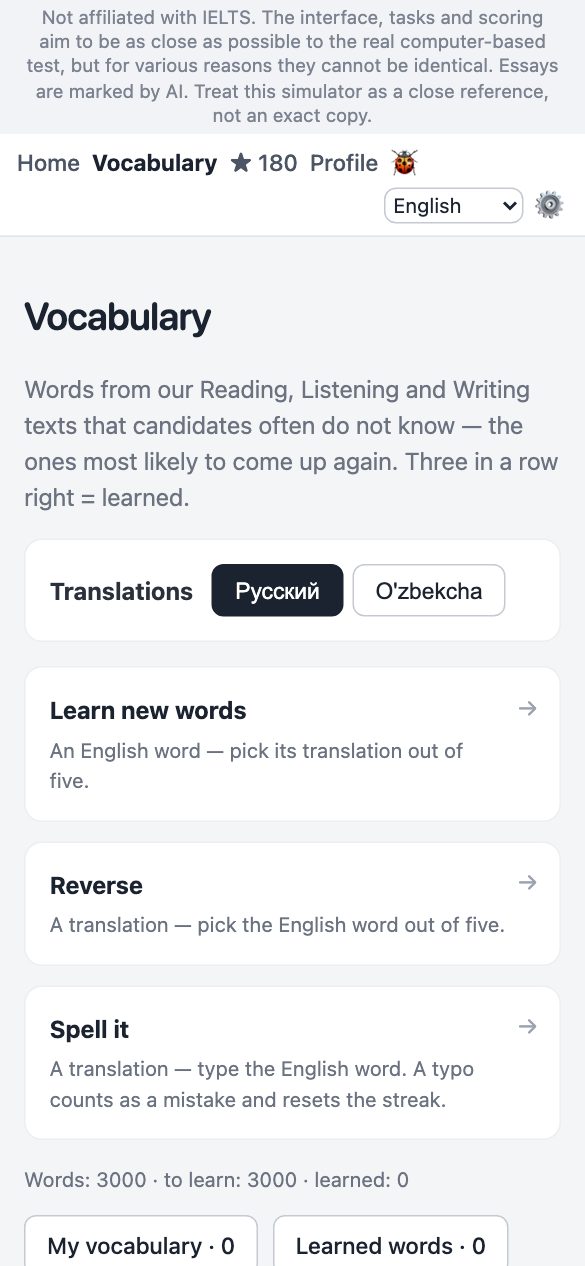
The trainer's menu now has a Vocabulary section. It is built from the words of our own Reading, Listening and Writing texts: the program picked the ones that occur most often in them and go beyond everyday English. Nouns, verbs and adjectives — yes; articles, prepositions and numerals — no. Every word has a Russian and an Uzbek translation and a short example.
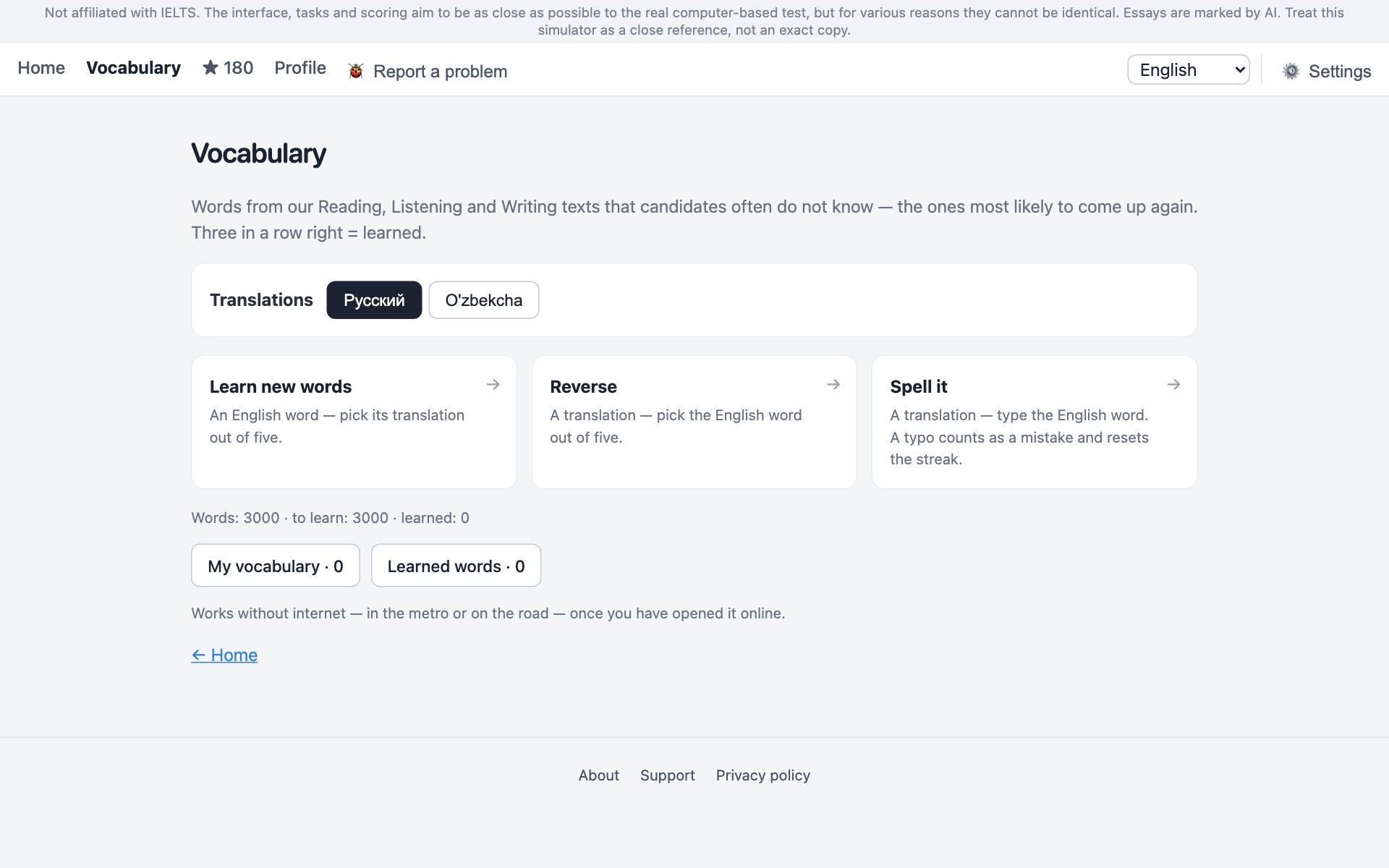
Three modes, from easy to hard:
- Learn new words. An English word — pick its translation out of five. The wrong options are words of the same part of speech, so guessing by form does not work.
- Reverse. A translation — pick the English word out of five. This is recall rather than recognition: what Writing and Speaking need.
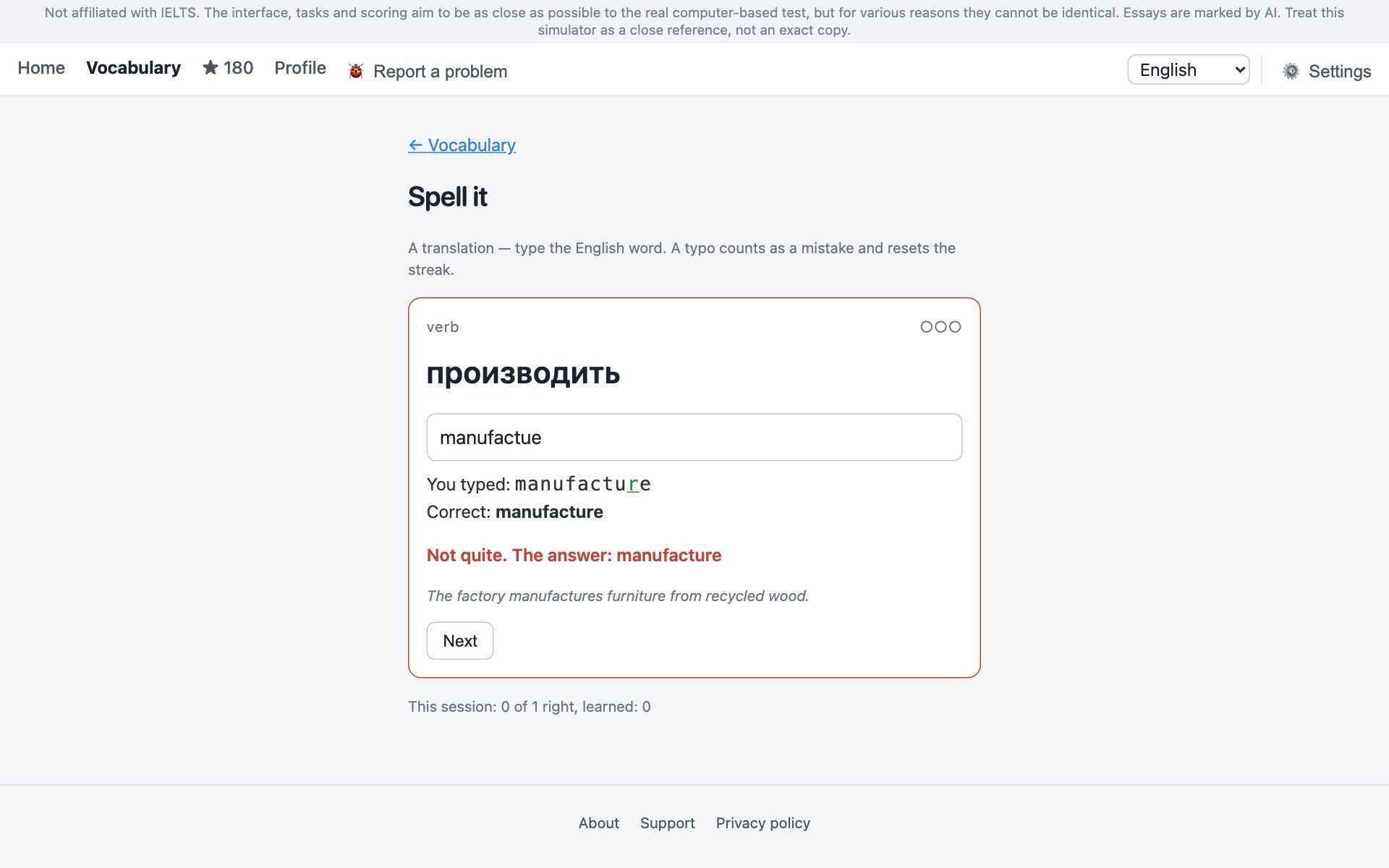
- Spell it. A translation — type the word yourself. Any typo counts as a mistake: the trainer shows which letter is extra or missing and resets that word's streak.
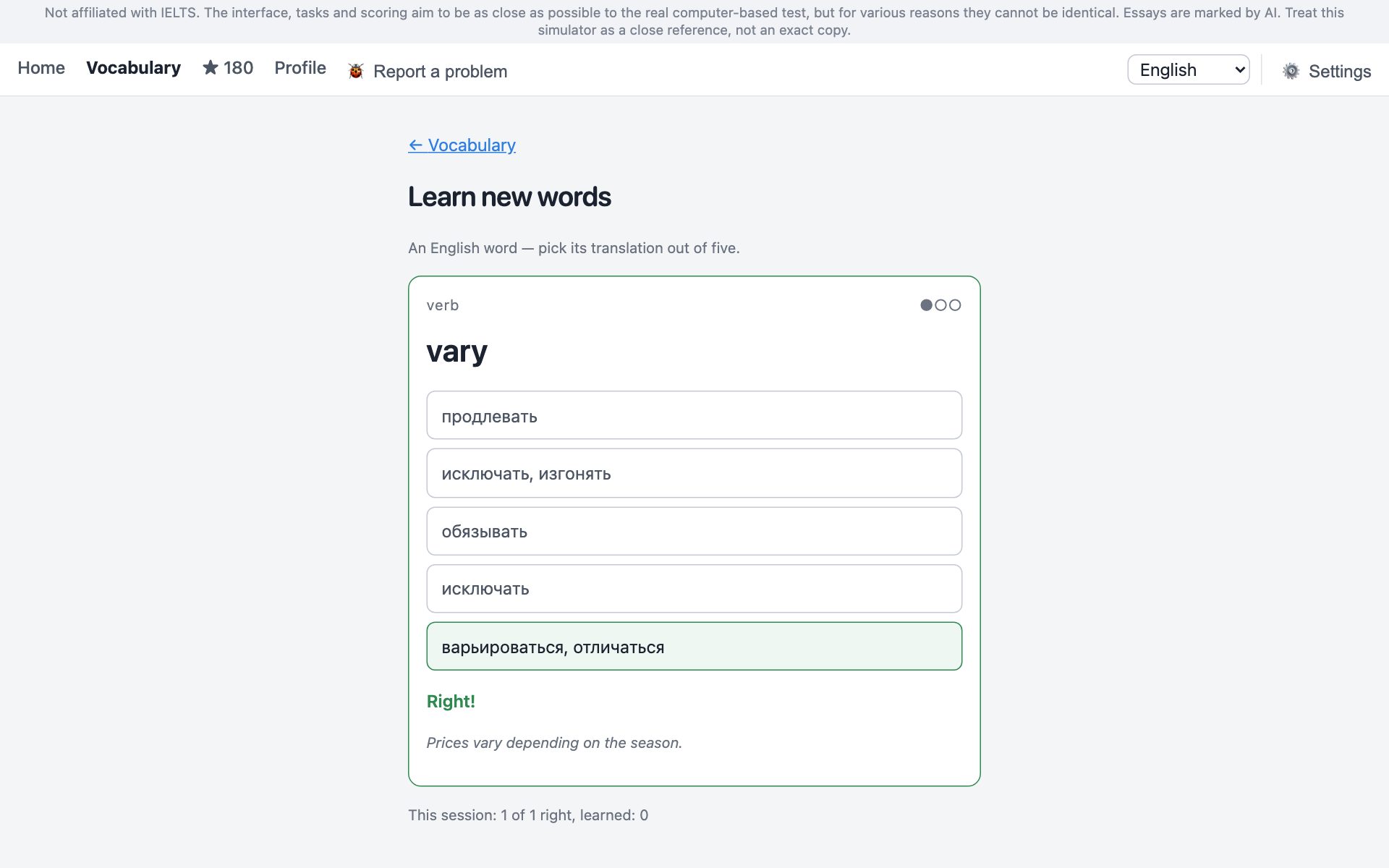
The "three in a row" rule. A word counts as learned after three correct answers in a row, in any mode. One mistake and the count starts over, and the word goes back into training. Learned words are listed separately and can be returned to training by hand if you feel you have forgotten one.
Tied to your tests. After every Listening and Reading the results screen lets you tick the words you did not know — they go to "My vocabulary". In training those words come first: your own gaps, not an abstract list.
Why it works without internet
Tilmashq is a web app, but the Vocabulary section is built not to depend on the network. Open it once with a connection: the word list with translations and the page itself are stored in the phone's browser. After that the train can go underground — the cards keep opening, answers keep counting and progress is saved on the device. When the connection returns there is nothing to send: vocabulary progress never leaves the phone at all.
Two honest limitations. First: for the word list to reach the phone's memory it has to be opened online at least once — and occasionally afterwards, when we add new texts. Second: progress lives in the browser of that particular device. If you study on both a phone and a computer, move your history as a file through the profile — learned words travel with it.
Fitting it into the week
- Morning, on the way to class — Learn new words, 10–15 cards. A fresh head takes new words easily.
- Evening, on the way home — Reverse, on the same words. Recall is harder than recognition, and that is what makes them stick.
- Once or twice a week — Spell it. A slow mode, but it catches the typos that cost marks in the exam.
- After every Reading or Listening — two minutes ticking the unknown words on the results screen. They move to the front of the queue.
A full test once a week remains the main reference point — see How to start preparing for IELTS on your own on a small budget. The commute will not replace it, but it takes over the part of preparation you would otherwise have to do at a desk in the evening.
Read next
- IELTS Academic: how the exam works and what to read for each section
- How to start preparing for IELTS on your own on a small budget
- IELTS Reading: format, the three passages, timing and every task type
- IELTS Listening: format, parts, timing and every question type
- Why IELTS preparation needs practice tests, not just textbooks
Updated: 2026-09-16