
How to describe trends in IELTS Writing Task 1: sentence patterns, prepositions and line shape
Three quarters of a Task 1 body paragraph is sentences about how something changed. The problem is rarely the words: everyone knows rise, fall, sharply. The problem is that every sentence comes out the same ("X increased from… to…", eight times over), and a line that rose and then fell makes the pen stop. Below is a kit that covers any graph: four sentence patterns, prepositions with numbers, a scale for how strong a change is, and words for the shape of a line and for comparison. Everything is worked through on one graph, with a full answer at the end. The general mechanics of Task 1 are in IELTS Writing Task 1: how to describe graphs, tables, processes and maps.
The graph
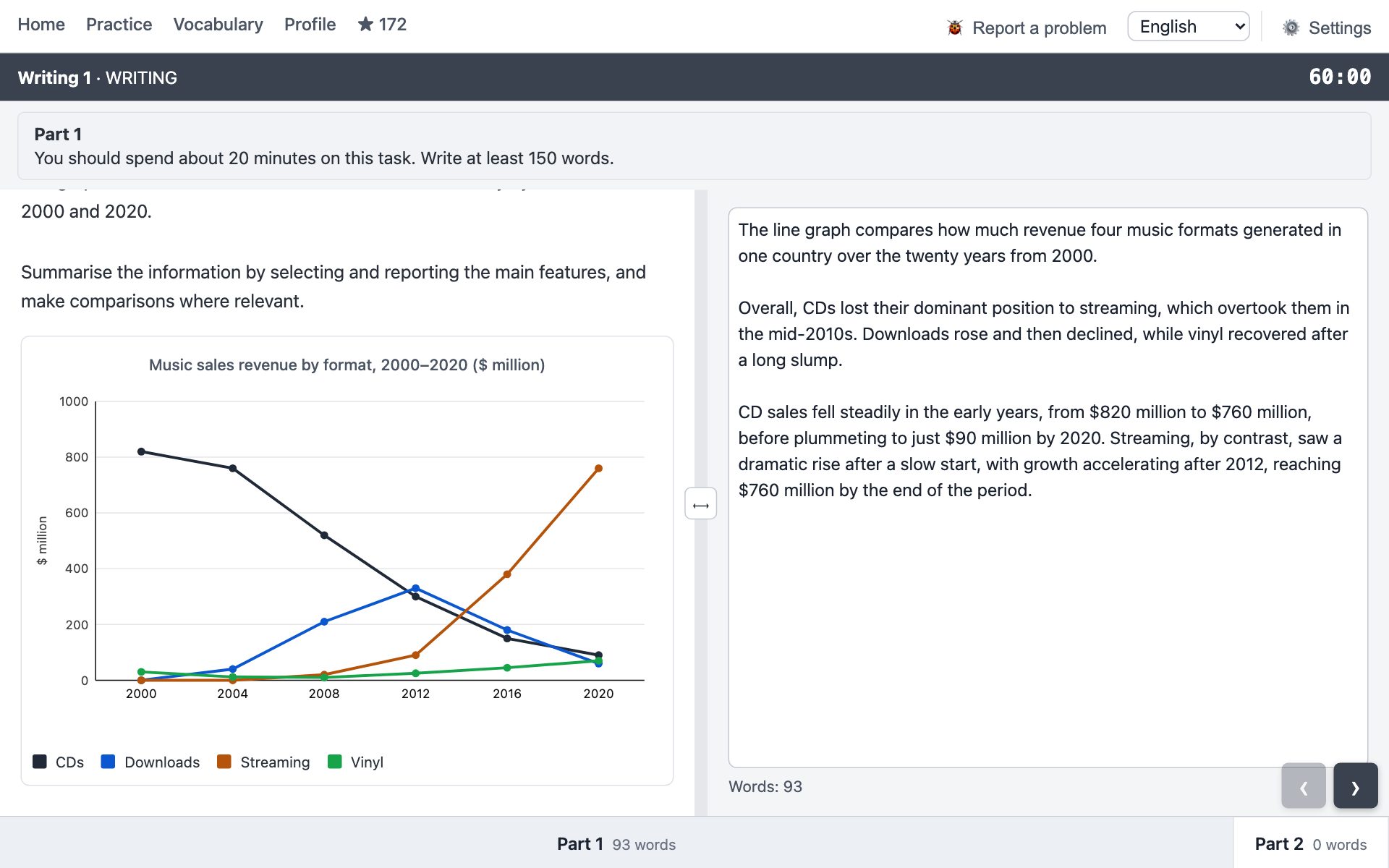
Music sales revenue in one country by four formats, in millions of dollars:
| Format | 2000 | 2004 | 2008 | 2012 | 2016 | 2020 |
|---|---|---|---|---|---|---|
| CDs | 820 | 760 | 520 | 300 | 150 | 90 |
| Downloads | 0 | 40 | 210 | 330 | 180 | 60 |
| Streaming | 0 | 0 | 20 | 90 | 380 | 760 |
| Vinyl | 30 | 12 | 10 | 25 | 45 | 70 |
The main features are already in the overview on the screenshot: CDs lost first place to streaming, downloads rose and fell, and vinyl went through a slump and recovered. How to find observations like these is covered in The overview in IELTS Writing Task 1: how to find the main features of a graph. This article is about the next step: turning those features and their figures into body sentences.
Four sentence patterns
Almost any sentence about a trend follows one of four patterns. They are not four sets of words but four frames: the same rise, sharp, steadily fit into any of them. Variety in your writing comes from switching frames, not from hunting for ever rarer verbs.
1. Verb + adverb
CD sales fell steadily from $820 million to $760 million.
Pattern: subject + verb of movement + adverb + from A to B. The workhorse, carrying about two thirds of your sentences. It is short, hard to get wrong, and the subject says straight away what you are talking about. The adverb goes after the verb: fell steadily reads more naturally than steadily fell.
2. There was a + adjective + noun
There was a sharp increase in download revenue, from almost nothing to $330 million.
Pattern: there was a + adjective + rise / fall / increase / decline + in + what. The same information, but the change itself is the centre of the sentence. Good for variety, at most once a paragraph: there was in every sentence reads as a template. The pair rule: if you know the adverb, you know the adjective. Sharply — a sharp, steadily — a steady, gradually — a gradual, slightly — a slight, dramatically — a dramatic.
3. X saw / experienced + noun
Streaming saw a dramatic rise in the second half of the period.
Pattern: subject + saw / experienced + a + adjective + noun. The subject stays the topic, as in the first pattern, while the change is a noun, as in the second. Especially useful at the start of a paragraph or when you switch to a new category: Vinyl, by contrast, experienced a gradual recovery. Make the category the subject, not the year: 2012 saw a peak in downloads is grammatical, but starting with the category is simpler and safer in Task 1.
4. Participle tail
Download revenue then declined, falling to $60 million by 2020.
Pattern: main clause + comma + reaching / rising to / falling to / peaking at / leaving X at…. The cheapest way to add a second figure without starting a new sentence. The tail continues the main clause rather than contradicting it: CDs fell, reaching $90 million is fine; CDs fell, rising to… is not.
One fact, four ways to say it:
- Streaming revenue rose dramatically after 2012.
- There was a dramatic rise in streaming revenue after 2012.
- Streaming saw a dramatic rise after 2012.
- Streaming revenue took off after 2012, reaching $760 million by 2020.
In a four-sentence paragraph, two sentences of the first pattern, one of the third and one tail are enough to stop the text reading like a list.
Prepositions with numbers
Prepositions cost more marks than verbs, because a mistake changes the meaning: rose by $300 million and rose to $300 million are different facts.
| Preposition | Meaning | Example |
|---|---|---|
| from … to | start and end value | fell from $820 million to $90 million |
| to | end value only | rose to $760 million |
| by | size of the change, the difference | fell by $60 million between 2000 and 2004 |
| at | a level at one point: peak, low, value in a year | peaked at $330 million; stood at $30 million in 2000 |
| of | size of the change after a noun | a fall of $60 million; a rise of 50% |
| in | what changed, after a noun | a rise in streaming revenue |
| between … and / from … to | a period | between 2000 and 2020; from 2012 to 2016 |
| by + year | no later than that year (with the Past Perfect) | by 2020, streaming had overtaken CDs |
When both nouns appear, size comes first and then the thing: an increase of $120 million in download revenue. Reach takes no preposition: reached $760 million, not "reached to".
How strong the change is
Pick the word by how much the value changed relative to where it started, not by the angle of the line on the page. The angle depends on the axis scale: on a graph that goes up to 1,000, vinyl rising from 10 to 70 looks almost flat, yet it is a sevenfold increase.
| How strong | Rise | Fall | Adverb / adjective | On our graph |
|---|---|---|---|---|
| Several times over | surged, soared, rocketed, took off | plummeted, plunged, collapsed | dramatically / a dramatic | streaming 90 → 760, CDs 760 → 90 |
| Clearly | rose, increased, climbed, grew | fell, dropped, declined, decreased | sharply, considerably, significantly / a sharp, a considerable | downloads 330 → 180 |
| Moderately, evenly | rose steadily, climbed gradually | fell steadily, declined gradually | steadily, gradually, moderately / a steady, a gradual | vinyl 25 → 45 → 70 |
| A little | edged up, crept up, rose slightly | edged down, dipped, fell slightly | slightly, marginally / a slight, a marginal | vinyl 12 → 10 |
| Not at all | remained stable, stayed flat, levelled off, held steady | — | streaming 2000–2004 (at zero) | |
Do not jump tiers within one answer: if CDs going from 820 to 760 is called plummeted, you will have nothing left for the collapse from 760 to 90. Save the strong words for the strongest changes on the graph. The reverse also holds: remained stable is wrong if the line moved at all; fell only slightly, from $12 million to $10 million is accurate.
The shape of the line
Strength says how far a line went; shape says how it got there. They are different things: a line can rise a lot but evenly, or a lot with a spurt at the end. A named shape is a separate fact about the data, and the examiner gives you credit for it.
- Accelerating (curving upward). Growth accelerated after 2012; the increase gathered pace; rose at an increasing rate. Streaming: +70 in 2008–2012, then +290 and +380.
- Slowing down (still rising, but more slowly). Growth slowed; the rise lost momentum; began to level off. Downloads: +170 in 2004–2008, then only +120, then the peak.
- Slow start, then a spurt. After a slow start, streaming took off in the 2010s.
- Slow decline, then a collapse. CD sales declined only slightly at first, before plummeting after 2004.
- Peak and fall. Downloads peaked at $330 million in 2012 before falling back; reached a high of…; went into decline after 2012.
- Low and recovery. Vinyl hit a low of $10 million in 2008 and then recovered; bottomed out at…; the trend reversed after 2008.
- Fluctuation. fluctuated between A and B; rose and fell repeatedly. Not on our graph, but it does come up. Do not describe every zigzag: one word, fluctuated, plus the range.
- Plateau. rose until 2015, after which it levelled off at around A.
A line that changes direction needs two halves, and the easiest joint is before + -ing or and then: Download revenue rose sharply to a peak of $330 million in 2012 before falling to $60 million by 2020. One sentence, three figures, the whole shape of the line.
Comparing with other lines
Task 1 asks you to compare, not just describe. A sentence about one line gets stronger when another line is in it.
- Who was faster. Streaming saw by far the steepest increase of the four formats.
- A similar path. Vinyl followed a similar pattern, though from a much lower base.
- The opposite path. Streaming, by contrast, moved in the opposite direction. / CDs fell, whereas streaming rose. (Whereas does not start a sentence.)
- Crossover. Streaming overtook CDs between 2012 and 2016. / Downloads briefly overtook CDs in 2012. / By 2020, vinyl had overtaken downloads.
- The gap. The gap between the two formats narrowed / widened. / the two lines converged at around $300 million.
- How many times. In 2000, CD revenue was more than 27 times that of vinyl. / By 2020, streaming earned over eight times as much as CDs.
- Even at its worst. Even at its lowest point, CD revenue remained above that of vinyl.
Multiples and percentages
A multiple is often shorter and more precise than two figures. Learn them in rise–fall pairs: falling data comes up in the exam as often as rising data.
| Rise | Fall |
|---|---|
| doubled | halved |
| more than doubled | more than halved |
| tripled / trebled | fell to a third of its 2000 level |
| rose sevenfold | fell to a ninth of its original level |
| was twice as high as | was half the figure for |
On our graph: vinyl revenue rose sevenfold from its 2008 low; CD revenue fell to around a ninth of its 2000 level; streaming more than quadrupled between 2012 and 2016. Check the arithmetic: 90 → 380 is "more than quadrupled", not "increased fivefold".
Percent and percentage points. If the axis is already in per cent, a move from 45% to 65% is 20 percentage points, not "a 20% increase". Multiples (doubled, threefold) are safe either way. Keep multiples out of the overview: they are numbers too, and belong in the body.
Building a strong sentence
A band-7 sentence usually names two or three properties of a line at once: the movement with figures, the shape and a comparison. Do not look for one perfect word; stack the layers:
- Movement: Streaming revenue rose from nothing to $760 million,
- + shape: with growth accelerating after 2012 —
- + comparison: by far the steepest increase of the four formats.
One sentence, three facts, about twenty words. Three of these per body paragraph and you reach 150 words without padding.
The full answer
A complete answer to the graph above, about 190 words. The body groups match the overview: the old and new leaders in the first paragraph, the two formats that changed direction in the second.
The line graph compares how much revenue four music formats generated in one country over the twenty years from 2000.
Overall, CDs lost their dominant position to streaming, which overtook them in the mid-2010s. Downloads rose and then declined, while vinyl recovered after a long slump.
CD sales fell steadily in the early years, from $820 million to $760 million, before plummeting to just $90 million by 2020. Streaming, by contrast, saw a dramatic rise after a slow start. Its revenue was negligible until 2008, but growth accelerated after 2012, and by 2020 it had reached $760 million, the same level as CDs in 2004.
There was a sharp increase in download revenue in the first half of the period, from almost nothing to a peak of $330 million in 2012, when downloads briefly overtook CDs. The format then went into decline, falling to $60 million by the end of the period. Vinyl followed the opposite path. It dipped from $30 million to a low of $10 million in 2008, then climbed gradually, reaching $70 million by 2020, slightly above downloads.
What it has: all four patterns (find fell steadily, there was a sharp increase, saw a dramatic rise, reaching $70 million), the shape of every line (a collapse after a slow decline, acceleration, a peak, a low), three crossovers, the Past Simple for the years and the Past Perfect after by 2020. What it lacks: reasons ("because of smartphones"), the same verb over and over, and "as we can see".
Common mistakes
- By instead of to, and vice versa. Rose by $760 million and rose to $760 million only mean the same when the start was zero. Otherwise they are different numbers.
- Increase of instead of increase in. An increase of sales → an increase in sales; of is only for the size: an increase of $100 million.
- Reached to, peaked on. Reached $760 million, peaked at $330 million, peaked in 2012.
- Adverb instead of adjective. There was a sharply rise → a sharp rise. After a, an adjective; after a verb, an adverb.
- One pattern eight times. X increased… Y increased… Z increased… Change the frame, not just the verb.
- A strong word for a weak change. Soared for a rise from 25 to 45 next to a line that grew eightfold. The strength of a word is measured against the other lines.
- Remained stable on a moving line. 12 → 10 is dipped slightly, not stable.
- Every point in turn. "In 2000… in 2004… in 2008…" for all six years. Take the start, the end and the turning points; leave the rest.
- Present Perfect for past years. Streaming has grown → grew. When the dates are in the past, there is no "now" on the graph.
- Reasons. …because people switched to smartphones. Maybe, but it is not on the graph.
How to practise
Take one graph and describe the same line with all four patterns, as in the example above. Then add a shape and a comparison to each. Five minutes per graph, and within a week the patterns start to come on their own, without searching. In the exam, use the five-second rule: if the right word has not come, write the plain X fell from A to B and move on. A plain correct sentence costs nothing; an unfinished paragraph costs a band.
Tilmashq has all seven Task 1 types on an exam-style screen: the graphic on the left, the answer box with a word counter on the right. After you answer, you get a band for each of the four criteria, feedback with quotes and corrections, and a version of your text rewritten to the target band. The grading is done by AI and is on average stricter than an examiner, so read the band as "at least". The tasks are our own, not from the exam.
Read next
- IELTS Academic: how the exam works and what to read for each section
- IELTS Writing Task 1: how to describe graphs, tables, processes and maps
- The overview in IELTS Writing Task 1: how to find the main features of a graph
- IELTS Writing: format, criteria, timing and how to prepare
- IELTS Writing Task 2: how to write an essay for band 7
Updated: 2026-09-19